Darina Allen's recipes made from the magical ingredient milk
Time for St Brigid to be as big as St Patrick — after all neither of their lineages stands up to real scrutiny, so no grounds for nit picking there, writes Darina Allen.

Darina Allen's recipes made from the magical ingredient milk

Time for St Brigid to be as big as St Patrick — after all neither of their lineages stands up to real scrutiny, so no grounds for nit picking there, writes Darina Allen.

But if what we can gleam from folklore and much repeated hearsay is to be believed Brigid was a feisty, spirited entrepreneur and quite the role model for modern women. She is purported to be the patron saint of the dairy.


St Brigid’s Day is still celebrated in virtually every school in Ireland; many of our local national schools also teach the children how to make the Crois Bríde or St Brigid’s cross.

Last Thursday, the beginning of spring, children’s nimble fingers wove green rushes into the little Brigid’s cross while they listened to the colourful story of Ireland’s female patron saint. Brigid, we are told, was born in 451 in Faughart, near Dundalk, Co Louth. Her father, Dubhthach, was a pagan chieftain of Leinster and her mother, Broicsech, was a Christian. It was thought that Brigid’s mother was born in Portugal but was kidnapped by Irish pirates and brought to Ireland to work as a slave, just like St Patrick. The story goes that she converted a pagan chief in his last hours by explaining the story of Christianity as she wove a little cross from the reeds strewn on the bedroom floor (as was the custom then).

The children’s St Brigid’s crosses are stuffed into school bags and proudly brought home to bless the house and/or cow byre because this gentle saint was said to have loved her cows who gave a prodigious amount of milk which she distributed to the poor.

So this week, we will choose recipes made from milk, a magical ingredient with infinite possibilities found in everyone’s fridge. Milk can be transformed into numerous products.

Every country has its own traditions and Ireland was forever famous for the quality and variety of its bán bia (or white meats, as dairy products are known in Gaelic) – not surprising because in our climate we can grow rich nourishing grass pastures like virtually nowhere else in the world.

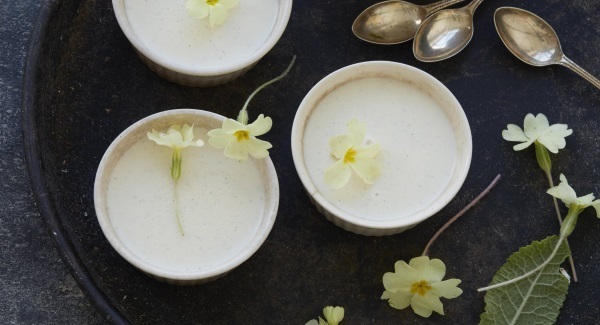
Buttermilk Pots with Primroses

These buttermilk creams are also delicious with roast peaches, apricots, nectarines, or rhubarb in season.

Serves 6

2 sheets of gelatine (use 3 sheets of gelatine if you plan to unmould each one)

350ml organic buttermilk

60g caster sugar

1/2 vanilla pod

250ml cream

Primroses

Fresh mint leaves

Equipment

6 x 110ml glasses or white china pots

Soak the sheets of gelatine in cold water.

In a heavy bottomed saucepan, bring 100ml of the buttermilk to the boil with the sugar and a vanilla pod.

Drain the softened gelatine sheets and discard the water.

Remove the saucepan from the heat, add the gelatine to the buttermilk and stir until dissolved. Leave to cool and whisk in the remaining buttermilk and cream.

Scrape the seeds from the vanilla pod and add to the cream. Mix well. Pour into six small pots or moulds. Cover and refrigerate until set.

To serve: Sprinkle each little pot with primroses and a few fresh mint leaves. Alternatively, unmould into a deep soup plate and garnish as above.

From Darina’s new book ‘Grow Cook Nourish’

These buttermilk creams are also delicious with roast peaches, apricots, nectarines, or rhubarb in season.

Chicken Poached in Milk

Cooking milk in milk produces the most delicious curdy liquid. There is honestly no point in attempting this recipe if you cannot find a really good free-range chicken. The lactic acid in milk has a tenderising and moistening effect on meat. This recipe is of Italian origin where they also cook pork, veal and lamb in milk on occasions.

Serves 10-12

1.8kg (4lb) chicken (free-range and organic if possible)

a dash of extra virgin olive oil

sea salt and freshly groundpepper

600ml (20fl oz/1 pint) milkapproximately

thinly sliced peel from 1 lemon, unwaxed

1 teaspoon of slightly crushed coriander seeds or a small handful of fresh sage leaves

4 cloves garlic, cut in half

sprig of marjoram

Season the chicken generously with sea salt and freshly cracked pepper. Heat a few tablespoons of olive oil in a casserole, large enough to fit the bird. Brown well on all sides, remove to a plate and pour off all the oil and fat. Add the lemon peel, coriander seeds and garlic. Return the chicken to the saucepan, add the milk, it should come about half way up the meat. Add a sprig of marjoram or sage and bring to the boil and simmer for 1½-2 hours with the pan partially covered — after about an hour the milk will have formed a golden skin. Scrape all this and what has stuck to the sides back into the milk, continue to cook uncovered.

The liquid should simmer very gently all the time. The whole objectof this exercise is to allow the milk to reduce and form delicious, palecoffee-coloured “curds” and a golden crust while the meat cooks. When the chicken is cooked slice the meat and carefully spoon the precious curds over the top.

Cooking milk in milk produces the most delicious curdy liquid. There is honestly no point in attempting this recipe if you cannot find a really good free-range chicken. The lactic acid in milk has a tenderising and moistening effect on meat. This recipe is of Italian origin where they also cook pork, veal and lamb in milk on occasions.

Old-Fashioned Milk Rice Pudding

Serves 6–8

A creamy rice pudding is one of the greatest treats on a cold winter’s day. You need to use short-grain rice, which plumps up as it cooks. This is definitely a forgotten pudding and it’s unbelievable the reaction we get to it every time we make it at the Cookery School. It’s always the absolute favourite pudding at my evening courses.

100g (31⁄2oz) pearl rice (short-grain rice)

40g (1 1/2oz) sugar

small knob of butter

850ml (1 1/2 pints) milk

Equipment

1 x 1. 2 litre (2 pint) capacity pie dish

Preheat the oven to 180C/350F/Gas Mark 4.

Put the rice, sugar and butter into a pie dish. Bring the milk to the boil and pour over. Bake for 1¼–1½ hours approximately (usually the latter but keep checking). The skin should be golden, the rice underneath should be cooked through and have absorbed the milk, but the rice pudding should still be soft and creamy. Calculate the time it so that it’s ready for pudding. If it has to wait in the oven for ages it will be dry and dull and you’ll wonder why you bothered.

A creamy rice pudding is one of the greatest treats on a cold winter’s day. You need to use short-grain rice, which plumps up as it cooks. This is definitely a forgotten pudding and it’s unbelievable the reaction we get to it every time we make it at the Cookery School. It’s always the absolute favourite pudding at my evening courses.

Melktert (Milk Tart)

Serves 12

Alicia Wilkinson from the famous Silwood Cooking School in Capetown generously shared this recipe with us.

For the crust

125g (4 1/2oz) butter

2 tablespoons sugar

1 egg

185g (6 1/2oz) flour

1 teaspoon baking powder

1/2 teaspoon vanilla essence

For the filling

35g (1 1/2oz) flour

3 tablespoons cornflour

2 tablespoons custard powder

1.2 litres (2 pints) milk

150g (5oz) white granulated sugar

2 eggs, separated

1 vanilla bean, split in half

2 teaspoons butter

1 teaspoon baking powder

2 teaspoons caster sugar

2 teaspoons ground cinnamon

Equipment

28cm (11 inch) fluted tart tin

baking beans

To make the crust:

Beat the butter and sugar together until light and creamy.

Add the egg, flour, baking powder and vanilla and mix until combined.

Press the pastry into the tart tin and chill for 45 minutes.

Preheat the oven to 180C/350F/Gas Mark 4.

Lay a sheet of greaseproof paper inside the pastry case so that the edges come over the rim and fill with the baking beans.

Bake the pastry case for 15 minutes or until the sides begin to colour.

Remove the baking beans and greaseproof paper and continue cooking the pastry case for 5 minutes to dry out the base.

To make the filling:

Mix together the flour, cornflour and custard powder, adding a little of the milk to form a smooth paste.

Place the remaining milk in a saucepan with the sugar, egg yolks, vanilla bean and the cornflour paste. Bring to a boil, stirring continuously, and simmer for three minutes.

Remove from the heat, stir in the butter and baking powder and set aside. Whisk the egg whites until they form soft peaks. Fold the whites into the custard mixture, then spoon into the pastry case, discarding the vanilla bean.

In a small bowl, stir together the caster sugar and cinnamon then sprinkle the mixture over the custard filling.

Place the tart in the refrigerator to set.

Alicia Wilkinson from the famous Silwood Cooking School in Capetown generously shared this recipe with us.

Where to buy raw milk: In Cork Glenilen sell raw milk at Mahon Point Farmers Market; the Aherne family sell raw milk at Mahon and Midleton Farmer’s Market; Batt Sheehan in Fermoy, phone 087 2323771; Liz and Kevin O’Donovan in Dunmanway, 087 3507060; Magpie Dairies in Balinhassig, 086 30378781. For suppliers in other counties see rawmilkireland.com.

Home Butchery, Charcuterie and Sausage Making Demonstration: Philip Dennhardt is our resident master butcher at the Ballymaloe Cookery School and on Friday, February 23, from 2.30pm to 5.30pm , Philip will teach the skills needed to butcher a side of pork from nose to tail, learn the technique involved in dry curing and how to make different types of sausage and salami. This course is ideal for those who would like to explore ways to add value to their meat products with a view to developing an artisan food business; cookingisfun.ie

Artisan Chocolate: I popped into the Koko Chocolate Shop in Kinsale recently and was mightily impressed by the handmade artisan chocolates. I’d come in search of a little pottery shop that sold beautiful ceramics, instead in the same premises I found Frank Keane who had responded to the challenge of the demise of the Celtic Tiger by starting to make beautiful chocolates with beautiful ingredients and that coupled with skill is the secret. Depending on time Frank also does bespoke commissions for parties and special occasions. I loved many of the flavoured dark chocolate spoons with a fat brazil nut. Phone 087 6110209.

More in this section

ieFood

Newsletter

Feast on delicious recipes and eat your way across the island with the best reviews from our award-winning food writers.

Cookie Policy Privacy Policy Brand Safety FAQ Help Contact Us Terms and Conditions

© Examiner Echo Group Limited