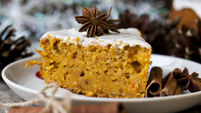
Michelle Darmody: How to use autumn apples in tarts, pastries and cakes

Michelle Darmody. Picture: Fergal Phillips
Cox's Orange Pippin apples have a very satisfying sound when you give them a shake, the seeds rattle around inside when they are ripe as they are quite loosely held in the apple's flesh. Their smell always evokes autumn, the slight stickiness of the skin and russet colours add to their charm. Their taste softens and mellows with age but when newly picked from the tree they are sharp and slightly astringent. I like to use them in crumbles and tarts as they add an extra dimension to the taste that some blander varieties lack. There are other varieties that will also add bite, such as Elstar or Bramley's. If you cannot find any of these, a good fresh cooking apple will do the trick for these recipes.
The rosettes can be a little fiddly to roll but the results are very nice. If you have a mandoline it will allow you to slice the apples thinly; just turn them slightly as you are using it to get long strips. I often make an apple puree that can be served with porridge or yogurt in the morning. It is the basis for the rosette tart — that and the apricot jam. For every medium-sized apple, which I dice, I use about 10g butter and a 1 tsp of honey. Place the ingredients into a pan, then cover with a lid and simmer until soft. A small sprinkling of cinnamon or some raisins can add flavour.

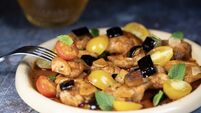
- 400g apples, peeled and cored and cut into chunks
- the juice of 1/2 a lemon
- 225g soft butter
- 4 eggs, lightly beaten
- 220g golden caster sugar
- 350g self-raising flour
- 2 tsp baking powder, sieved
- 1 tsp ground cinnamon
Preheat your oven to 180°C and line a 9-inch round spring-form or loose-based tin with baking parchment.
Toss the chunks of apple in the lemon juice and set aside.
Put the butter, eggs, sugar, flour, and baking powder into a large bowl and combine well. Scoop the batter into your prepared tin and dot the chunks of apple on top. Some might sink. Sprinkle or sieve the ground cinnamon over the top.
Bake for about 50 minutes until the cake is baked through. Once cool enough to handle remove from the tin and place on a wire rack to cool completely.
- 2 large apples, peeled, cored, and finely diced
- 30g golden raisins
- 20g golden caster sugar
- the zest of an orange
- 1 tsp cake spice
- 1 large sheet of puff pastry, about 375g in weight
- 1 egg yolk
- 4 tsp of milk
- 1/2 tbs of demerara sugar
Place the apple, raisins, caster sugar, and zest into a saucepan and gently bring to a simmer, then set aside.
Lay the sheet of pastry out on a sheet of baking parchment. Scoop the apple mixture onto one side leaving a gap around all of the edges. Fold the pastry over and crimp the edges by pressing down a fork to seal the parcel well. Make a few holes in the top with a knife to allow the air to escape as it bakes.
Mix the egg yolk and milk together and brush the mixture over the top of the pastry. Sprinkle the demerara sugar on top so that it sticks to the egg.
Transfer the parcel into the fridge while you wait for your oven to heat up to 200°C. Heat a large flat baking tray in the oven.
Gently transfer the parcel onto the hot tray and bake for about 20 minutes until the pastry is golden. Allow to cool and cut into slices.

- 200g cold butter, cubed
- 250g plain flour
- 1 egg yolk
- 60g demerara sugar
- 6 medium-sized apples, cored and sliced into long thin strips
- 1 tbs melted butter
- 2 tbs lemon juice
- 2 tbs apple puree or stewed apple
- 2 tbs apricot jam
- 1/2 tbs golden caster sugar
- 30g cold butter, cubed
Rub the butter into the flour until it looks like rough breadcrumbs. Add in the sugar and combine. Add in the egg yolk and bring the mixture together with your hands. Wrap the pastry in parchment and place it into the fridge to cool for at least an hour.
Preheat your oven to 190°C and grease and flour a 10-inch tart tin.
The apple should be sliced as thinly as possible with a sharp knife or mandoline. Toss the slices in the melted butter and lemon juice. Spread them onto a flat baking tray in a single layer and bake for about 10 minutes until soft but pliable. Set aside to cool.
Roll out your pastry to a circular shape just larger than your tin. Gently sit the pastry disk onto the tin and nudge it into shape. Cut off any excess pastry. Cover the base in a circle of parchment and top it with dried beans, or clean coins to bake the pastry blind. Bake for about 20 minutes until a light, biscuity-colour is beginning to form. Remove the parchment and set aside to cool for 10 minutes. Turn your oven down to 180°C.
Spread the stewed apple and apricot jam onto the base. Roll the strips of apple into rosette shapes and place them on top. Sprinkle with the sugar and dot very small cubes of the butter around the rosettes.
Bake for 40 to 45 minutes. Allow to cool in the tin.