Ambassadors on Horseback: The history of the Army Equitation School
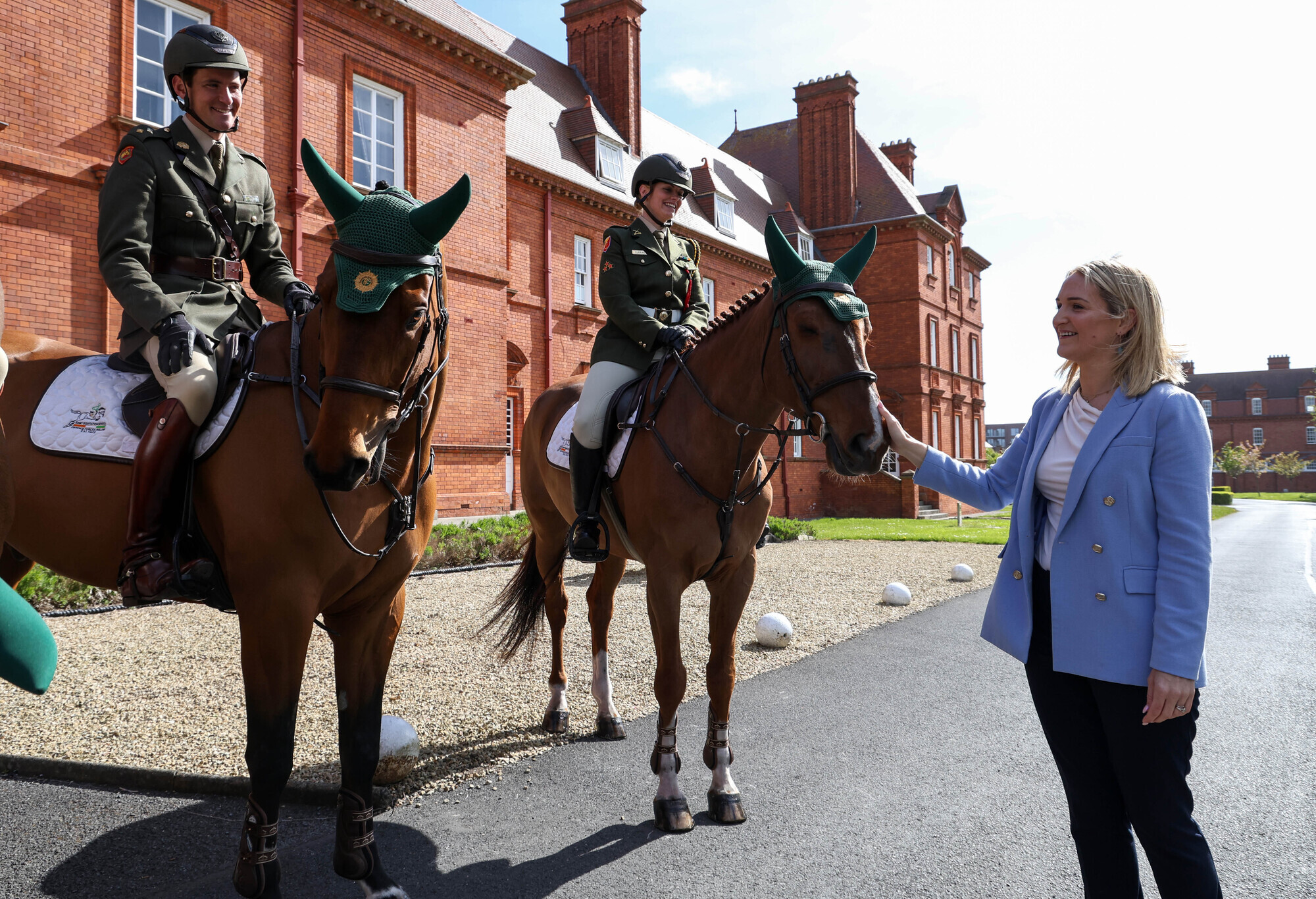
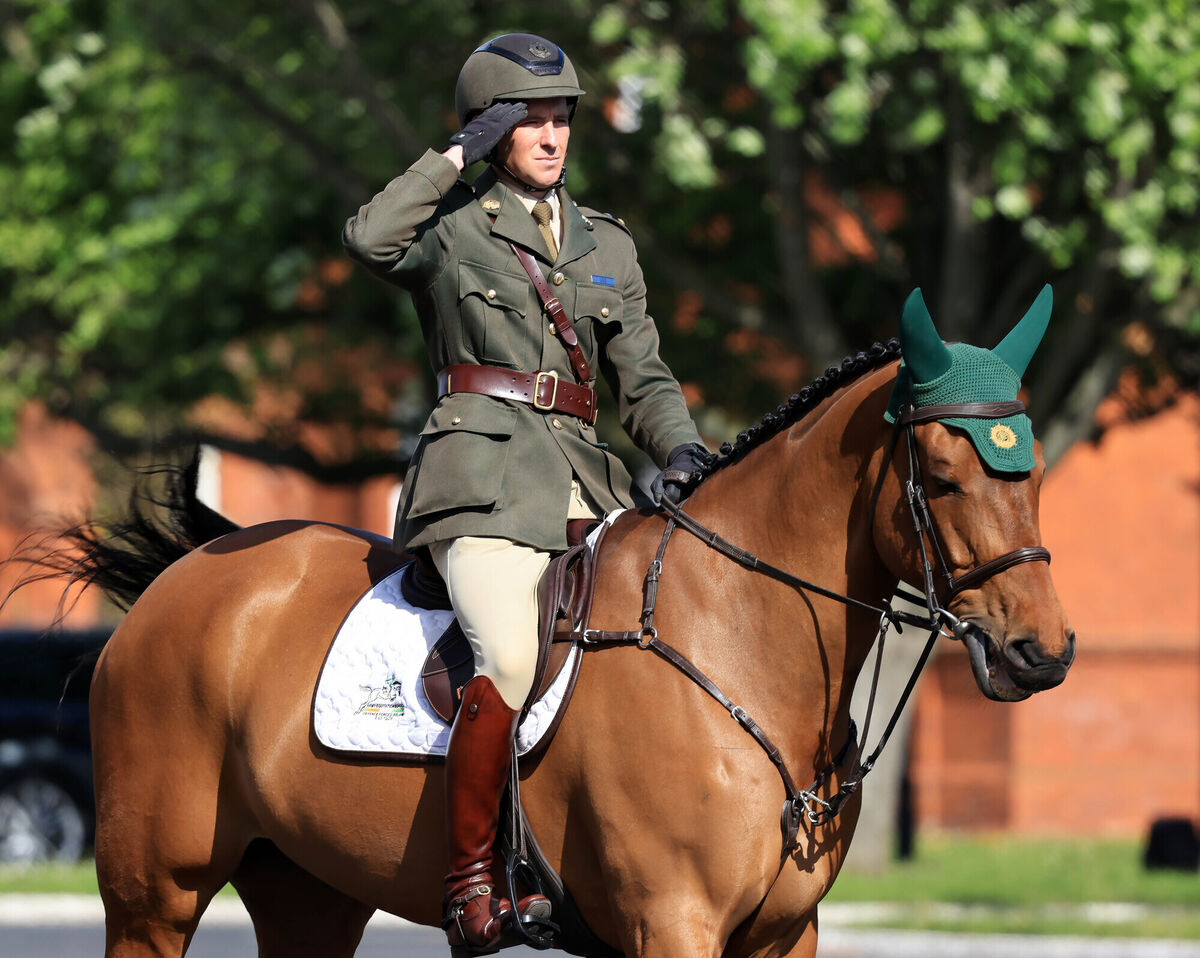
Lt. Raphael Lee on Bon Mahon and Pte. Aoife Curran on Glen Darra greet Minister for Defence Helen McEntee, TD at McKee Barracks at a parade to mark the centenary of the Army Equitation School. Pictures: Colin Keegan.
The sight of an Irish Army officer partnering an Irish-bred horse to success on the world's great show jumping arenas is always a source of national pride.
is the apt title of the Army Equitation School’s history, compiled by Michael Slavin and Louise Parkes, and published in 2010.
The school was founded in 1926 in the aftermath of the Easter Rising, the War of Independence, the Civil War and the emergence of the Irish Free State.
It was a period of bitter divisions in the mainly agricultural country. Living standards were poor and the economy was in shambles. The spirits of the people were low and there were growing pains with the infant State.
But a love of horses brought two men together in dramatic circumstances and led to the foundation of the Equitation School - Judge William Wylie and William T. Cosgrave.
Wylie, a lawyer from Coleraine in Co. Derry, had been a Crown prosecutor at the Military Court-martial Tribunals, which tried the captured rebels after the 1916 Rising.
After prosecuting Cosgrave, a Dubliner, for his role in the rebellion, Wylie represented him at his request when no defence counsel was available and is credited with having his death sentence commuted to penal servitude for life.
The paths of both men from different backgrounds would cross again in the new Irish Free State as it struggled to gain status in the world.
Cosgrave was President of the Executive Council, the office now known as Taoiseach, and Wylie, a prominent member of the RDS, was serving the new State in many roles.
They combined their common interest in Irish horses to benefit breeders on small farms across the country and to secure international recognition for the country.
After the Government established the Army Equitation School in April,1926, it insisted that a full military team should compete in the Nations Cup at Dublin Horse Show in the RDS three months later.
Major Liam Hoolan, the school’s first officer commanding, got down to work with steely determination in the knowledge that Colonel (later General) Michael Hogan played a pivotal role in establishing the school, with the strong support of his brother, Agriculture Minister Patrick Hogan.
Army officers Ged O’Dwyer, Dan Corry and Cyril Harty were the first recruits, but then the horses had to be found because the Defence Forces did not have a cavalry unit.
Potential showjumpers, which came straight from the fields and had to be trained from scratch to competition level, were purchased for a total of £1,615.
Russian riding instructor Colonel Paul Rodzianko, who was appointed Chief Instructor of the Equitation School in 1928, was instrumental in its early competitive successes.
Between 1931 and 1939 it won 20 Nations Cups in Lucerne, Dublin, Boston, Toronto, New York City, Nice, Amsterdam, London, and Aachen.
Ged O’Dwyer later recalled how Rodzianko, “took a bunch of raw farmer’s sons and in three years turned them into the greatest national team of all time.” The victories brought sporting recognition but also helped place Ireland on the world stage and showcased the quality of Irish bred horses, especially their athleticism, strong bone structure, docility and willing nature.
Commissioned officers in the Defence Forces, who compete only on Irish-bred sport horses, have represented Ireland at the Olympic Games, World and European show jumping championships and in three-day eventing.
It all began competitively on August 6, 1926, when an Irish Army Jumping team, took part for the first time in the Nations Cup at Dublin Horse Show.
The centenary of that event will be recalled on Friday of next week with the staging of the 100th Aga Khan Trophy competition, a high point of the five-day Gallagher Dublin Horse Show, which opens on Wednesday and continues until Sunday.
Captains Dan Corry, riding Finghin, Jed O’Dwyer (Oisin) and Cyril Harty (Cuchulainn) took the runner-up spot for Ireland before a record crowd of 34,000 people at the inaugural event in 1926.
That was the start of a golden era for the Equitation School and boosted the Irish sport horse sector, which now contributes about €1bn annually to the national and rural economy and supports more than 14,000 jobs.
Civilian riders joined the Nations Cup selections for the first time in 1963, but Defence Force officers and Irish-bred horses continue to play important roles as individuals and as team members in competitions at home and abroad.
Minister for Defence, Helen McEntee, recently visited McKee Barracks, the Equitation School HQ in Dublin, to recognise the contribution it has made.
She said the school represents the best traditions of the Defence Forces - excellence, discipline, commitment and service.
For 100 years, its riders and staff have represented Ireland with distinction across the world and made an enormous contribution to Irish equestrian sport.
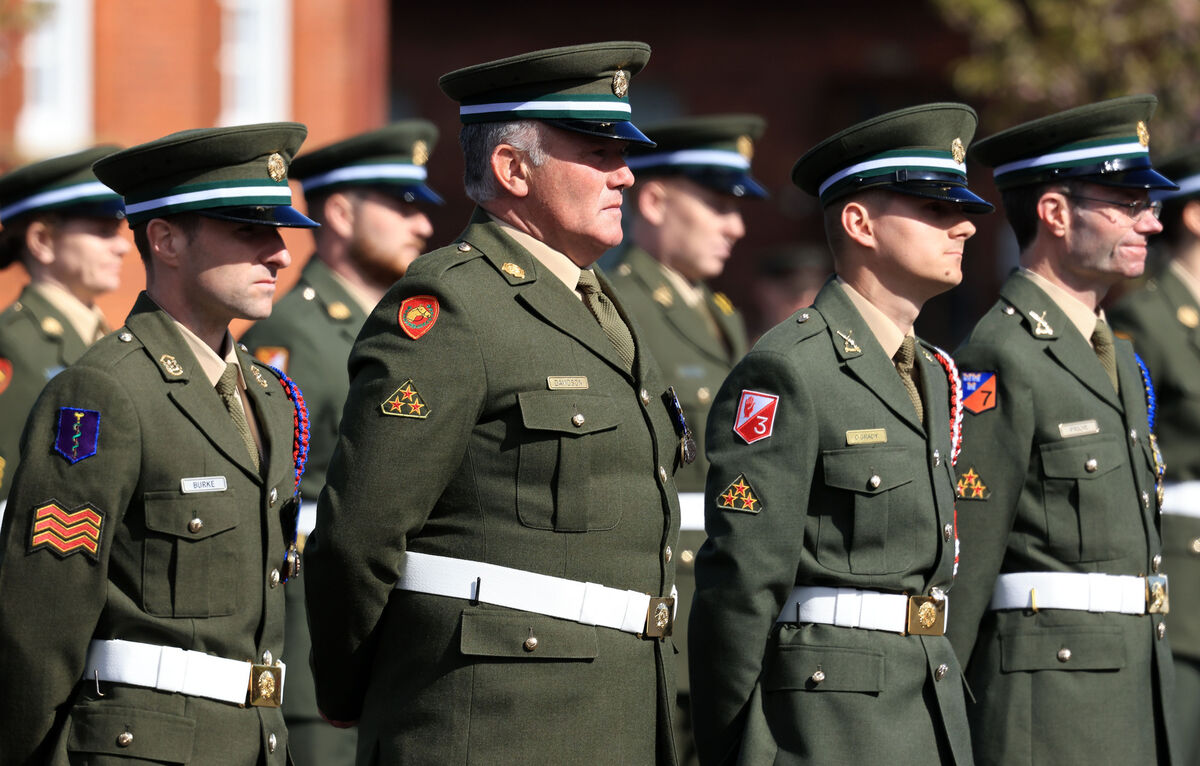
“The school has also played an important role in strengthening Ireland’s reputation as a leading equestrian nation and continues to inspire future generations through its dedication and professionalism,” she said.
The occasion was symbolic in another way because Helen McEntee is the first woman Minister for Defence in the State’s history and she was greeted by Lieutenant Colonel Sharon Crean, the first woman to serve as O/C of the Equitation School.
Chief of Staff Lieutenant General, Rossa Mulcahy said the school centenary year honours a legacy defined by discipline, pride, excellence and an enduring partnership between the Defence Forces and the Irish Horse.
“For the past 100 years the school has represented the best of our traditions with innovation, skill and unwavering dedication on a national and international stage.
As we look to the future, we do so with pride in what has been achieved and with confidence that this proud institution will continue to inspire generations to come,” he said.