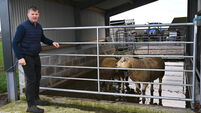
Stephen Cadogan: Reduced cultivation helps in region lacking in soil moisture

Jim McCarthy's Southern Harvest Romania located in Botosani northeast Romania.
Jim McCarthy is one of Ireland’s top regenerative farmers. But it is in north-eastern Romania, on a large land area, that he takes a no-till regenerative approach to tillage farming.
It works well in this region, not least because of a lack of soil moisture.
In a recent Tillage Edge podcast, he said the lack of moisture has been a key constraint where he farms in eastern Europe.
“In 2022, 2023 and 2024, we missed out on a full year’s rain. We were short coming into 2025, we were short of a full year’s rainfall, and so there was no subsoil moisture of any kind”.
But the reduced cultivation methods employed by McCarthy coped better than some of his neighbours’ more traditional approaches. He said:
“We didn’t sow any sugar beet in 2025. We went from over 2,000 acres of beet to zero”.
He explained that in very dry years, crops after sugar beet were a disaster, because the beet used all the moisture. He added, “The factory was dropping the price, and we had a problem with this disease called macrophomina”.
“In the no-till, there are huge savings when you’re into the game five, six years” McCarthy said.
“55% of our land is basically in corn [maize] and wheat, which really raises the organic matter levels. Now we have a huge amount of our land at 6% organic matter”.
“When you lift your soil organic matter 1%, you will get an extra 22 to 30 kilos of nitrogen over the full season. The big thing is you’ll store about 300 tonnes of carbon for 1%.
“So you’ve got to stop tilling, because you’ve got to build soil aggregates, to get the microbial activity.
“This idea that you can continue tilling and have sandy land and raise your organic matter, no, forget it”, he advised.
“We used 55 kilos of nitrogen on all our corn last year. Our best block, 150 hectares, was 13 tonnes a hectare with 55 kilos of N. The corn is the most suited, because it has the longest growing season, and it will get all the nitrogen”, McCarthy said.
“Last year, we grew the best yield of sunflowers we ever had by a long stretch. We only used 40 kilos of N. With the higher organic matter fields, we actually had a trial with a high grade compost tea.
"If you told me this 10 years ago, I’d have laughed at you. A high quality compost tea where we have three and a half tonnes of sunflower with no fungicide and no fertiliser”, he said.
“We cover crop everything, because when you have higher organic matter levels, you’re continuously recycling nutrients, and nitrogen is becoming available”, McCarthy said.
“Regenerative agriculture is a journey, not a destiny. You’re continuously trying to improve and upgrade your land.
“You’ve got to be very careful ,because when you go changing systems, risk comes in. There aren’t the profit margins any more to cover bad mistakes”, he said.
“Definitely the longest, coldest winter I’ve been here.
“It’s been very good for the winter wheat and the rape. They’re looking very well”, he said.
“We’d finish harvesting maize 7th, 8th, 9th, 10th November, and it’ll be often 17%, 18% moisture. But we didn’t harvest any maize this year below 24%”, he said.
“We had never dried sunflowers before. This is the first year”.
Pedrotti dryers were used, despite the high fire risk from oily sunflower seeds. “There were two very big dryers burned here drying sunflowers”, he said.
"Quite a bit of soybean was not harvested at all”, he said. “It’s not been an easy time for people here”.
McCarthy’s experience in Ireland taught him to be opportunistic with weather conditions.
“On the 14th of November, we hadn’t combined for 10 days. We had a huge amount of maize to harvest, and yields were good.
“On the evening of the 14th, a Friday evening, we put out two of the combines. We normally run three night and day on maize, but we have five cutter bars, and we said, okay, there’s going to be a break over the weekend.
“They did a bit on Friday evening, but on Saturday morning, we put out the five combines, five maize headers, and did two shifts, night and day shifts. Come Monday morning at six o’clock when it rained, they’d harvested 5,700 tonnes of corn”.
About 15% of the maize still had not been harvested by March, but the modern, hybrid cobs were resilient. “The big thing is the cob hangs down when it’s really ripe, and has a leaf sheath on it, so the water tends to run down and not into it”, McCarthy said.
“We have a very good rotation. We grow about 25% wheat. We actually for the first time ever seeded wheat between Christmas and New Year, because we hadn’t finished seeding.
“The wheat seeded up till the 20th of November looks fantastic. Obviously, the Christmas New Year seeded crop is very ropey looking, but hopefully it’ll come on now. We’re promised rain at the weekend”, he said.
“Wheat yield really is good, but the price of wheat is no good”, he said.
“The oil seed crops last year, and the year before, were really the ones that carried the game”, McCarthy said. He remains cautious about the outlook for prices, and expressed concern about overall costs rising and eroding profitability.