Cattle carcass weights increasing in Newford demonstration farm, report finds
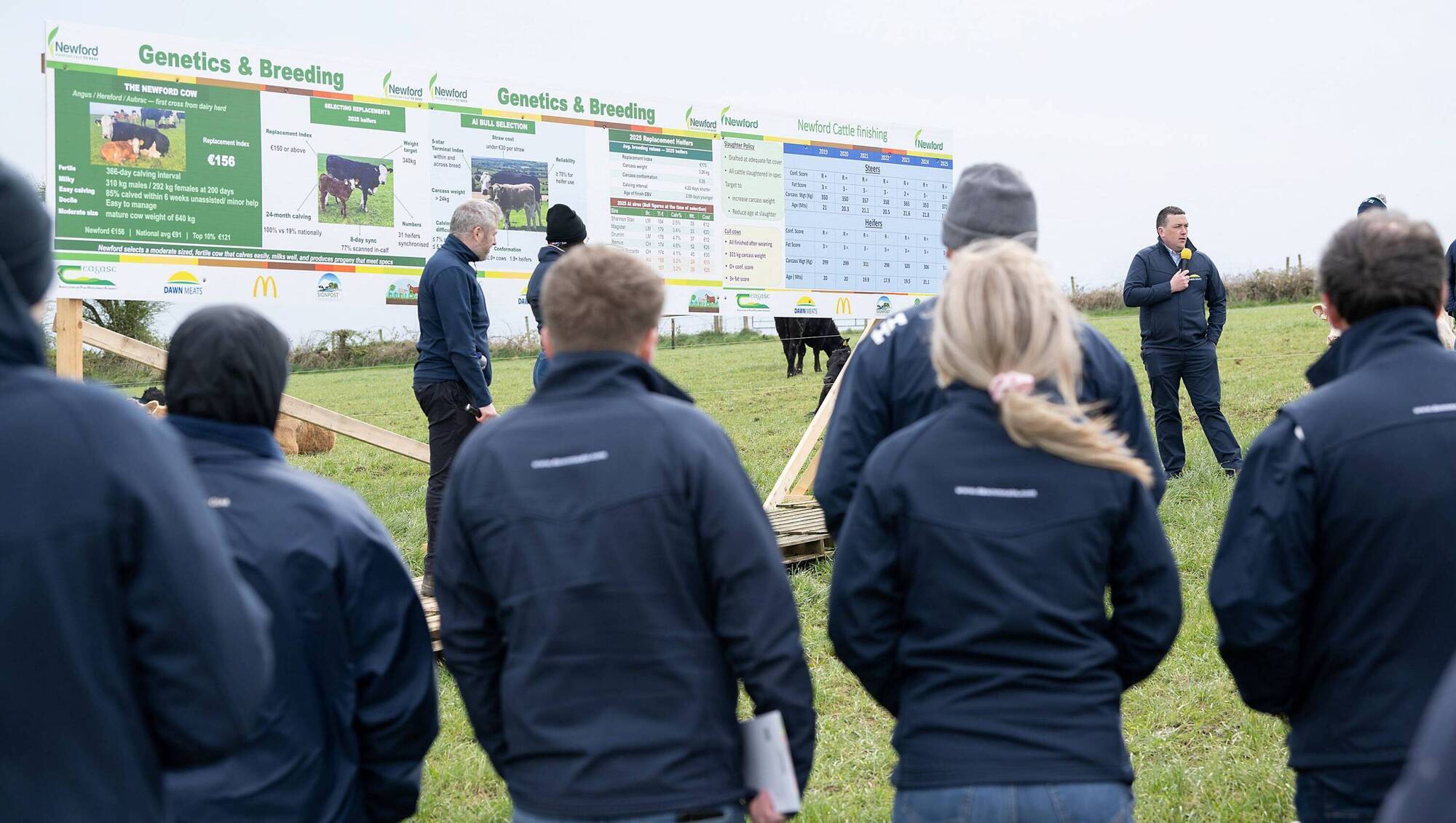
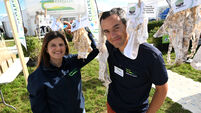
Attendees at the Newford Suckler Demonstration Farm's Suckler Breeding Open Day last week.
Average carcass weights have increased steadily due to improved genetics, grass management and overall efficiency at Newford Suckler Demonstration Farm.
The ‘Breeding Efficient and Profitable Sucklers’ report was released to coincide with the demonstration farm’s breeding open day on April 22.
Read More
The report shows that the average carcass weights being achieved at the farm in Co Roscommon have increased steadily over time, rising from 341kg in 2017 to 372kg in 2025 for steer and an increase from 291kg to 331kg in heifers within the same period.
The farm is a joint project operated by Dawn Meats and Teagasc with support from McDonald’s. A commercial research farm, it seeks to demonstrate sustainable and profitable suckler-to-beef production.
Founded in 2015 in Athenry in Galway, it moved to Scrine in Athleague in Co Roscommon in 2024.
The report shows that both steers and heifers have consistently achieved ‘R’ conformation and 3 fat score over the last eight years at Newford while being fit for slaughter and meeting market specification at between 18 and 22 months of age.
The report highlights the consistent ability to meet market specifications, maximising carcass values, avoiding price penalties and improving the predictability of the farm’s returns.
It also allows cattle to be finished efficiently on grass-based diets, reducing reliance on concentrate feed, lowering production costs and improving labour efficiency while allowing for a clear and repeatable finishing strategy.
On-farm improvements have aided Newford’s efficiency. The report details a number of water protection works carried out at Newford under the Farming for Water European Innovation Programme (EIP).
In total, Newford received just over €18,000 in EIP funding and this was invested in two farmyard settlement tanks, three constructed wetland ponds and farm roadway rain bars, with each playing a specific role in improving the farm’s overall water management system.
The breeding open day featured demonstrations and talks on improving herd performance and reducing labour through smarter tools and management plans.
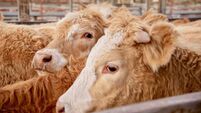
Attendees learned how the Newford herd is composed of high replacement index cows comprised of Angus x Friesian, Hereford x Friesian, and Aubrac x Friesian crosses. These specific genetics were selected to ensure optimal milk yield, high fertility, docility, and a moderate mature frame.
Reportedly, 81 cows and heifers in the herd calved down in 71 days in 2025 from January 31 to April 11, with the vast majority being unassisted or needing minor assistance.
Within the first six weeks, 85% of the herd had calved compared to the national average of 56%. Of the replacement heifers that scanned in-calf, all calved at 24 months of age, compared to a national average of just 19%.
The report also shows that 2025 gross output at Newford was significantly higher than in previous years, driven by a combination of stronger beef prices and improved weight gain.
As variable and fixed costs remained broadly stable, the farm achieved its highest-ever net margin.
CEO of Dawn Meats, Niall Browne, said: “At Newford, we are seeking to both achieve and demonstrate sustainable and profitable suckler-to-beef production, so it’s great to have the opportunity to share our latest results and findings with farmers, students and the wider farming and agriculture community.
"Our new report shows that Newford continues to highlight how targeted management decisions, smart technologies and data-led practices can achieve measurable improvements in herd performance, labour efficiency and overall financial returns.”