Michael O'Leary tells Irish beef farmers to "stop whingeing" about Mercosur
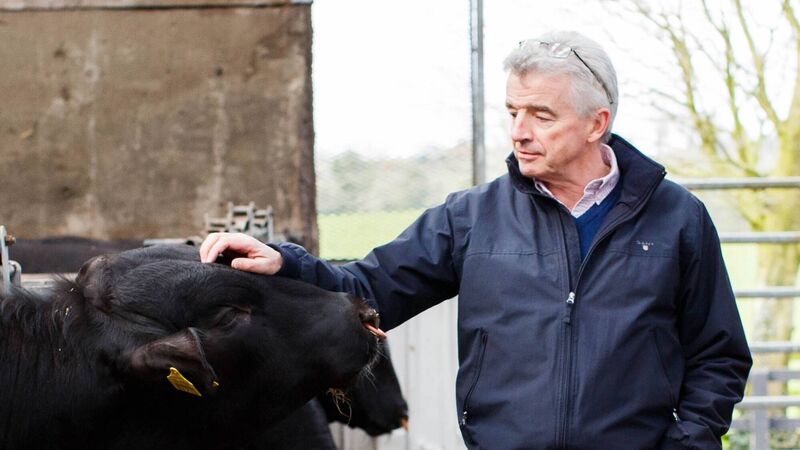
Michael O'Leary of his 650-head farm in Co Meath. Picture: Jeff Harvey
Irish beef farmers need to “stop whingeing” about Mercosur, according to aviation business mogul Michael O’Leary, as he doubles down on his bullish outlook for the sector.
Speaking to the ahead of his annual cattle sale, O’Leary also outlined why he has fully vaccinated his herd against bluetongue and how he is managing rising input costs on his farm.
Since last year, the Ryanair boss has added a further 90 acres of land to his Westmeath farming empire.
He has also completed construction on two new winter sheds, each capable of holding 200 cattle.
His pedigree herd now totals a mighty 650 head, with a 200-strong commercial herd, and plans are afoot to move towards 700 pedigree cattle and 300 commercial. It will mean the herd will total 1,000 head of cattle over winter.
However, it appears that is as big as O’Leary wants his passion project to get — at least for now — explaining that he felt that at around 2,150 acres, the farm had got to “about as big as he wanted it to grow”.
But despite easing off on expanding his agricultural empire, O’Leary said he remained bullish on beef.
He predicts beef prices will “remain elevated”, with a likely return towards €8/kg in the middle of the year.
“I think, over the medium term, that’s where prices will stay,” he said, explaining that he believed rising input costs would “inevitably be passed on to consumers”.
“There’s clearly uncertainty at the moment but I think that uncertainty… will be short-term,” he said.
“Neither the Iranians nor the Israelis and Americans can sustain this kind of war beyond another month or two, so things will settle down again.”
‘Scare stories’ on Mercosur
O’Leary is one of the few high-profile Irish beef farmers to publicly support the EU-Mercosur trade deal, describing opposition to it as “fundamentally misplaced”.
“I would generally be a supporter of the IFA but I think they handled it very badly,” he said.
“I don’t think there’s any basis for the IFA’s opposition to the Mercosur trade deal,” he added, insisting that fears of South American beef undermining Irish production are “exaggerated”.
O’Leary rejected concerns that market dynamics make it inevitable that the influx of extra beef would push down prices for local farmers, pointing to strict limits on imports and the positioning of Irish beef as a premium product.
“All of these scare stories that Brazilian beef is going to flood the European market and wreck the economy are bullshit,” he said.
He surmises that imported beef is likely to be confined to low-visibility processed products, while Irish beef continues to command a premium in retail and food-service markets across Europe.
“We produce a very high-quality product here… wherever it appears on the supermarket shelves of Europe or in restaurants, it’s a premium product,” he said.
“Free trade has been very good for this country… and whatever is good for the Irish economy is good for Irish agriculture,” he added, highlighting the benefits for Irish pharmaceutical and IT firms.
“There are significant restrictions on the amount of Brazilian beef that can be imported into Ireland.
“I don’t think Brazilian beef would be able to compete with Irish beef, in restaurants or supermarkets.
“Under the trade deal, very little Brazilian beef is allowed into Europe… it’s not significant as a [risk],” he added.
While critical of trade protectionism, O’Leary insisted that the high-quality Irish beef brand is strong enough to ensure premiums for Irish farmers that would allow them to keep ahead of South American producers.
He argued that Irish producers benefit financially from meeting higher EU standards and should recognise that those standards underpin their premium positioning.
“You’re asking Irish producers to produce to a European standard. They get a very significant premium as a result,” he said.
One of the first fully bluetongue-vaccinated herds
On herd health, O’Leary said his farm was among the first in Ireland to fully vaccinate against bluetongue virus, taking a proactive approach at the start of the year.
“We took the view that
bluetongue was going to spread and, therefore, ‘let’s get out and vaccinate everything and vaccinate early’,” he said, explaining that all animals in this year’s sale have been vaccinated for bluetongue virus, as well as leptospirosis and BVD.
“I think we’re probably one of the first herds in the country to be fully vaccinated,” he added, explaining that the decision reflects a focus on protecting high-value breeding stock, particularly females.
While acknowledging some reluctance among breeders, including concerns that vaccination might signal underlying issues, O’Leary said vaccination was the right business decision.
“We don’t have a problem but I think Ireland Inc is going to have a problem — the whole of Europe is going to have a problem,” he said, referencing the expected spread of the disease.
The vaccination programme is expected to cost close to €10,000 across approximately 800 to 850 cattle but he sees it as a straight-forward risk management decision.
“If it saves one or two calves, it pays for itself,” he said, explaining the vaccination programme had cost around €10,000.
“We’ve invested so heavily in the herd. I have a lot of high-value females and I don’t want to run the risk that in a year or two they’re either aborting or giving birth to dummy calves or dead calves… I would rather spend the money now on the vaccine. If you take that across nearly 850 cattle, it’s not that expensive… if it saves me, you know, one or two calves, or one or two cows don’t abort, it pays for itself.”