At the risk of sounding like Shania Twain, little about the Bord Bia and Larry Murrin controversy has impressed me much this week.
As things stand, Mr Murrin is due to appear before the Oireachtas Joint Committee on Agriculture in the coming days. If his recent public comments are any indication of what we can expect to hear, his position is clear: he believes he has done nothing wrong and points to decades spent building a successful agri-food business that is a major buyer of Irish beef on a scale comparable with countries.
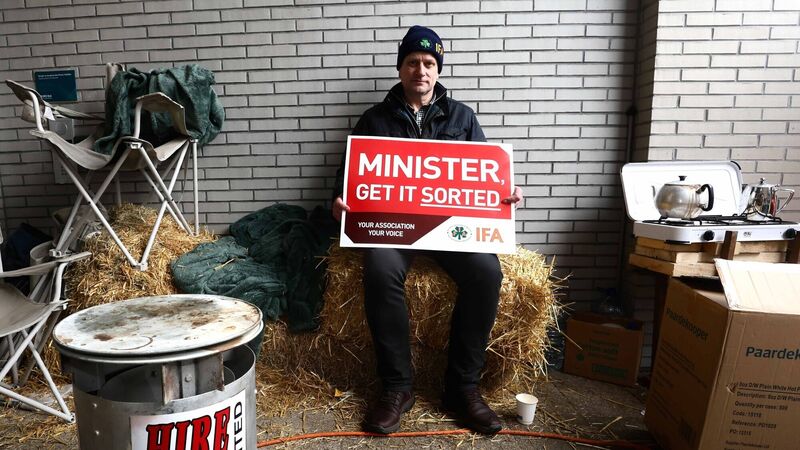
Meanwhile, political pressure has continued to build. Sinn Féin has tabled legislation calling on the Minister for Agriculture to intervene, while protests have escalated to the point where demonstrators have entered the Bord Bia building itself and remain there at the time of writing.
Lines on all sides are hardening. The IFA has said it will continue protesting until Mr Murrin steps aside, while much of the agri-business community has rallied firmly behind him.
But at its heart, this controversy is no longer really about Brazilian beef, Mercosur, or even Bord Bia as an organisation. It is about a more fundamental question: who government believes agricultural policy ultimately serves — the primary producers who carry Ireland’s food brand, or the export-facing entities that monetise it.
By standing so firmly behind Mr Murrin, government appears - intentionally or not — to be answering that question. Farmers are listening carefully, and increasingly, they are reacting not just to Bord Bia, but to government itself.
Once a governance issue becomes a ministerial credibility issue, it tends to resolve in only one of two ways: either through a negotiated de-escalation that allows someone to step aside with dignity, or through a hardening standoff that eventually forces a political decision from above.
Neither outcome is helped by dismissing legitimate questions or underestimating the depth of anger that now exists.
At this point, only humility and institutional flexibility can change the arc of this dispute. The Taoiseach’s strong defence of Mr Murrin means that any next move will need to be deliberate rather than reactive.
At the same time, the escalation of protests into the Bord Bia building itself raises serious questions about the protesters’ own position. Concerns have been voiced about staff safety and the optics of occupying a semi-state body - an image that does little to strengthen farmers’ case at a moment when scrutiny was already guaranteed through the committee process.
Crucially, while occupation increases the urgency of the situation, it also reduces government flexibility. It forces resolution, but narrows the range of acceptable outcomes. And governments are typically reluctant to be seen to reward escalation that crosses institutional boundaries.
As a result, the space for a negotiated, face-saving compromise has shrunk considerably.
The most likely way forward may now involve a broader reset: reconstituting the Bord Bia board, commissioning an independent governance review, or appointing an interim chair to allow the organisation to function while trust is rebuilt.
Mr Murrin may still ultimately depart — but if that happens, it is increasingly unlikely to be on farmers’ terms.
At this stage, what we are witnessing is less a single controversy than a widening mismatch of values and power within Irish agriculture. How it is resolved will say far more about the future direction of agri-food policy than any one appointment ever could.