Ireland tops EU table for share of land used for agriculture
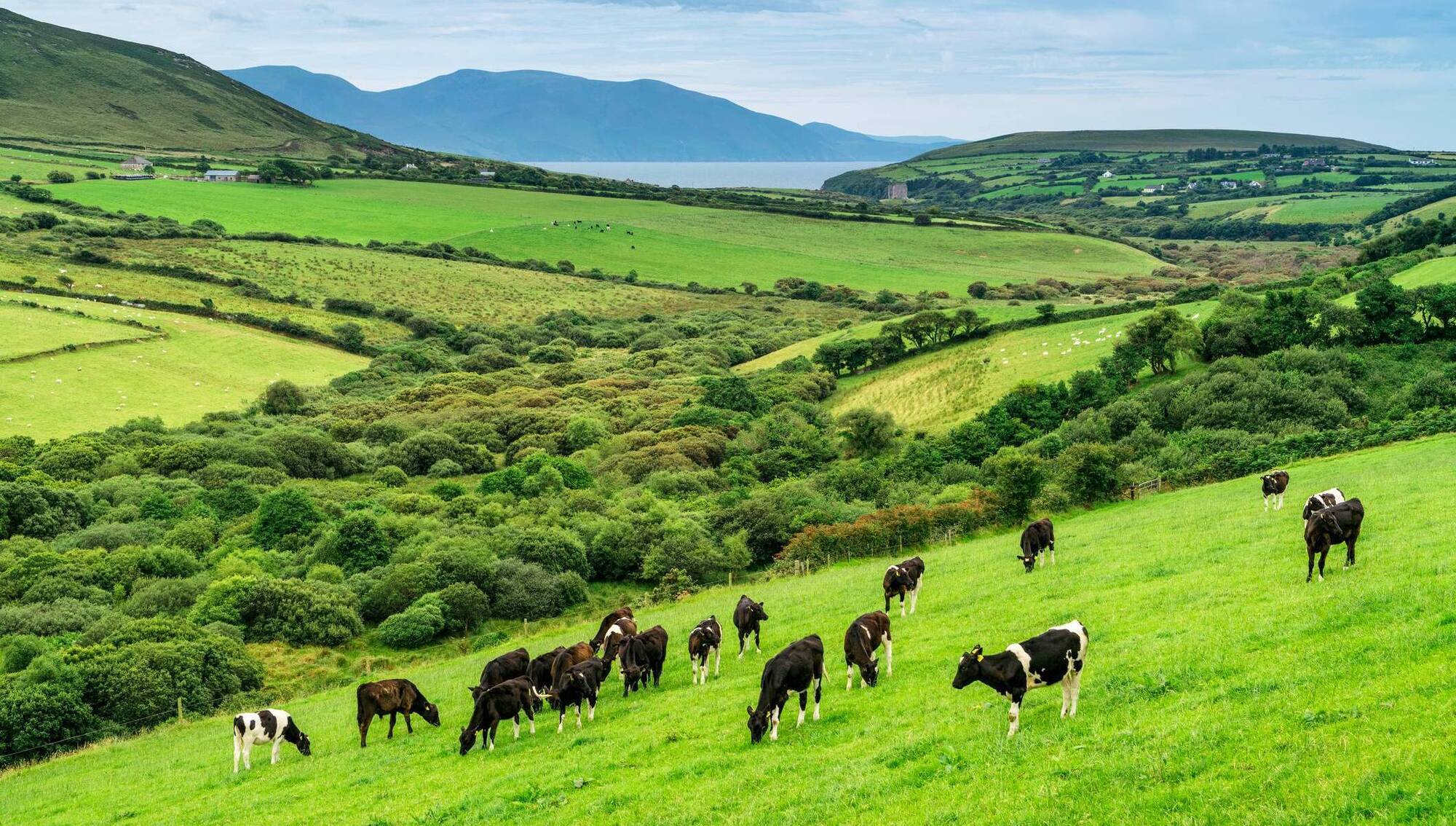
Figures show that utilised agricultural area accounted for 71.7% of Ireland's total land area; by far the highest share of land used for agriculture among the 27 member states.
Ireland stands out in the EU as an agricultural country, with 2020 figures showing that utilised agricultural area accounted for 71.7% of its total land area. That is by far the highest share of land used for agriculture among the 27 member states.
This compares with just 38.4% of the EU’s total land area used for agriculture. The proportion is less than a tenth in Sweden and Finland, but more than 50% in Luxembourg, the Netherlands, Hungary, Romania and Denmark.

However, the farming giants remain the two largest member states. France’s 27.4 million hectares make up 17.4% of the EU’s agricultural area, while Spain’s 23.9 million hectares account for 15.2%.
Nevertheless, Ireland’s strong agricultural base and dominant livestock sector place it relatively high in production terms. Ireland accounts for 9.2% of EU beef production, behind France (19.7%), Germany (15.3%), Spain (10.9%), Italy (10%) and Poland (9.7%).
Spain leads EU sheepmeat production, with 98,500 tonnes, representing 26.6% of the EU total in 2024. This is followed by France (18.4%), Ireland (17%) and Greece (11.5%).
France and Ireland were the second- and third-largest butter producers in the EU, with outputs of 348,000 and 268,000 tonnes, respectively. These figures come from Eurostat’s Key figures on the European food chain — 2025 edition.
Some of the most revealing statistics compare employment in food and beverage processing with the sector’s manufacturing value added. Food and beverage processing employed 15.8% of the EU’s manufacturing workforce in 2023, but accounted for just 12.1% of manufacturing value added.
In most EU countries — Poland and Estonia were the only exceptions — food and beverage processing had a larger share of employment than of value added, pointing to below-average labour productivity and, potentially, relatively low wages and high levels of seasonal or part-time employment in the sector.
The gap was widest in Ireland and Greece, where employment share exceeded value added share by 15.6 and 10.4 percentage points, respectively.
According to Eurostat: “Ireland’s very low share of manufacturing value added in food and beverage processing also reflects, in part, exceptionally high added value in capital-intensive, high-technology industries such as pharmaceuticals and electronics”.
Ireland’s share was even lower 16 years ago.
Ireland is also one of four member states — along with Hungary, Latvia and Czechia — where value added in the agricultural industry more than trebled between 2009 and 2024.
In 2024, Italy’s agricultural industry had the highest value added among EU countries, contributing 17.4% of the EU total. Spain (16.6%), Germany (13.6%) and France (13.6%) were the only other countries with double-digit shares.
Output value in the agricultural industry in 2024 exceeded its 2009 level in all EU countries, and more than doubled in Hungary, Ireland, the three Baltic states and Poland.
Irish consumers know, to their cost, that living in a strong agricultural country has not insulated them from rising food prices. EU expenditure on food and beverages rose by 8.8% from 2022 to 2023.
Average spending reached €4,290 per EU inhabitant in 2023, accounting for 21.6% of household expenditure. Of this, 11.7% was spent on food, 7.1% on eating out, 1.6% on alcoholic beverages and 1.2% on non-alcoholic beverages.
Spending on alcoholic beverages fell in every EU country except Latvia (up 0.3 points) and Bulgaria (up 0.1 points). The largest decline was recorded in Ireland, at 0.4 points.
Household expenditure on food and beverages varies widely across the EU. In 2023, the lowest shares were in Germany (17.7%) and Luxembourg (17.9%), while the highest were in Portugal (29.3%) and Latvia (30.7%).
Only in Ireland, Malta, Spain and Austria did household expenditure on catering services exceed spending on food.
In 2024, Ireland had the EU’s most expensive non-alcoholic beverages, according to Eurostat. Prices ranged from 81.8% of the EU average in Italy to 140.4% in Ireland.
For alcoholic beverages, some of the EU’s most populous countries — Italy, Germany, Spain and Romania — reported prices below the EU average in 2024. This compared with prices at around twice the EU average in Ireland and Finland, partly reflecting differences in alcohol taxation.
More positive news is that the lowest shares of people unable to afford a proper meal at least every second day were recorded in Ireland (1.8%) and Cyprus (1.2%).
This compares with an EU average of 7.3% in 2021, which rose to 9.5% in 2023 before easing back to 8.5% in 2024.
Hungary, Romania, Slovakia and Bulgaria reported the highest shares in 2024, with between 15.5% and 18.7% of people unable to afford a proper meal every second day.
In 2024, the EU produced 258 million tonnes of cereals, 162 million tonnes of raw milk and 21 million tonnes of pigmeat. It also exported €36 billion more in agricultural, fishery, food and drink products than it imported.
Separately, Eurostat reported that EU agricultural labour productivity rose by 9.2% in 2025. This was driven by an estimated 8.1% increase in income generated by agricultural holdings and a 1% reduction in the agricultural labour force.
Labour productivity rose most sharply in Luxembourg (40.1%), followed by Poland (33.4%) and Estonia (30.9%). Ireland recorded an estimated increase of 15%.
Declines were estimated in eight member states, with the steepest falls in Croatia (down 14.9%), Portugal (10.7%) and Greece (8.8%).
Overall, EU agricultural labour productivity in 2025 was 49.4% higher than in 2015, reflecting a 20.8% increase in income and a 19.1% decline in labour input.