Irish weather is to blame for the grass shortage, not protected urea
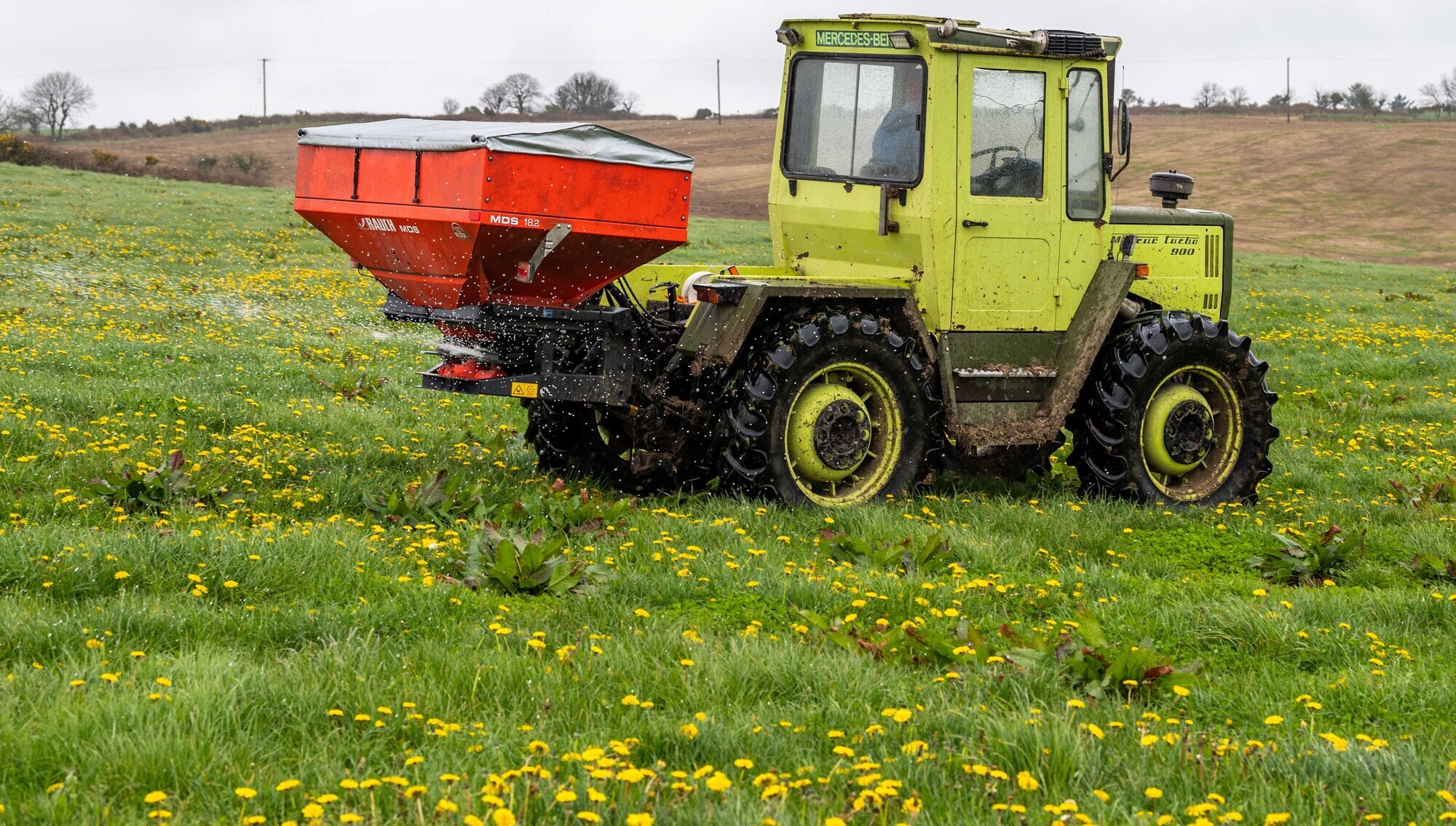
For those trying protected urea for the first time in 2024, they might feel it’s not working effectively, but that is due to the weather. File Picture: Andy Gibson
Where did the grass and silage go this year?
Well, it wasn't replacing Calcium Ammonium Nitrate (CAN) with protected urea that caused a grass shortage, said Dr Joe Patton, Head of Teagasc Dairy Knowledge Transfer, on a recent edition of the Teagasc Dairy Edge podcast.
He dispelled that rumour, saying “Protected urea delivers the same growth, if not slightly higher, than CAN. That hasn’t changed this year. We are seeing a weather effect. For those trying protected urea for the first time in 2024, they might feel it’s not working effectively, but that is due to the weather", Joe said.
“Growth rates have been checked by the weather conditions. There’s no doubt about that”.
He said protected urea generated the same growth as CAN on many sites, in controlled experiments, over many years. In 2024, grass growth is estimated to be back about 10% so far.
Dr Patton said this was confirmed by the results of the fodder survey of Teagasc client farms in June. The 563 responses (54% drystock and 46% dairy) indicated dairy farms had about 60% of their winter feed secured, after the first cut. It was 65% for drystock.
“Since 2018, the figures on the survey have always been in or around 70%, or 70 plus, at this time of the year, for dairy farms. The fact that it’s only at 60% this year is what’s making us sit up and take notice that we do need to be careful and keep a watching eye, particularly given that second cuts aren’t probably where they need to be”, Joe said.
The next survey will be in September when all second cuts are completed. Another cause for concern was that many farmers in the June survey didn't know how they would address their winter fodder problem.
“On the dairy side, of the farms that identified themselves as being short, and they’ve also said they don’t think second cut is going to close the gap, 50% of people in that category have no plan to do much at the moment”, said Dr Patton.
Of those actively considering options to meet the anticipated deficit, 5-6% were considering forage crops, about 10% were thinking of growing maize or wholecrop, but the majority were considering buying silage or bringing extra ground in for a cut.
“If that land is not under your control at this stage, it could be difficult enough to get much of a yield off it. People need probably to be making decisions within their own land base at the moment”.
“Maybe cash is the thing that’s limiting people from going and doing something, that’s a worry”, said the Teagasc Head Dairy Knowledge Transfer. “About 38% of dairy farms that responded and about 30% of drystock farms actually said they would expect a cashflow issue to arise from the feed situation,” he said.
“If there’s very low-yielding or poorly productive stock in the place, and you’re short of cash, you have to ask the question, which is the lesser of two evils, which side of the equation should you address.
Roughly an extra 12 kilos of N per hectare is available to those farmers who would have been affected by the proposed 5% reduction in nitrogen limits, which the Department of Agriculture Food and the Marine recently decided will not apply this year, after all.
"It’s half a round again of nitrogen for the grazing block or indeed, if somebody wanted to be making a third cut, it’s enough to put out for a third cut on about 20% of your land area”, Dr Patton said.
“One clear message would be, really, go back and establish what nitrogen is available,” he said. “Some farms are 15% to 20% behind where they would normally be at this time of year, based on maybe struggling to get nitrogen out in the spring".
For farmers stocked at over three livestock units per hectare, extra silage ground may not be an option, said the Teagasc official. “I think there’s a certain level of stocking rate at which building cover becomes very, very difficult indeed.
"You’re really into a situation where you have to almost accept that you’re not going to get to the high average farm cover in September. The consequence of that is that you’re going to be in the shed from October onwards.”
There are better options in the middle stocking rate range. “For September, it’s maybe up to a 30-day rotation. In order to achieve that, we have to actually offer less area per day on the farm and make up the difference in supplement. That can be from high-fibre concentrate, from a bit of silage, whatever it needs to be to feed the herd within that smaller allocation of area.
"When you get to very high stocking rates, it can be very difficult to achieve that, because the amount of extra feed that has to go in is quite significant, and you’ll struggle to extend the rotation anyway.
"The additional feed is probably going to be dry cow feed, and we’ll be keeping our higher quality feed for the milking herd,” Dr Patton said. “Forage quality for dry cows in good condition can be ordinary enough, and you can still get through the winter. The ambition should be to put away as much of that as possible for the dry cows at the moment.
“The second thing I would say is that experience shows us that in most yards, the extra work required to put more concentrate in front of cows during the winter period, particularly dry cows, is very significant. It’s much easier to feed a few extra purchased bales than it is to feed 2-3 kilos of a concentrate mix per cow, and have the feed space and the headspace for them all in the month of December. So, I think, for the labour reasons even alone, closing the gap earlier is important”.
“At a minimum scale, depending on the quality of the forage and all the rest of it, you would in theory get away with 10-11 kilos of dry matter per cow, which could be down as low as 7 -8 kilos of dry matter of fresh fibrous forage, something like that, but I wouldn’t like to be heading into the winter with only a budget of 7 kilos per cow per day in the yard for the entire winter period.
"Experience tells us that people move through that forage quicker than they plan, and if you don’t have a good way of restricting the forage, the cow will not restrict herself. If you feed her concentrate, you will end up feeding concentrate and not saving much forage and then you’ll end up with two problems rather than one, over-fat cows and also, no silage anyway in the month of February.”


Check out the Irish Examiner's WEATHER CENTRE for regularly updated short and long range forecasts wherever you are.