What do young farmers need from Budget 2025?
"Macra sees a future in rural Ireland, a future where we have viable communities where our members can live, work and bring up families."
Young farmers have outlined what they need from Budget 2025 to avoid "turning out the lights" on rural Ireland.
Macra has compiled its pre-budget submission, which it has been working on since last November.
The five key action areas, according to Macra president Elaine Houlihan, are: agricultural supports for young farmers; general practice healthcare; housing; transport; and rural wellbeing.
"Without any of these, there is no hope for rural Ireland," Ms Houlihan said.
"Macra sees a future in rural Ireland, a future where we have viable communities where our members can live, work, and bring up families.
"The backbone of these communities are our people and our farms; these farms have to be ran in an economically sustainable manner as well as in an environmentally responsible manner."
A large part of the pre-budget submission is a proposed succession scheme.
The amount of young farmers in Ireland is of increasing concern to Macra - "through our membership, we know that they are becoming a rarer breed".
In June this year, the Department of Agriculture announced the figures for the 2023 Complementary Redistributive Income Support for Sustainability (CRISS) and the Complementary Income Support for Young Farmers (CISYF).
"To date, CRISS payments in excess of €116m have been paid to over 120,000 applicants, with a further €33m paid out under CISYF to 6,200 young farmers. All good news - until we see that 6,200 as a percentage of 120,000 is 5.1%," Macra said.
The organisation is seeking the extension of the Young Trained Farmer Stock Relief and the Registered Farm Partnership Stock Relief until the end of 2027, and for a 20% increase on the current threshold bands within the Capital Acquisition Tax.
Macra is also seeking: an education programme for young farmers on taxation supports and Vat; funding of €100,000 for the Land Mobility Service; funding for a financial and hardship mediation service for farmers; and a dedicated financial support for the cohort of ‘forgotten’ farmers.
In its budget submission, Macra has also outlined how there should be priority for new entrants and young farmers to enter schemes such as the Agri-Climate Rural Environment Scheme and the Suckler Carbon Efficiency Programme.
It has also sought the creation of an independent category under TAMS for slurry storage, with a more timely process for planning permission approval in line with the seasonal farming calendar.
Macra has also outlined a proposal for a capital allowance for environmental infrastructure, similar to the UK model.
This would be a targeted annual investment allowance focusing on smart agriculture, renewable energy equipment, and climate change mitigation infrastructure
In regards to healthcare in rural areas, Macra proposes that a review is undertaken to investigate the barriers to newly qualified young GPs practicing in rural Ireland and determine what rural practice supports and incentives are required.
The organisation has also proposed grant provisions for established GPs so they can hire young and newly qualified GPs, thereby helping to address the issue of vacant GP positions.
On housing, Macra has urged that rural planning guidelines be delivered as a matter of urgency, while the objection fee for planning should be increased and be in proportion to the square footage of the building.
In relation to renovation /derelict housing grants, Macra has said that the time limit for completion of work should be increased from 13 months to 24 months.
It has also proposed that standard procedures be put in place to enable applications for grant extensions due to delays in getting contractors to complete the works due to labour shortages.
It has also sought for the Help to Buy scheme to be extended to 2030 at the enhanced rate of €30,000.
On transport, Macra has called for: better integration of bus and rail service timetables to connect communities; development of better connectivity in cross-country direct rail services; improved parking options at train stations; and development of a ‘park and ride’ network to enable greater access to, and connectivity with, the rail and bus network for the key regional centres.
This week, Macra hosted its annual lobbying day in Dublin, inviting all members of the Houses of the Oireachtas to engage with members regarding the pre-budget submission.
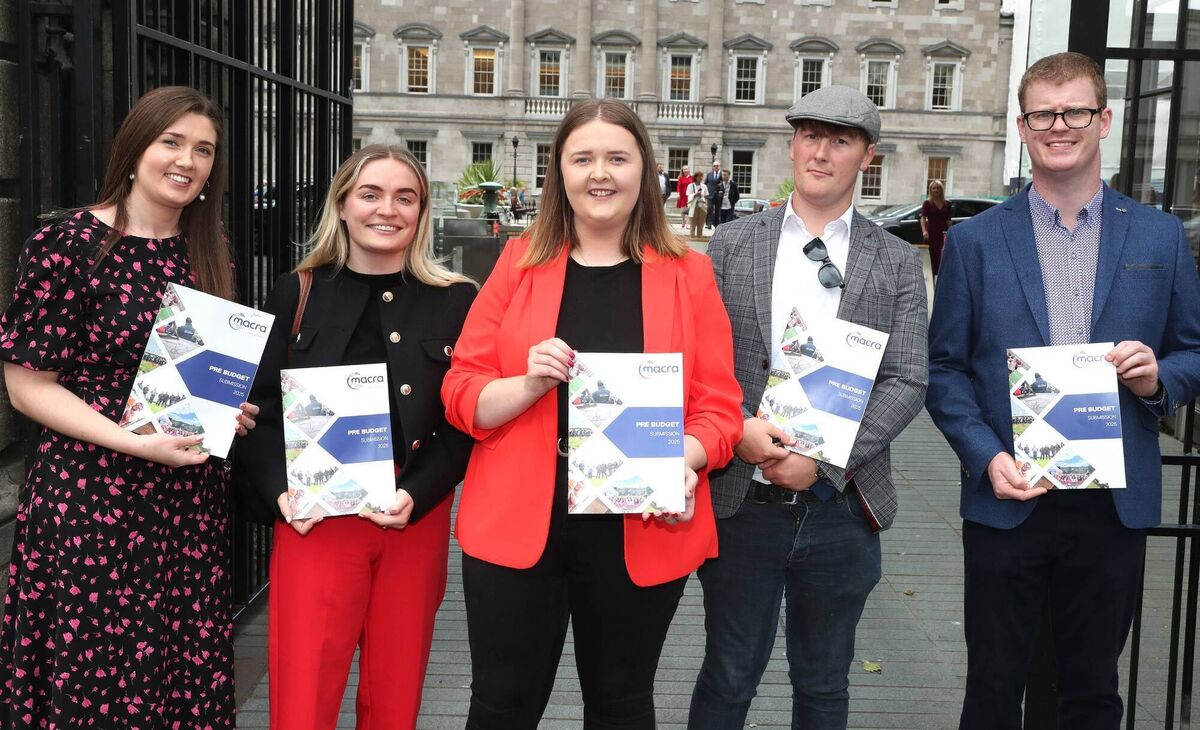
Macra president Elaine Houlihan said that in excess of 60 TDs and senators attended to "listen to our concerns".
"Our lobbying day is a high priority for Macra as it gives our members a chance to put their concerns forward in a structured manner to those who can effect the change that is needed to protect rural Ireland," Ms Houlihan added.
Read More