Changing colours for a more resilient herd
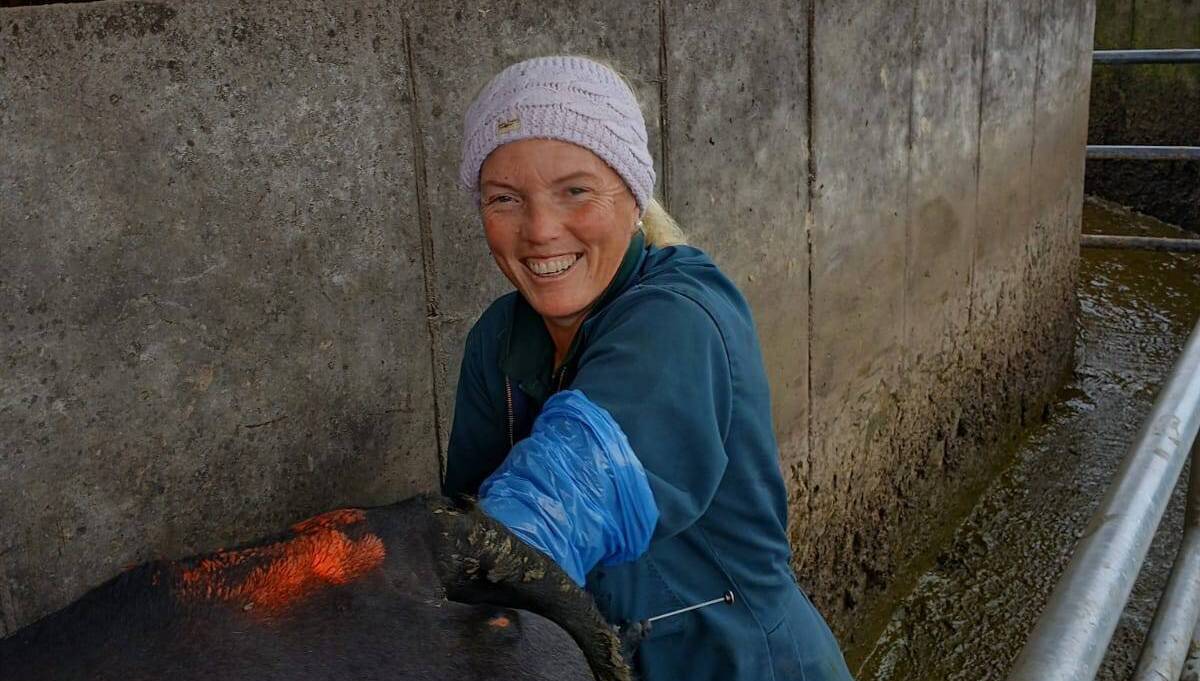
AI technician Kirsten Wahlberg
The maiden heifers were synchronised this week and AI-ed to shorthorn. It was a first for me, as I hadn’t used AI, nevermind synchronised heifers, since taking up the farming baton more than a decade ago.
What possessed me to take these actions this year was a combination of things but definitely influenced by the extremely long winter we experienced.
Perhaps the most unusual aspect of this past week’s events, though, was the use of milking shorthorn straws on the heifers, which is a bit of an oddity in dairy farming circles.
Like the majority of dairy farmers, my cows are exclusively Friesian with an historical base of British Friesian or the fuller-bodied Holstein, save for two crossbred shorthorn cows, which have been in my herd for about four years.
The two were bought as pet cows for my two daughters and their obviously differing colour scheme meant they could be easily picked out on a visual inspection from a field of cows by the girls.
Those two shorthorns haven’t caused me an ounce of bother over their lifetimes with me and seem to be hard working cows that just get on with their business.
One of them, Molly, definitely has a friendlier personality and has filled the role of pet cow both in name and in nature.
Unashamedly, I had a record number of cows for the hoof parer this spring due to a combination of ailments from the dreaded Mortellaro to foul, and a host of drops despite what seemed like very good efforts on foot bathing and general housing hygiene.
To be honest, I was fed up with needy cows by the end of the winter and decided that if I could replicate my small subset of Shorthorn-cross cows and in the hope that my new hybrids could share the traits of Molly and Milly then this would perhaps mean less needy cows for the future.
My heifers that calved down this year to an Angus stock bull also seemed to drift on a bit, with six of them calving past the milestone of St. Patrick’s Day.
Milly and Molly are certainly of the smaller type, more like the traditional British Friesian and perhaps carrying less fat cover, but the calves from these two have been exceptional over the past four years, and it’s clear to see there is definitely some hybrid vigour coming through in them and they could easily put their counterparts to shame.
The one daughter of age has now also joined the herd and was christened Brownie for obvious reasons.
In the parlour, my mottled grey and brown friends can also hold their own when it comes to milk production, albeit Milly is a little on the slower side in terms of milking time. Milly is the better of the two, currently producing 37 litres per day, and Molly puts in less grunt with 33 litres.
I've been asked how they are performing in terms of milk solids, and while they are on par with the Friesians, I couldn't say they are standing out.
I am hoping that they will be a hardier cow, with less money spent on mastitis and lameness. The economic benefit is not the sales side, but rather a saving on the costs side.
The introduction of milk yield banding has also put the kibosh on chasing yield and I am resolutely pinning the future strategy for the farm at scraping in under the 6,500kg of milk bracket.
Vet Cathal Ó Sé was on hand to provide the hormone therapy and a very helpful and capable New Zealander AI technician Kirsten Wahlberg served them on a very horridly wet Tuesday afternoon.
Although there were 31 heifers to do, I managed to clean out the AI company of all of their Shorthorn AI straws and took the last 28 available of my chosen sire.
I would be very hopeful to have 10 live shorthorn cross heifer calves on the ground next spring, which will give Milly and Molly a bit more company in the mottled grey colour stakes; who knows, maybe I might even get a roan variant.
One of the advantages we farmers have, which we sometimes lose sight of, is that we do, for the most part, have at least some degree of control over our business and that we don’t have to repeat what we’ve always done.
For me, whilst there was a bit more work in getting the heifers AI-ed to shorthorn than simply opening the gate to leave the bull off, it does give a sprinkling of excitement, and if it means that farming will be a bit more fun, then it’s definitely worth a go.