Stephen Cadogan: The huge catch-up task facing Ireland's growers

In a normal year, spring barley, spring oilseed rape, and peas, could be established up until late April
Stephen Cadogan: The huge catch-up task facing Ireland's growers

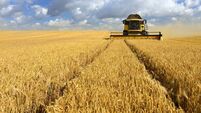
Estimates from last autumn suggest that about 95,000ha were sown, leaving 235,000ha to be sown this spring if last year’s area is to be maintained. Picture: Dan Linehan

The tillage area (cereals, oilseed rape, beans, maize and beet) in 2023 was 330,000 hectares.

Estimates from last autumn suggest about 95,000ha were sown, leaving 235,000ha to be sown this spring if last year’s area is to be maintained.


With the seed trade saying the upper availability limit of spring barley is 130,000ha, that leaves 105,000ha of other crops to be sown.

However, Teagasc crops specialist Ciaran Collins said the feedback from farmers, advisers and those in the trade suggests a significant area of land has been lost from tillage to grassland, following changes such as new nitrates rules.

The wettest fields could take a month to dry. File picture.

In the Tillage Edge podcast last week, specialist Shay Phelan suggested only 1%-2% of spring plantings were completed at that time, and very little ploughing had been done. 

The wettest fields could take a month to dry, and Mr Phelan said the choice between planting seed which cannot be returned, or leaving it in the shed for next year, becomes more and more difficult as the weeks pass. It is an especially tough choice if growing on rented ground.

Teagasc advisers have advised on the huge catch-up task facing growers.

Teagasc director of knowledge transfer Dr Stan Lalor said at least one week of dry weather was needed before planting.

Too late for winter wheat

Even last week, it had gone too late to establish winter wheat. Ideally, crops such as spring wheat, beans and spring oats should have been sown by mid-March.

In a normal year, spring barley, spring oilseed rape, and peas, could be established up until late April.

Dr Lalor said: “Crops sown after mid-April are at higher risk of lower yield, and require perfect growing conditions after sowing, to attain a reasonable yield. Along with this, the harvest window tends to be later, bringing risks when it comes to saving these crops.

“Under normal growing conditions for later-sown crops, yields of 3t/ha to 3.5t/ha would be expected for spring beans, 5.5 to 6.5t/ha for spring wheat, and 5 to 6t/ha for spring oats.

“Based on previous years, late-sown crops can be badly impacted where planting is followed by a short or moderate drought in May or June, and can result in reduction in yield of up to 3-4t/ha in cereals.” 

Red clover (scheme available) or summer cover crops could also be options.

Dr Lalor also noted that with fewer winter crops to cut early, and the slower ripening of spring crops, there was the risk of more of the harvest running into September (when there may at best be six hours per day for harvesting).

Nevertheless, planting spring wheat, spring oats and beans should be considered for as long as possible, to maximise the tillage area.

Late-planted spring wheat could be considered for whole crop silage if a suitable client is available.

Keeping break crops (beans and oats) in the rotation is important.

Red clover (scheme available) or summer cover crops could also be options.

Avail of fixed price offers

Dr Lalor advised growers to avail of fixed price offers where available (beans may offer value, in light of falling grain prices, but beans should be sown ASAP).

Growers are also advised to contact their usual straw customers and look for a solid commitment and an agreed price for 2024.

Relying on a very large area of just one or two crops could make workloads unsustainable — crop diversity can usefully spread dates of planting, fertiliser and spraying, and harvesting.

Shallower ploughing could speed up operations. Increased seed rate is needed for late crops, and pressing or rolling the soil as soon as possible after ploughing, primary cultivation, or one-passing, is advised.

Ciaran Collins said every tillage farm needed an individual plan for sowings, taking into account seed availability, the likely crop profit margin, availability of premium crop contracts, maintenance of rotations, soil suitability for individual crops, what crops are already sown and what area remains to be sown, drilling capacity, harvest capacity and how much of the harvest will be in September. 

They should also look at the availability of supports such as the Straw Incorporation Measure or protein aid, and the local markets for forage crops such as maize, beet, wholecrop silage etc.

A big advantage of beet and maize is that yield may not be adversely affected by delayed sowing. File picture Denis Minihane

A big advantage of beet and maize is that yield may not be adversely affected by delayed sowing. A signed forage contract outlining payment terms should be in place before sowing (export of slurry can be incorporated in this agreement).

Mr Collins also recommended growers get an advance deposit from buyers for forage crops, to secure the buyer's commitment. A staged payment system could include one third before sowing.

Delayed fertiliser spreading

Delayed fertiliser spreading and spraying for winter crops must also be factored into plans.

Mr Collins advised those looking for alternatives to spring barley that beans have the advantage of an insurance in the form of a protein payment that could be anything from €400 to €500 per hectare. 

That could make even a low-yielding crop profitable. There is also the rotational benefit, and a strong forward contract price, which could also offset any lower yields.

There may also be premium contracts for oats. Oats also can allow the opportunity for first wheats next autumn, and straw in late-harvested crops could be incorporated (incorporation could pay better for a late grain crop with only a few bales per acre). Very few winter oats were sown.

April-sown spring wheat can yield (2.5t breakeven yield), but the harvest will be late.

Wholecrop silage is a spring wheat option if a suitable client is available (it gets the crop off the field a bit earlier).

Late sowing of spring malting barley poses unique challenges for farmers, according to Teagasc/Boortmalt joint programme adviser Rebecca Bayley.

Teagasc has a Tillage Helpline on 059 918 3533, Monday to Saturday, 9am to 9pm.

More in this section

Farming

Newsletter

Keep up-to-date with all the latest developments in Farming with our weekly newsletter.

Cookie Policy Privacy Policy Brand Safety FAQ Help Contact Us Terms and Conditions

© Examiner Echo Group Limited