Farmers urged to be vigilant as uptick in virus causing birth deformities detected
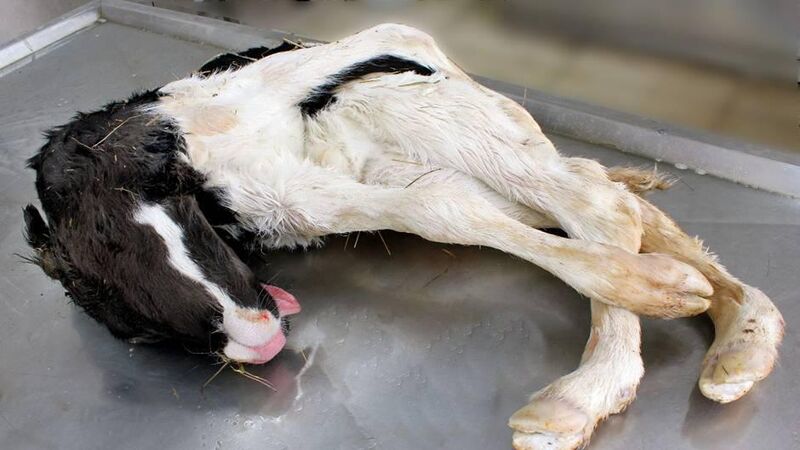
Deformed limbs, spinal curvature, twisted neck and shortened lower jaw in a Friesian calf caused by Schmallenberg virus. Picture: DAFM / Cosme Sanchez Miguel, senior research officer, Cork regional veterinary laboratory
The Department of Agriculture's regional veterinary laboratories have detected an uptick in the number of confirmed cases of Schmallenberg virus (SBV), a midge-borne virus that can cause birth deformities in calves and lambs.
One case in Co Tipperary involved a calf, while there were two outbreaks in sheep in Co Wexford, the department warned on Monday.
SBV was first detected in Ireland in 2012.
It spread across Europe, carried by wind-borne infected midges.
In Ireland, as with other affected countries, the impact of the disease was short-term, after immunity built up in cattle and sheep (through exposure and vaccination).
Since, there have been a small number of outbreaks, but this has been a low-impact disease overall - except on a small number of farms where animals were infected at the stage of pregnancy when the foetus in utero is most susceptible to the effects of the virus. This unfortunately resulted in the birth of deformed off-spring.
While Schmallenberg continues to be regarded as a low-impact virus, the department said its labs are emphasising the value of ensuring that deformed calves and lambs are submitted to them for testing, to increase the intensity and sensitivity of surveillance for both Schmallenberg virus and the potentially more impactful Bluetongue virus (BTV).
Both viruses can result in the birth of deformed off-spring. Bluetongue has been detected in the UK and in Europe in the past year.
Bluetongue can cause a wide spectrum of clinical presentations, and it would risk causing significant animal welfare impacts as well as trade challenges if it became established here.
Both viruses can cause a wide variety of birth deformities, especially deformed limbs (arthrogryposis), spinal curvature (scoliosis), torticollis (twisted neck) shortened lower jaw (brachygnathia inferior), and domed skulls (hydranencephaly).
Some of these birth deformities can make natural calving or lambing very difficult and farmers should be alert to an increased risk of these ill effects in this season.
Bluetongue virus could come to Ireland through the wind-borne spread of infected midges, through the importation of infected animals or contaminated fomites or animal-derived biological material.
Farmers are advised to be vigilant and to ask their vet to refer any birth deformities in sheep or cattle to the nearest lab for investigation.