Government working on national plan to tackle Ireland's most damaging invasive species
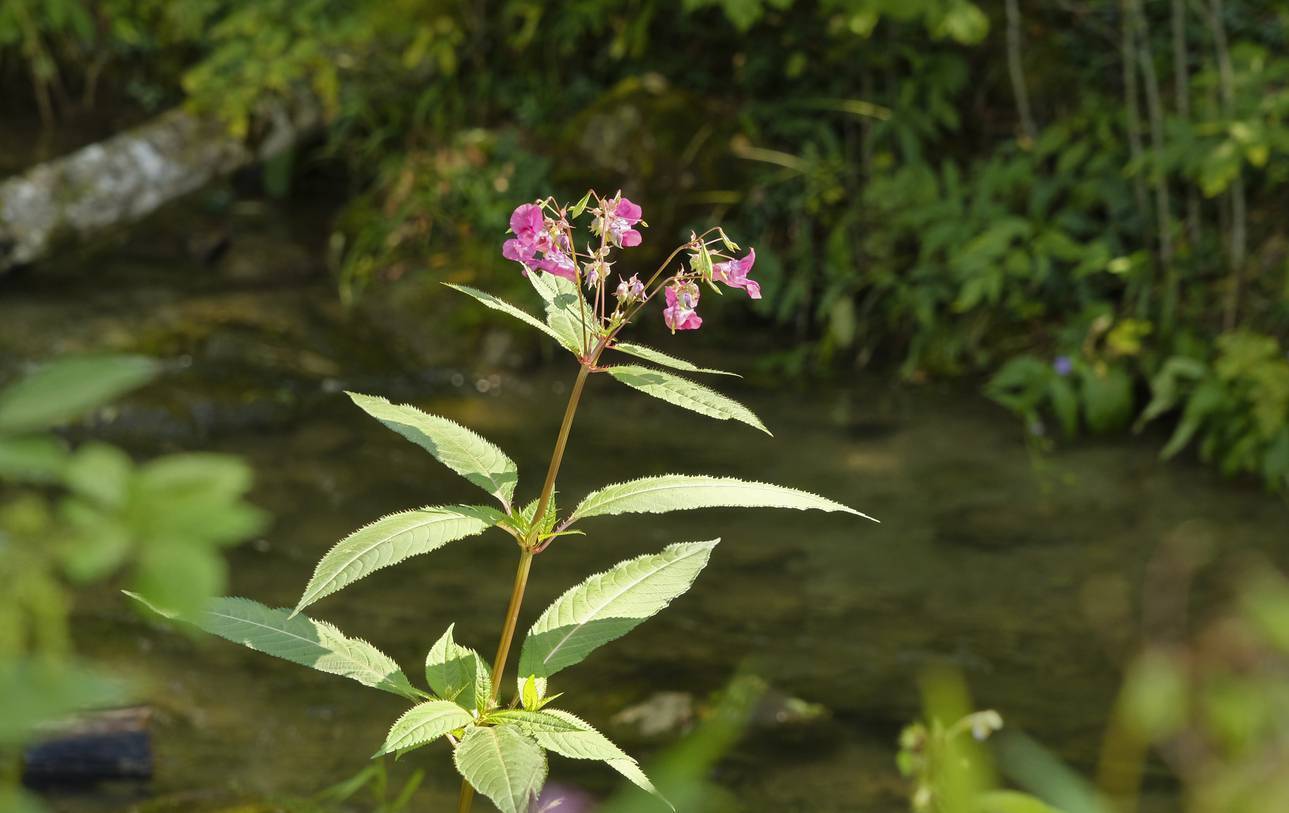
Plants like Japanese knotweed, Giant Hogweed and Himalayan Balsam (pictured) are the most common non-native species found on farmland.
The Government has confirmed that it is drafting a national management plan for invasive non-native species.
It also intends to put a range of biosecurity measures in place to tackle the introduction and spread of species which can harm the environment.
While people have introduced plants and animals to Ireland from all over the world across the centuries, there is now an increased focus on their status.
Many of them are in and around waterways, hedgerows, parkland, forestry, and farmland. Most are harmless.
But some pose a serious threat to wildlife and biodiversity and are estimated to be costing the economy over €2.2m every year.
Globalisation, with increased movements of people and goods, has led to the rise in the spread of invasive species and the resultant increased threats to biodiversity.
However, prevention, early detection, rapid response, eradication, and control measures can reduce the risk of their introduction and impact.
New regulations have also been introduced in the European Union and transposed into Irish law to mitigate the threat.
The Wildlife Acts and the European Communities (Birds and Natural Habitats) Regulations 2011 prohibit activities which introduce or spread invasive species.
According to the National Biodiversity Data Centre, there is an increasing trend in the introduction of invasive alien species to Ireland.
Housing, Planning and Local Government Minister Darragh O’Brien told the Dail that the national plan now being drafted will incorporate measures to increase awareness among the public.
Replying to a series of questions from Wicklow Social Democrats TD Jennifer Whitmore, he said the development of the plan is a priority in the Department.
A steering committee led by the National Parks and Wildlife Service has been convened to assist with the work.
New legislation dealing with invasive alien species is also at an advanced stage and is currently being finalised in the Department.
This will strengthen the legislative framework, particularly with regard to those listed species identified as being in trade, he said.
Deputy Whitmore also asked the Minister if he will ban the sale of rhododendron ponticum due to the environmental and economic cost of its spread.
While there are several different varieties of Rhododendron generally available for sale, only Rhododendron ponticum is invasive in Ireland.
He said the Department's National Parks and Wildlife Service does not monitor trade in garden centres.
However, it does undertake awareness raising around invasive alien species to help the public and business owners understand the threats posed to native biodiversity.
Where the NPWS is made aware of trade in invasive alien species, immediate action is taken to minimise any potential harm.
Meanwhile, a new technology that uses drone technology and artificial intelligence has been developed by Tyndall National Institute, in partnership with Teagasc, to monitor invasive insect species in Europe.
The collaborative research project is seen as crucial to ensuring that European orchards can continue to provide high-quality food produce.
It aims to monitor and sustainably manage a marmorated stink bug. It is native to East Asia but has been detected in Europe, with sporadic transient identifications in the UK since 2018.
The insect can cause malformed fruit when feeding, and potentially damage significant amounts of tree fruit crops, as well as some vegetable and arable crops.
Brown marmorated stink bugs can also be an annoyance when they migrate into dwellings to hibernate as they emit a foul odour.
Experts say the arrival of this species in Europe is concerning, as huge amounts of crop production are already lost each year due to insect pests.
Monitoring plays a crucial role in the mitigation of crop damage. Traditionally, farmers use sticky traps, which are manually checked periodically to estimate the type and quantity of the insect.
This is a time-consuming and labour-intensive task, which often requires a high level of expertise. To combat this challenge, the new Tyndall-led project will automate the process.
Tyndall, a leading European deep-tech research centre in integrated ICT materials, devices, circuits and systems, is a research flagship of University College Cork.
With a network of over 200 industry partners and customers worldwide, Tyndall is Ireland’s largest Research and Technology Organisation specialising in both electronics and photonics.