Flying autonomous robots take on orchard fruit picking
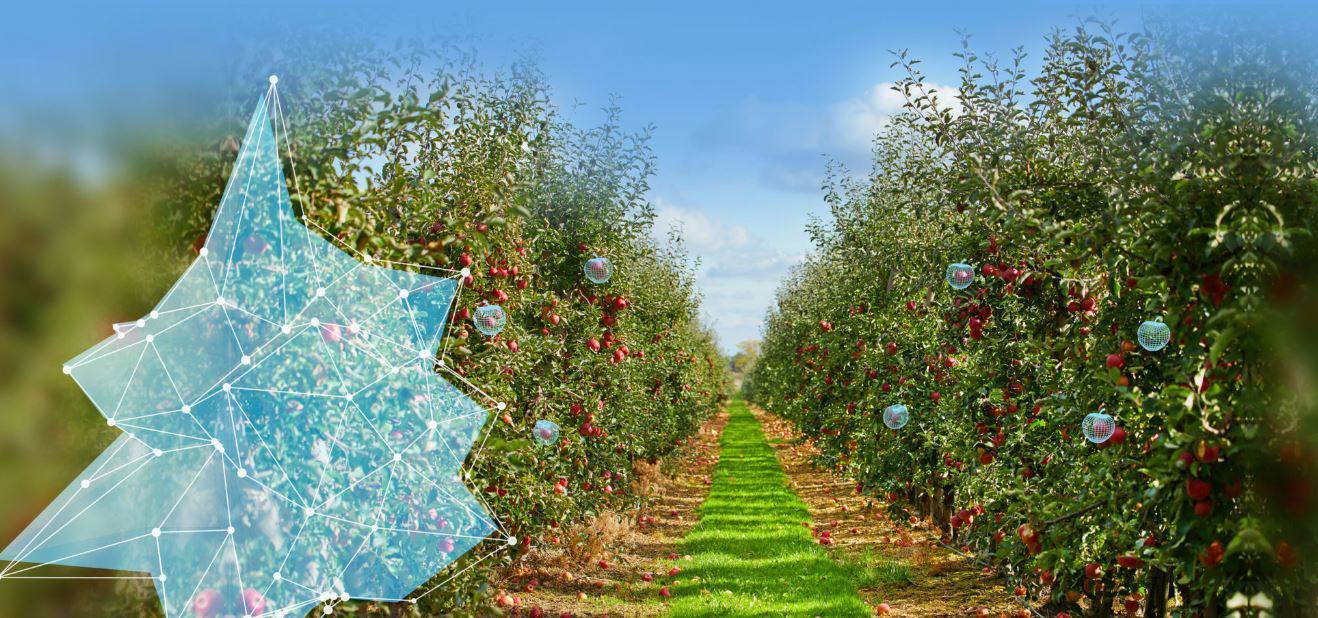
A robot's eye view: An artists' impression of how the visualisation algorithms used for Tevel's Flying Autonomous Robots interpret an apple orchard.
Sowing and growing is one thing, but one of the most difficult tasks on any fruit farm is the arduous and often manual task of harvesting the crop.
Israeli-firm Tevel Aerobotics Technologies’ flying autonomous fruit-picking robots could offer just the solution.

Zipping along the rows of trees in an orchard, the drone-like machines can already pick anything from apples through to peaches, pears and nectarines.
The technology isn’t quite delicate enough for raspberries or strawberries at this point, but testing with larger fruit on commercial farms in California and Washington, USA, and the Piedmont region of Italy has already proved successful.

The technology uses specially-designed visual guidance and control algorithms capable of detecting fruit, foliage, and other objects, that enable a high level of accuracy and manoeuvrability.
It then uses artificial intelligence to choose the best trajectory and angle from which to execute the picking process.
It also continuously collects data on every single piece of fruit it picks, providing a level of real-time harvesting data never seen before in the industry.
Such data includes the total amount of fruit picked, weight, colour grade, and size of each fruit, which combined can offer information on the distribution of weight, size, and colours in the bin.

The really clever bit is that this data is then fed into internal algorithms to optimise fleet management to improve the entire harvesting process.
And it has added benefits for further down the supply chain too; the technology is also capable of adding timestamps and geolocation tagging for traceability.
Tevel’s Flying Autonomous Robots have also managed to overcome one of the biggest practical challenges previously for automated orchard picking, interacting with moving foliage on the trees.

The innovation has been granted 11 patents worldwide and is designed to continuously fly in and out of the trees without harm.
The firm claims the advantages for farmers include improved yield and quality and more streamlined harvesting logistics, resulting in better control over produce and better profitability for the business.