New plant breeding techniques needed
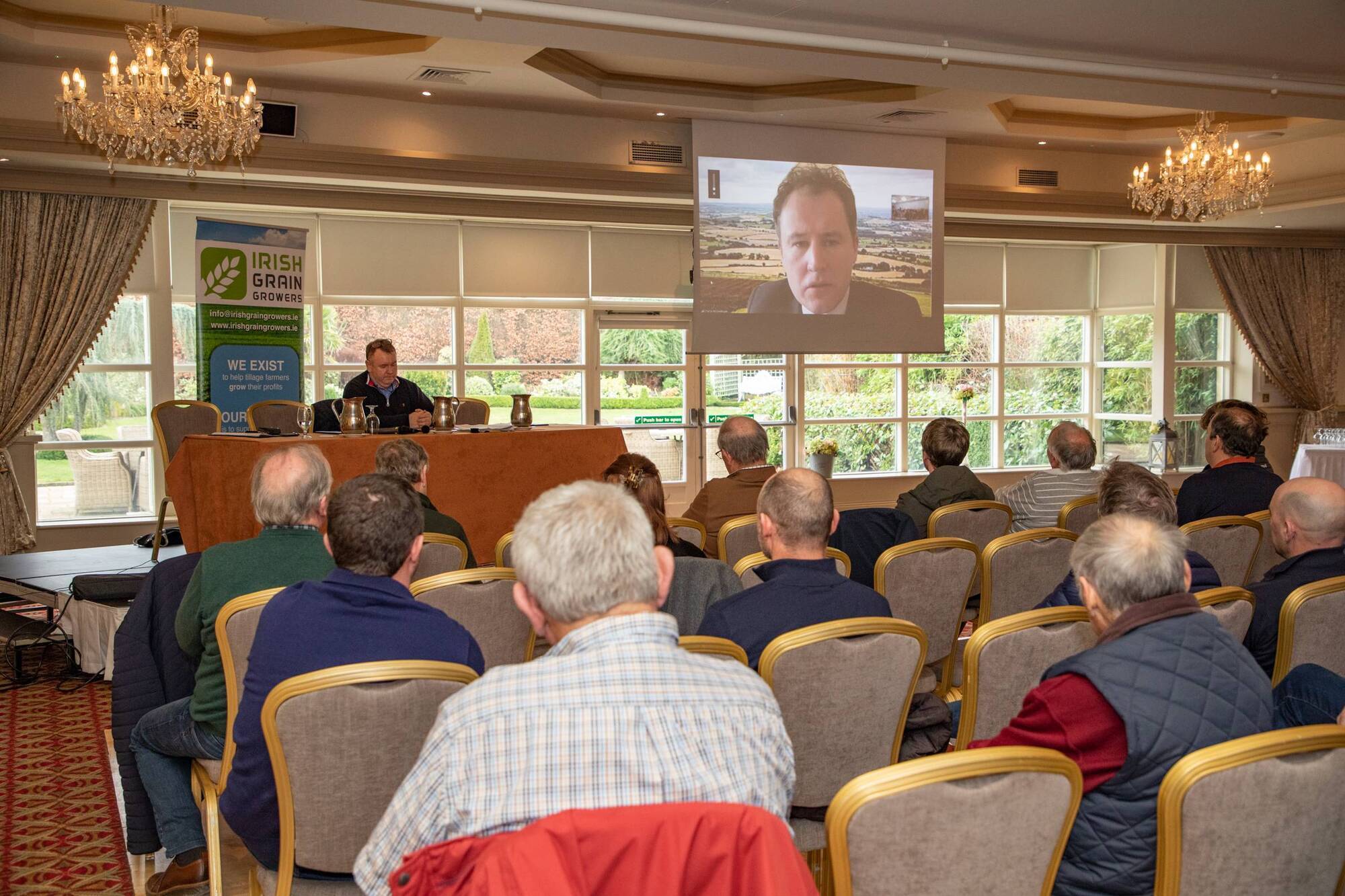
Minister for Agriculture, Food and Marine Charlie McConalogue speaking via livelink at the Irish Grain Growers Group AGM at the Clanard Court Hotel, Athy, Co Kildare. Picture: Michael Donnelly

Try from €0.25 / day
SUBSCRIBEThe consideration of new plant breeding techniques will be needed to help achieve the Farm to Fork Strategy goals.
Farm to Fork is targeting a 50% cut in the use of pesticides by 2030, and Teagasc’s Ewen Mullins has said that the key focus now has to be on improving the disease resistance of crops.
“To achieve the Farm to Fork ambition there have to be alternatives there [to pesticides] - otherwise, many of our systems will lose profitability overnight,” he told the Irish Examiner.
“We know the challenges that we’ll face through Farm to Fork, and it’s important to add that no farmer likes to spray; they could have better use of their time and better use of the money they put out to protect the crop but they have to do it.
“So, if you take that away or reduce it, at one end that’s a welcome action, but you still have to maintain that profitability.”

Mr Mullins told the Irish Grain Growers Group AGM event this week that there has been an emphasis on breeding techniques “going back 20, 30 years, when genetic modification and other techniques first came to the stage”.
“In probably the last three to four years, it’s gained an awful lot of attention and that’s primarily due to Farm to Fork.”
Sustainable Use of Pesticides Regulation
The Department of Agriculture is currently seeking views on the European Commission’s proposed Sustainable Use of Pesticides Regulation (SUR) to replace the existing Sustainable Use Directive. The regulation will establish a framework for achieving the Farm to Fork pesticide reduction targets.
Integrated Pest Management (IPM) needs to be a “cornerstone” of achieving the targets, Mr Mullins said.
“The whole idea about IPM is that it is not a one-solution process, there are multiple solutions that will be used to knock back a disease and ideally, the goal is to protect profitability, protect yields,” he told the AGM event.
“Anything on IPM is not going to achieve its goal unless the varieties are up to scratch. They have to be resistant or highly tolerant to disease.”
Mr Mullins said that while variety and crop breeding has been ongoing for thousands of years, the “problem” now with conventional breeding is “that it just takes too long; an Irish cereal variety is approximately 10 years and a potato variety is about 12 years”.
“There are two new breeding techniques, we call them new but really they’ve been around for over 10 years,” he continued.
“One is cisgenics, one is gene-editing, and editing is the one capturing an awful lot of attention, and editing applies not only to crops; it’s really a complete game-changer when it comes to scientific research across the world.
“What they [techniques] have is the opportunity to enhance an existing variety, and you have the potential to do it much quicker.”
Awareness
He said that there is awareness needed around “their power and accuracy”, which have “huge potential”.
2023 is going to be a “busy year” in terms of the regulatory oversight of edited crops in the EU, Mr Mullins said.
While China, the US, “even Japan which technically would be adverse to novel breeding techniques” are all adopting the use of editing “in a fast way because they see its potential”, Mr Mullins said that the EU is currently lagging behind.
“What is clear is that the commission, if they’re focused on delivering Farm to Fork, they are acutely aware that we will need to have all the techniques available on the table to be used,” he added.
Newsletter
Stay ahead of the season. Sign up for insights, expert advice and stories shaping Irish agriculture.
Newsletter
Stay ahead of the season. Sign up for insights, expert advice and stories shaping Irish agriculture.
Newsletter
Had a busy week? Sign up for some of the best reads from the week gone by. Selected just for you.
Newsletter
Get a lunch briefing straight to your inbox at noon daily. Also be the first to know with our occasional Breaking News emails.
Saturday, June 20, 2026 - 10:00 PM
Saturday, June 20, 2026 - 11:00 PM
© Examiner Echo Group Limited