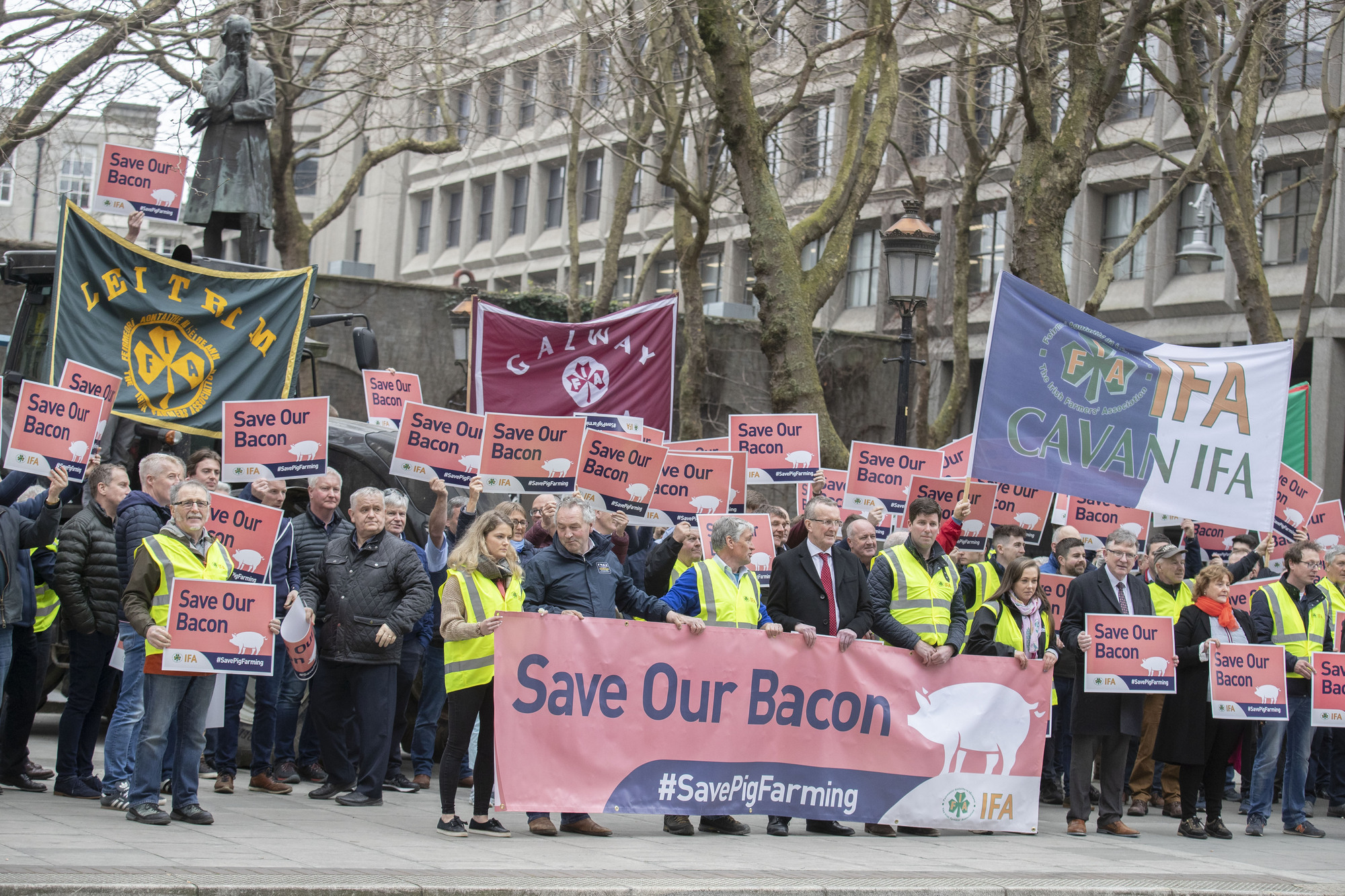
Rocketing feed input costs have created an “unbridgeable gap” between production costs and pig prices the producers have warned.
This comes as the Government announced a fresh package of measures to support farmers including €13m in funding for the pig sector, along with €2.8m in support for the horticultural sector.
It amounts to about €70,000 for each pig farmer and approximately €100,000 for horticultural growers.
The Government also announced on Wednesday that excise reductions on petrol, diesel, and green diesel will also be extended to Budget Day.
This fresh round of supports come as farmers battle soaring prices for inputs.
Industry and farmer representatives appeared at the Oireachtas joint committee on agriculture, food and the marine on Wednesday, saying that the Government must “be open” to reviewing supports for the pig industry as “circumstances evolve”.
Cormac Healy, senior director of Meat Industry Ireland (MII), said fuel price inflation is driving on-farm costs, as well as at processing level in terms of energy, packaging, transport, and deep-sea shipping rates.
“Over recent years, the sector has faced a series of challenges including Brexit, African swine fever outbreaks in the EU, the Covid pandemic, and a turbulent Chinese market,” MII’s Philip Carroll said in the opening statement to the committee.
“In Q4 of 2021, producers were already contending with rising feed costs pushing them into a loss-making position.
“However, since the onset of the Russia-Ukraine conflict, we have witnessed an unprecedented and rapid escalation in grain and protein prices which has crippled the sector.
“Additional shipping costs further increase feed prices in Ireland compared to the continent.”
MII said that while this sector has always endured cyclical economic fortunes, the sector “cannot withstand the level of losses it is now encountering”.
“Significant stabilisation and liquidity support is urgently required from Government.”
Acknowledging the package announced by Agriculture Minister Charlie McConalogue this week to support pig farmers along with the previously announced €7m Pig Exceptional Payment Scheme, MII believes this is “insufficient to save the sector from serious long-term damage”.
Despite the challenging market environment, the processing industry has delivered prices to Irish producers “well ahead” of EU average and prices in the main EU pig producing member states over the last year, MII said.
“Depressed prices were exacerbated by rising feed costs over last autumn. Since September, the Irish pig price has been 10% above the EU average price and overall 15% ahead of the price across the seven member states that account for 80% of total EU pigmeat production.
“Processors have done everything possible to support their producer suppliers over this period.
“Pig price in recent weeks has increased by approximately 20c/kg to 170c/kg. Unfortunately, this does not bridge the gap between feed costs and market price, and more support is needed to help bridge this gap through an unprecedented price cost squeeze.”
Irish pig prices have remained the same this week as last with farmers receiving quotes of €1.60c/kg up to €1.64 or €1.66–€1.70/kg.
The Irish Farmers’ Association market report notes that farmers will “urgently” need more “significant upward movement” for the price they receive for their pigs from the marketplace.
The European market is continuing to improve with pigmeat prices moving upward. The UK and France have passed the €2.00/kg and Spain looks likely to follow suit with its current price of circa €1.98/kg. The average European price is circa €1.80c/kg.
Speaking at the Oireachtas meeting this week, IFA president Tim Cullinan said that the sector is in the “midst of a crisis, the likes of which it has never experienced before”.
To prevent the demise of the sector, the IFA, MII, and the Irish Grain and Feed Association are proposing the immediate establishment of a pig stability fund.
Their proposals include the establishment of a state-administered fund to provide an immediate cash injection to pig farmers.
The fund would be jointly funded by a State contribution along with a long-term fund sourced by way of a new statutory levy.
The statutory levy of 90c/pig would be on all pigs slaughtered in the Republic of Ireland or exported to Northern Ireland which, based on 2021 output, would generate a revenue stream of circa €3.6m per annum.
Based on a 14-year payback period, this constitutes a direct farmer contribution of circa €50m, Mr Cullinan said.
A commitment is sought from the State to initially fund the farmer contribution of €50m along with an additional upfront funding from the State of €50m. The former will be repaid by the revenue from the newly-established statutory levy, it is proposed.
Teagasc analysts warned last month that pig sector losses are expected to reach €160m by March 2023, with up to 30% of farmers at risk of closure.
A new report by Teagasc economists has said that the greatest challenges at present are “undoubtedly” being faced by pig farmers, with the average pig farm losing an estimated €166,000 since the year began.
While a rise in pig prices is anticipated over the coming months, pig farmers will continue to lose money in the meantime.
The Irish sow herd has already begun culling 10,000 sows, with a further 12,000 sows deemed at high risk of destocking over the coming weeks, it is warned.