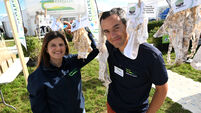
Retired Animal Health Ireland chairman Mike Magan has thanked all those involved in the organisation since its beginning in 2009.
AHI disease programmes are estimated to have saved Irish farmers and the agri-food industry at least €135m per year by reducing BVD and mastitis.
Meanwhile, work also continues on reducing Johne’s disease and IBR in cattle, parasitic and other diseases in cattle and sheep, and in pig health and calf rearing.
“Johne’s disease is a big part of why AHI exists,” said Mr Magan. “Before AHI was formed, an industry meeting identified JD as an area of vital interest and that it should be tackled on a national scale.”
He said the low level of participation by farmers in the Irish Johne’s Control Programme is “disappointing”, and warned Johne’s is a silent disease.
Once it takes hold in a herd, it can cause severe problems which will take years to manage.
“One of the greatest achievements over this time has been the collaboration and the working together of a wide-ranging group of stakeholders, with their own concerns and responsibilities, which has made the organisation what it is today,” said the retired AHI chairman.
“For me personally, the big one is BVD.” He said the BVD programme has been more protracted than was suggested initially and admitted to being overly optimistic and ambitious at the earlier stage of this programme.
“We were naïve, and we had no experience of running such an ambitious, industry-led, animal health programme.”
“However, today, as we prepare to seek EU approval for the programme in advance of recognition of achieving BVD-Free status, the journey has proven successful, with the delivery of an €85m saving for Irish farmers and the agri-food industry, in 2021 alone. Over the last 10 years, the national mastitis programme, CellCheck, has been central in helping to reduce SCC in the national herd from 280,000 cells/mL to 180,000 cells/mL.
“This has put €40m into the pockets of Irish dairy farmers annually, with a further €10m being added to the margins of Irish processers each year,” said Mr Magan, a dairy farmer at Killashee, Co Longford who is a former chairman of Lakeland Dairies.
“The Beef HealthCheck programme captures kill-line parasite information in real-time, with the information being fed back to the farmer and their vet. This information is vital in terms of on-farm parasite control. Evidence suggests that resistance is developing. This programme can help to educate farmers to avoid resistance and, with the prudent use of anthelmintics, improve the health of their animals and their carbon footprint.”
He wished his successor, James Lynch, every success. A dairy farmer from Sixmilebridge, Clare, Mr Lynch was the Dairygold Co-op chairman from 2015 to 2017.