Cost of keeping a dairy cow to reach €1,560 in 2022
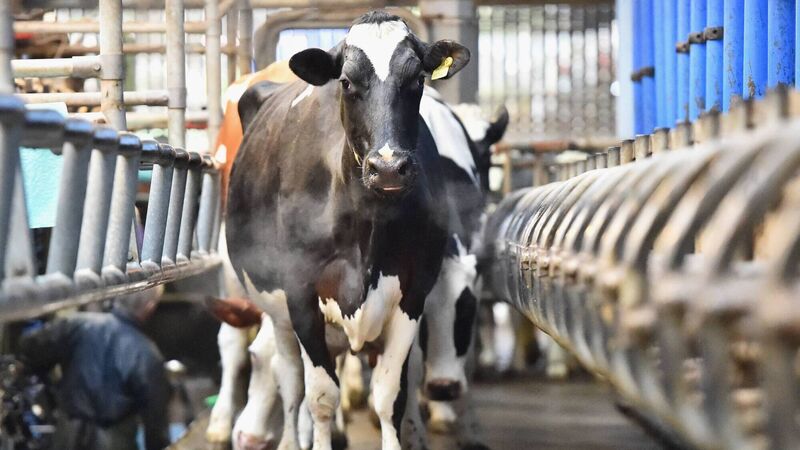
Holstein cow walks through milking parlour. Picture: by Jeff J Mitchell/Getty Images
The cost of keeping a dairy cow is to reach €1,560 in 2022, Teagasc Dairy Specialist Patrick Gowing told delegates at this year's National Dairy Conference.
Mr Gowing revealed that the average cost per cow rose from €1,115 in 2015 to €1,180 in 2017, and €1,311 in 2020; meaning the cost has risen almost a fifth in the space of just a year.
The data is based on actual figures from Teagasc's eProfit monitor service for spring-calving dairy herds, which offers herd keepers a snapshot of their farm’s financial performance.
The results showed feed costs increased steadily from €210 in 2015 to €288 in 2020. Part of this was due to the amount of feed per cow increasing by 200kg per cow.
Fertiliser costs fell from €142 in 2015 to €128 in 2020.
Feed and fertiliser together account for 40% of costs. Meanwhile, fixed costs increased from €480 to €559, which Mr Gowing associated with the expansion of farms.
The overall increase in costs from 2015 to 2020 was €196. However, satisfactory milk prices and an increase in milk solids of 40kg per cow over the six years more than covered the increase in costs of production.
Now, dearer feed and fertiliser are likely to add another €200 per cow to costs, raising in just one year as much as in the years from 2015 to 2020.
The cost increase predicted by Mr Gowing is based on assuming that 2022 feed and fertiliser input amounts are unchanged compared to 2020, but with feed costing €350 per tonne, the price of fertiliser doubling, and all other costs rising by just 1%.
This brings the cost per cow to €1,560, compared to €1,311 in 2020.
With milk price uncertainty, farmers have to look closely at how to control the big jump in costs, said Mr Gowing.
If farmers can do good deals on all their inputs, the cost saving is €15 per cow. But cutting feed usage 10% can save €35 (equivalent to feeding 0.4 to 0.5kg per day less over the lactation).
One of the best ways to do this is by better grazing management, including grass budgeting, with a special focus on the quality of mid-season grass.
The focus on fertiliser use should be on becoming more efficient, if fertiliser use can be cut 10%, the saving is €26 per cow. This can be achieved by using treated urea, plus low emission slurry spreading, said Mr Gowing.
Farmers can also save costs per cow by getting rid of 'passenger cows' as under-performing cows are less likely to pay their way, going forward.
Mr Gowing recommended a breakeven analysis of the herd, looking at the cost per cow available from an eProfit monitor, to arrive at the cow yield needed to break even. Any cows with lower yields are a cost to the system and need to be considered for culling.
A lifetime milk recording report showing profit margin per cow per lactation will also pinpoint passenger cows. Getting rid of these will reduce feed and fertiliser costs per cow. “Sell all non-performing stock,” advised Mr Gowing.
The cost of silage on the farm should also be looked at, bearing in mind it will be more expensive to produce next year. Silage already made, benefiting from lower fertiliser prices, is the cheaper option. It is “money in the bank”, and should be fully utilised, with the help of fodder budgeting.
Silage wastage must be avoided, a poorly managed silage pit face can result in 10% to 20% losses, which adds hugely to costs.
Mr Gowing also recommended cash flow budgeting, particularly for the spring, when it can take €300-350 in cash to keep a cow going for the first four months of the year (a figure likely to increase in 2022 due to the higher input costs).