The migratory locust has got the official stamp to be marketed as a snack or as a food ingredient in the EU.
It follows stringent scientific assessment by the European Food Safety Authority (EFSA) to verify that the food does not pose a safety risk to human health.
Insects in our food represent a very small niche market in the EU but may gain popularity due to the environmental benefits of insects for food, because of their high feed conversion efficiency, less greenhouse gas emissions, less use of water and arable lands, and insect-based bioconversion being a marketable solution for reducing food waste.
Insects are one of the innovative foods, along with algae, new plant proteins or traditional food from third countries, that will contribute to the objectives of the EU’s Green Deal and Farm to Fork strategy.
The approval means frozen, dried, and powder forms of locusts will be allowed in food products.
However, legs and wings have to be removed from frozen and dried locusts by the food business operator, to reduce the risk of intestinal constipation.
As an added benefit, using locusts as food could help to offset the often devastating impact of these insects as a crop pest.
Since 2019, vast clouds of locusts have devoured crops and pastureland in Yemen, Somalia, Ethiopia, and Kenya. Locusts swarms continue to threaten agriculture and food security worldwide, from East and South Africa to Trinidad in the West Indies.
It is estimated a 100sq km swarm can eat what 3.5m people would eat in a day.
Swarms began forming in 2018 after cyclones dumped heavy rain on the deserts of Arabia, allowing locusts to breed in the wet sands, and strong winds blew them across the Red Sea. In the 1980s, similar locust plagues stretched from North Africa to India.
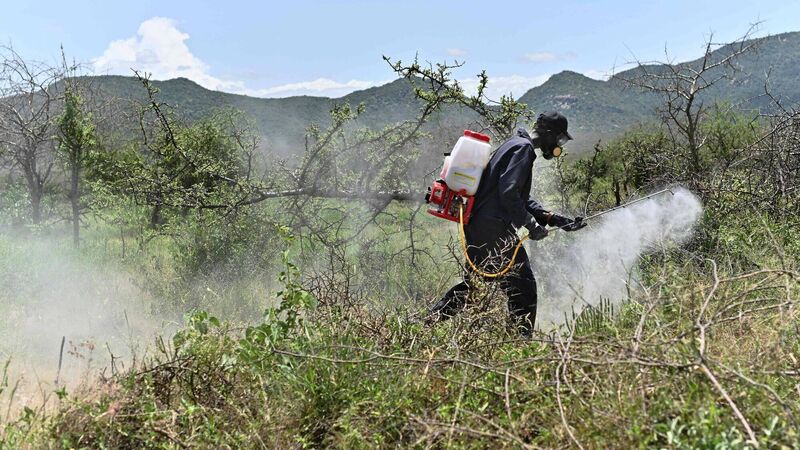
Swarming locusts can be collected in large numbers relatively quickly and easily; however, it is unlikely these insects will end up on our plates because they are tackled instead by ground and aerial spraying of insecticides.
Insects for our food would instead be bred in designated facilities.
The food business operator which requested the EU to authorise placing locusts on the market is Fair Insects BV, acquired in 2017 by Protix, a company in the Netherlands that claims to be the first worldwide that can produce insect-based ingredients on an industrial scale.
The firm says insects are a low-impact protein alternative that can be cultivated sustainably.
EFSA says insects are regularly eaten in many parts of the world, but it is up to consumers to decide whether they want to eat them.
It concluded that consumption of migratory locusts may potentially lead to allergic reactions. Food allergies are an important public health problem, affecting 2%-4% of adults and up to 9% of children.
It’s not the only insect to be given the go-ahead for inclusion in human food; along with locusts, the EFSA has approved yellow mealworm (the larva of Tenebrio molitor) and Acheta domesticus (house cricket) for food use.
Last September, the EU also authorised the use of insect proteins in poultry and pig feed.
Some other insects are already on the EU food market, while their scientific assessment by EFSA is still ongoing.
In October 2020, the European Court of Justice ruled whole insects didn’t need a pre-market authorisation, but an EU regulation re-classified insects as needing approval, while allowing a transitional period for whole insects to stay on the market, subject to conditions.
According to the Food and Agriculture Organization of the United Nations, insects as food emerge as especially relevant in the 21st century due to the rising cost of animal protein, food insecurity, environmental pressures, population growth, and increasing demand for protein among the middle classes.
Thus, alternative solutions to conventional livestock are needed.