Forestry owners want licence backlog cleared
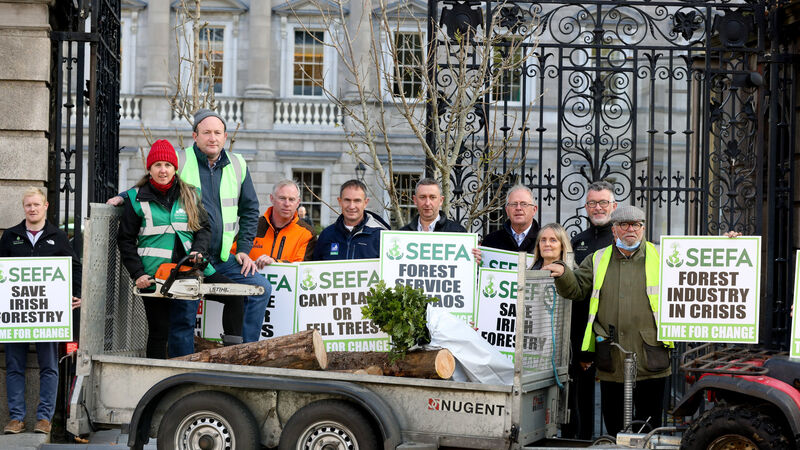
Pictured outside the Dail today are members of the Social, Economic, Environmental Forestry Association of Ireland (SEEFA), who are protesting against what they claim is the demise of the private forest sector. Photograph: Leah Farrell / RollingNews.ie
PRIVATE forestry owners have taken to the streets to highlight the growing crisis in their industry which employs over 12,000 people.
They claim the sector has been devasted by a backlog in granting afforestation and felling license and are calling on Taoiseach Micheál Martin to intervene.
Forests account for 11% or 770,020 ha of the total land area of Ireland, with 49% in private ownership. The value of the industry to the national economy is €2.3bn.
The newly formed Social, Economic, Environmental Forestry Association of Ireland (SEEFA) organised a protest outside Government Buildings in Dublin today as part of a campaign to highlight the issues.
Paddy Bruton, Forestry Services Limited and Euroforest Ireland, said afforestation is the largest opportunity in the land-use sector to remove carbon dioxide from the atmosphere.
Government targets are not being reached and in 2020 only 2,300 hectares were planted of an 8,000-hectare target.
In the last five years, the targets have been missed by over 15,000 hectares in total or the equivalent of 40 million trees.
Tipperary Fianna Fail TD Jackie Cahill, chair of the Oireachtas Joint Committee on Agriculture, Food and the Marine, said those trees if they had been planted, would have sequestered 5.4 million tonnes of carbon in their lifetime.
“We have really missed an opportunity to benefit the rural economy and in our fight against climate change.
“Our failure to issue licenses and our failure to plant trees for afforestation is haunting us and will continue to haunt us in the years ahead because we can’t reclaim that lost time,” he said.
SEEFA, an alliance of private sector forestry businesses, claims that over 1,000 afforestation applications and thousands of felling and road licence applications are still awaiting a decision.
“Forest owners cannot plant their land, manage their forests or sell their timber. For many owners, this is their pension or the manner to pay for education for their children. The implications of this crisis will be felt for many years to come,” it said.
SEEFA said the crisis is having a direct impact on home construction and adding unnecessary costs to mortgages for people building homes.
Marina Conway, Western Forestry Co-Op, said previous governments invested more than €3 billion in the industry over 35 years.
“Over 20,000 farmers have committed their land to forestry. This is now maturing, and private timber is ready to harvest.
But instead, sawmills are having to import timber to meet demands of other sectors – particularly construction.
Local timber needs to get to the market to maintain the forest supply chain, maintain rural jobs, keep local sawmills functioning and protect the economic benefits to rural communities,” she said.
Imelda Connolly, Greenbelt in Virginia, Co Cavan, said a sustainable forestry sector that can achieve commercial, climate and biodiversity goals is ready to flourish and deliver for rural Ireland.
But it needs a reduction in the volume of imported timber, and improvements to the current licensing system, which are holding back the industry’s potential.
Irish Farmers Association members led by Tim Cullinan, president, recently called for emergency legislation to reform the licence system.
Forest owners are beyond frustrated with the system and the never-ending red tape that is preventing them from realising the value of their investment, according to IFA Farm Forestry Chair Vincent Nally.
Meanwhile, Agriculture, Food and Marine Minister Charlie McConalogue has announced a budget allocation of over €100m for the sector in 2022.
He said his immediate priority is to resolve the issues which have led to backlog in felling licences and to issue them in the volume needed for this important sector to continue contributing to the rural economy.
“I am pleased to say that we are making significant progress on felling licences and that the volume of timber likely to be licenced this year will be the highest on record. It is already 90% higher than last year,” he said.
Minister McConalogue said in June that the Department had issued 415 forestry licences. This output was interrupted in July and August by a new requirement for public participation, which applies to all similar planning issues.
“However, we have now returned and indeed exceeded expected levels with 585 licences issued in September, 511 of which were felling licences.
“Up to October 15, the Department had issued 2,057 tree felling licences to cover a volume of just over six million cubic metres.
“Furthermore, Coillte's felling programme is fully licensed and they are working with the Department to ensure availability for this supply to market,” he said.
Minister McConalogue reiterated his commitment to supporting the forest sector and to building on the recent progress, so that a continual improvement in delivery is achieved.