With autumn suckler calving on the horizon, how do we start preparing? 
'Make sure you have everything ready in case you need to assist any births' 
With autumn suckler calving on the horizon, how do we start preparing? 

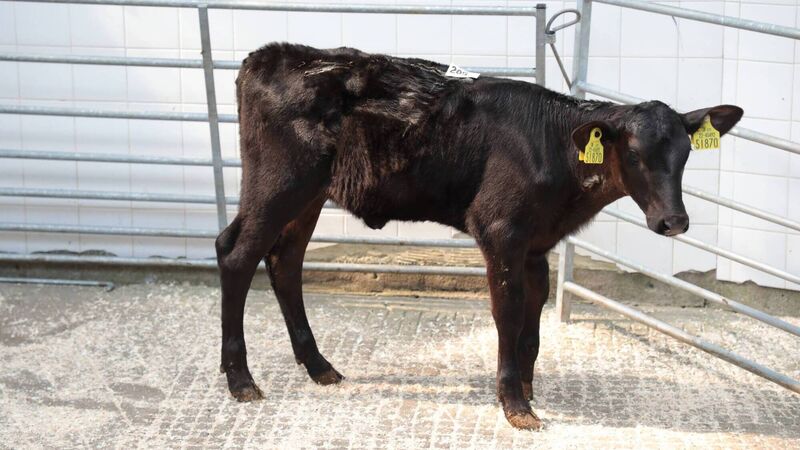
This AAX heifer calf born on June 7, 2021 sold for €135 at Bandon Mart on Monday. Picture: James Treacy. 

We sure live in a beautiful country, especially when the sun shines like it has for the last two weeks.

July is moving on and despite the heatwave, grass growth has not been too bad just yet.

Some have reported grass shortages, especially in the south and east where there is a drought of one degree or another.

Moisture deficits are now in the region of 50 to 70mm.

Thankfully a lot of forage was carried over from last year and a lot of silage has been made so far in 2021.

As a result, even though some silage is being fed on both beef and dairy farms, as of now there is no worry that there could be a deficit come the autumn.

All the while, suckler herds are gearing up for calving autumn cows and creep feeding spring born calves has begun.

Early Autumn cows are not far away now, while the later autumn calvers are all now dried off.

Autumn calving preparation 

Autumn calvers will almost all calve while outdoors.

Make sure you have everything ready for action indoors just in case you need to assist any births.

Wash out and disinfect calving boxes before the season gets going, if you haven’t already done so.

Check that the water troughs in the calving boxes are working.

Check the calving Jack and ensure that it is working and that the two ropes are in good order.

Ensure that your calving camera is working correctly.

Make sure that if you have a calving gate that it is fully functioning. Remember that cows can get very aggressive around calving so properly working equipment is essential.

Also remember that if you are in doubt about a calving call your vet sooner rather than later.

Stock up on iodine for navels and gloves to improve hygiene when handling cows and calves. Don’t forget to stock up on straw early too.

Nutrition for dry suckler cows this autumn 

It is important that you don’t have suckler’s over conditioned at calving.

Ideally cows should be dried off in the condition you would like to calve them in. Suckler cows that are too fat at calving tend to have more difficult calving’s and metabolic disorders, such as milk fever and held cleanings.

This may also have a negative effect on subsequent fertility performance.

Despite the lack of grass, cows dried off lately have loads of condition.

I am currently running my autumn calvers on virtually bare paddocks and they are very content and certainly don’t need any more condition between now and when calving starts in five weeks’ time.

Keeping cows on a relatively low plain of nutrition may involve dry cows running behind young-stock, cows with calves or finishers, that is if you have grass for those stock.

This means that the productive animals can get the best of the grass and the dry cows can tidy up behind.

Watch that you don’t graze cows close to calving on heavier covers that are stressed by the current dry spell, as drought draws additional Potassium (K) into swards which could contribute to an increase in held cleanings and milk fever.

Keep a good quality pre-calver mineral in front of all dry suckler’s for at least four to five weeks before calving.

If you know of specific mineral deficiencies on your farm, then you may need to give cows a bolus or get a specific mineral premix made up.

Also, keep a close eye on dry cows for mastitis as there are plenty of flies about which can be an issue.

Fresh cow management 

Once cows have calved it is essential to get sufficient colostrum into calves.

If calves are slow to drink or cows won’t stand for the calf, get them indoors so that you can milk the cow and get the calf fed.

Get fresh cows and calves on to good quality grass as soon as possible to boost the cow’s energy intake for milk production and recovery.

If you are tight on grass, you will need to supplement silage with concentrates for fresh cows.

The rate will depend on silage quality. 

This will help the next breeding season to run more smoothly.

Monitor cows for metabolic disorders in the first few days after calving and continue to supplement magnesium.

Many also dose fresh cows for internal and external parasites at calving.

More in this section

Farming
Newsletter

Keep up-to-date with all the latest developments in Farming with our weekly newsletter

Sign up
Revoiced
Newsletter

Our Covid-free newsletter brings together some of the best bits from irishexaminer.com, as chosen by our editor, direct to your inbox every Monday.

Sign up
Lunchtime
News Wrap

A lunchtime summary of content highlights on the Irish Examiner website. Delivered at 1pm each day.

Sign up