Point to point racing shutdown threatens continued success of Irish horse breeders
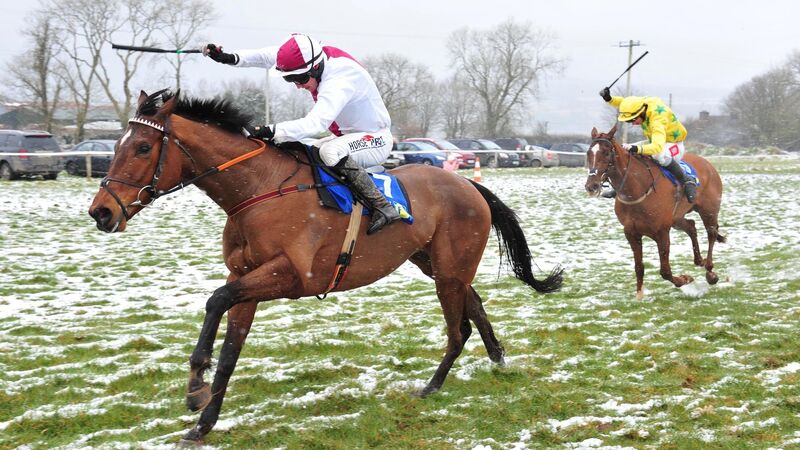
Minella Indo ridden by John Barry to win at Dromahane, Mallow, Co Cork in March, 2018, one of four top Irish winners at Cheltenham to win his first race on the point-to-point track at the O’Brien farm at Dromahane. Unfortunately, the shutdown of point-to-point racing last January due to Covid-19 casts a shadow, even as the Irish racehorse industry celebrates its Cheltenham success. Picture: Healy Racing
Horse racing was a big winner for rural Ireland last week, and a good example of how our small island nation punches above its weight.
Irish success at Cheltenham was greeted as part of the St Patrick’s Day global celebration of Irishness around the globe.
It’s no small achievement for the Irish farms on which the best jump racing horses in the world are reared and trained.
Racing over the jumps has its roots still firmly attached in parishes all over the country, from where talented breeders, trainers and riders sent their horses to win 23 of the 28 races at Cheltenham last week.
The €3.7m of prize money on offer for those 21 races is a measure of the achievement of the Irish jump racing (also known as National Hunt racing) industry.
The story begins on the Irish farms where the winners were bred, reared and raced.
For example, no fewer than four of the top Irish winners, Honeysuckle in the Champion Hurdle, Minella Indo in the Gold Cup, Appreciate It in the Supreme Novices’ Hurdle, and Vanillier in the Albert Bartlett Hurdle, had their first racing wins on a farm in north Cork.
The O’Brien farm at Dromahane, near Mallow, is the site of one of nearly 100 informal racecourses where point to point racing goes on from September to June every year.
Farms are converted to racecourses for the annual races, an important community event in horseracing areas in most Irish counties (Co Cork and Northern Ireland are the leading venues, with Co Wexford a leading training area).
Point to point racing, run by local people at the parish level, supervised by the Irish National Hunt Steeplechase Committee and the Irish Horseracing Regulatory Board, is more a rural sport than a business.
But it is where many riders, owners, trainers, and officials, get their first taste of jump racing, and is vital for the breeding and training aspects of the sport.
Of the 28 winners at Cheltenham, six were sold for six-figure sums after winning an Irish point-to-point race.
That’s how important these community events are for the ever-rising worldwide reputation of Irish jump horses.
Up to half a million euro can be paid for a promising young horse that has proved its ability to gallop and jump at racing pace in these local three-mile events.
No fewer than 13 of last week’s 28 Cheltenham winners, and 16 of the placed horses, began their careers in Irish point-to-points.
Well done to Agriculture Minister Charlie McConalogue for congratulating Irish racing on its outstanding successes at Cheltenham, welcoming this clear indicator that the Irish breeding industry remains extremely competitive at a global level.
Hopefully Minister McConalogue will work to keep the racing success story going. by helping point-to-point handlers overcome the major challenge posed by their racing “between the flags” being suspended since January 13 as part of the government’s Level 5 Covid-19 restrictions.
This has left trainers unable to run horses in the races for which they were bought, and subsequently unable to bring their stock to market.
Instead of prices reaching new heights on the back of 13 point-to-pointer wins at Cheltenham, a backlog of untested horses is building up in point-to-point handlers’ yards.
With no Irish point-to-point races since January 13 (even though racing “inside the rails” has continued behind closed doors), there’s a danger of missing out on the next crop of the Irish point-to-point graduates that won all of the Grade 1 novice events last week.
Meanwhile, the Minister’s department can bask in the success of how Government funding in the horse industry, which it oversees, yields a high return on investment.
Of the 28 winners at Cheltenham, 20 were Irish-bred, and they included nine Grade 1 winners.
That will help to ensure that bloodstock export sales worth hundreds of millions of euro per year continue, and the Irish bloodstock industry’s 14,000 jobs and estimated €1.1 billion value to the economy are underpinned.
Most people in the industry agreed that last week’s Irish domination of one of the world’s most important jump racing events was due to higher prize money in Ireland attracting the best horses.
So Horse Racing Ireland can take a bow for its prize money and capital investment programme that has grown the sector to become a world centre of excellence for horse racing, and a national success in terms of employment and foreign direct investment, as well as being export-oriented.
Racing is estimated to account for up to 80,000 tourists to Ireland each year, among the one million plus who attend horse racing (until Covid-19 sent it behind closed doors).
Ireland is the chosen destination for horseflesh, being the largest producer of thoroughbred foals in Europe and the fourth largest in the world. Government funding has been well spent for success in an ultra-competitive industry.
In the UK, the home of horse racing, there is hand-wringing this week over how they no longer breed enough jump winners.
In fact, it is France that mounts the biggest challenge to Ireland, albeit French breeders had only four winners (14%) last week.
But 31% of the Cheltenham winners between 2011 and 2020 were bred in France. That compares with 53% Irish-bred, and just 13% British-bred.
Just as in France, Government funding is crucial to remain one of the world’s leading breeding and racing nations.
Government help is needed now that Brexit has ended 13 years of seamless horse transport between the UK, France, and Ireland.
Breeders moving mares, or owners moving racehorses, now find it much more expensive.
Fortunately, that didn’t deter the big Irish contingent that went to Cheltenham.
Horse transporters and their vehicles must now be authorised before travelling overseas, and extra blood tests and certification are required for each horse.
VAT must be paid on the value of the animal being exported, even if it is only a temporary export, and can subsequently be reclaimed.
As a result, the cost of transporting horses has jumped, and the bureaucracy has multiplied.

Subscribe to access all of the Irish Examiner.
Try unlimited access from only €1.50 a week
Already a subscriber? Sign in