Co Cork students won two out of three main Young Scientist awards for agriculture projects
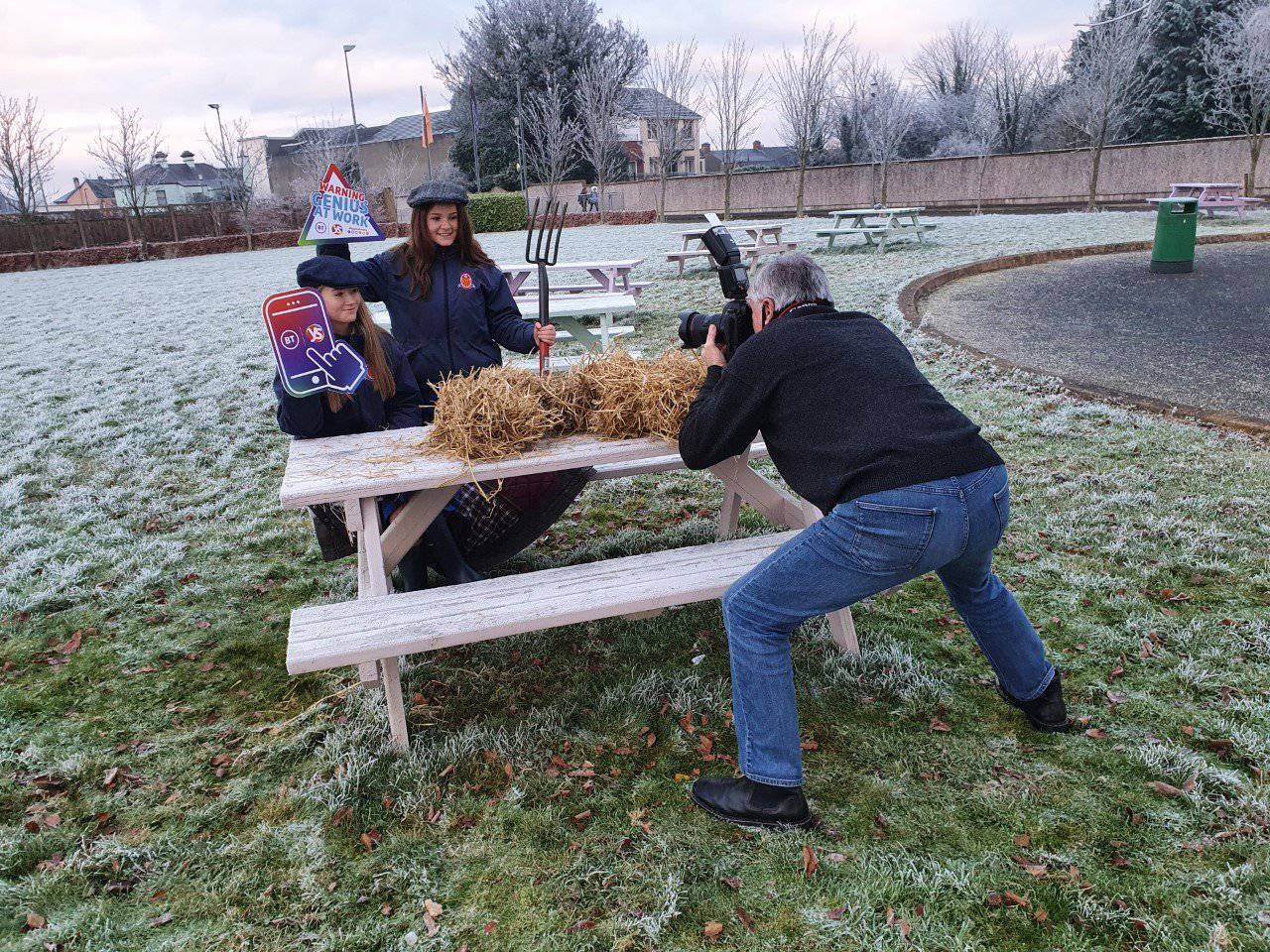
Young Scientists Claire Finnegan and Louise Crinion of St Joseph's Mercy Secondary School, Navan, Co Meath having their photograph taken. Their project investigated the best straw bedding choice for calves.
Co Cork students excelled in the BT Young Scientist & Technology Exhibition 2021, taking three of the top four awards.
They also won two of the three main awards for agriculture-related projects.
The Senior Individual and overall winner, Greg Tarr from Bandon Grammar School, built computer software for a more efficient and cost-effective way to detect fake videos, using artificial intelligence (teacher, Mrs Carena McCarthy).
The other two top award winners from Co Cork both came from students at Colaiste Treasa, Kanturk, Co Cork.
Jack Quirke was the overall individual runner-up award with his project investigating possible vegetable oil soil toxicity, using nematodes as environmental bioindicators (teacher Ms Joanne Corkery).
Isobel and Ava Hynes won the overall group runner-up award with their project to investigate elements informing young people’s attitudes towards Covid-19 (teacher Ms Joanne Corkery).
The overall best group award winner was one of the many agriculture-related projects in the exhibition.
Abby Mullins, Chloe Murphy and Megan Carroll from Moate Community School in Co Westmeath looked at developing a wool blanket which allows the timely and thorough removal of oil slicks following oil spills (teacher Ms Mairead Cusack).
From the Beara Community School in West Cork, Cathal O’Sullivan won the ABP Farm Safety category award.
Cathal’s teacher is Mr Dara Crowley.
In his project, Cathal designed a device that alerts users when they are too close to spinning machine parts, to help prevent them from accidentally coming into contact.
Annie Graham, Livestock Strategy Manager, ABP, said: “His innovative project embodies the spirit of this award, finding new solutions to make our farms safer”.
The award recognises projects that improve farm safety and educate young people about farm dangers, and is sponsored by the ABP Food Group for the seventh year.
ABP Food Group hosted a virtual stand at the exhibition, offering information on the Certified Irish Angus Schools Competition, an annual competition sponsored by ABP which provides students with hands-on farm-to-fork insight into modern beef production, which complements agricultural science course work.
Cian Walsh, a transition year student at St. Brogan’s College, Kilbrogan, Bandon, Co Cork, won the Teagasc award at the BT Young Scientist and Technology Exhibition.
Cian’s project looked at the social, economic and environmental benefits and drawbacks of growing hemp.
Cian’s teacher is Ms Laura O’Regan.
Cian explained: “100% of the hemp crop can be processed into many different eco-friendly products, some examples include hempcrete, hemp insulation, and hemp bioplastic”.
Cian surveyed farmers to determine current knowledge of hemp, and found that there was a great interest in the crop, but that only 36% of those surveyed would consider growing it.
He hosted a hemp information meeting on Zoom with the farmers surveyed, which included a presentation on hemp research in Ireland by Teagasc’s Energy & Rural Development Specialist Barry Caslin.
“At the end of the conference, I re-surveyed the farmers, and found a significant increase in interest in growing the crop [from 36% to 64%] if there were hemp processing facilities near their home farm,” said Cian.
The Teagasc special award is presented to the project that best demonstrates a thorough understanding of the science of agricultural or food production, or use of science to improve technologies available for agricultural or food production.
The Department of Agriculture, Food and the Marine award went to Elizabeth Bourke from St Mary’s College in Arklow for her “Nutrient recycling efficiency using bio-based organic fertilisers” project (teacher Ms Joanne English).
Elizabeth measured spring wheat crop yield and soil health benefits for chemical fertiliser and four types of bio-based fertiliser (lime-treated dairy sludge, cattle slurry, lime-treated pig slurry solids, and poultry manure. She found the best yields came from lime-treated pig slurry.
There were awards for many other agriculture-related projects in the exhibition.
The Environmental Protection Agency award went to Orlaith Ni Ghallchobhair, St Kevin’s Community College, Wicklow, for her project investigating if nettles can be the sustainable fast fashion solution.
The Eli Lilly award went to Aengus Price, Kinsale Community School, Co Cork, for his project investigating if casein-based plastics are a viable, sustainable and eco-friendly alternative to oil-based plastics.
There was a category group win for Áine Maxwell, Joyce Conway, and Laura Conlon of Moate Community School, Co Westmeath, for their milk spoilage prevention project.
A survey of plants with medicinal properties in local bogs was a category group winner for Orla Lyons, Lanesboro Community College, Co Longford.
There was a category runner-up award for Joseph Moran, Kildare Town Community School, investigating ash dieback and its impact on Irish biodiversity.
For Lauren Finan, Shana Brady, and Aine Broderick of Moate Community School, Co Westmeath, there was a category runner-up award for their investigation of the impact of diet on the prevalence of laminitis among Connemara ponies.
Epigenetics to help crops deal with climate change was the project that won a category runner-up award for Luke Fox-Whelan of Templeogue College, Dublin.
Do horses respond to human emotion? was the question posed by Aoife Giles, Megan Hegarty, and Tori Gallagher of Loreto Community School, Donegal, to win a category third place award.
For Fergal Keane, Ciarán Bonfil, and Fionn Doherty of St Joseph’s Community College, Kilkee, Co Clare, eco-friendly bale netting was their category runner-up project.
Decomposing rushes, the answer to heating homes? was the category third-placed project investigated by Jim Culhane and Paula-Eve Culhane of Tarbert Comprehensive School in Co Kerry.
Among the Highly Commended projects was “Vertical farming, the future of healthy schools”, investigated by Ali O’Donoghue and Eilís Mullane, St Brigid’s Secondary School, Killarney, Co Kerry.
There was a similar topic for Niamh McManus and Jess Joy of Loreto Secondary School, Balbriggan, Co Dublin, highly commended for investigating if vertical farming could be a more efficient method than conventional arable farming in Ireland.
“The future is bright: turning organic waste into biofuel” was the Highly Commended project of Annie Duffy, Leah Hallissy, and Ava Hallissy of Moate Community School, Co Westmeath.
Claire Finnegan and Louise Crinion, St. Joseph’s Secondary School, Navan, Co Meath, compared barley and wheat straw to see which is best for bedding calves, and were highly commended; as was Sarah Humphreys, Colaiste Treasa, Kanturk, Co Cork, who investigated the ability of different pasture swards to sequester carbon.
Why can some people consume goat’s milk but not cow’s milk? was the highly commended project of Zara Griffin, St Andrew’s College, Dublin.