Reform call as survey reveals income split
Drystock farmers have focused their attention on getting a better CAP reform deal, after the Teagasc Farm Survey for 2017 has revealed that CAP direct payments are marginally higher for dairy farmers, who the survey shows earning four to five times more than sheep and cattle farmers.
Patrick Kent, president of the Irish Cattle & Sheep Farmers’ Association, said the survey income figures have revealed where CAP supports need to be directed.
“The average per hectare income from dairying, at €1,530, is 4.75 times higher than sheep farming, at €322, and 4.2 times higher than cattle rearing, at €364.
“Beef finishing systems are slightly better, at €451 per hectare.
“So the post-2020 CAP is going to have to address this huge inequality, and more supports must be directed at low income sectors.”
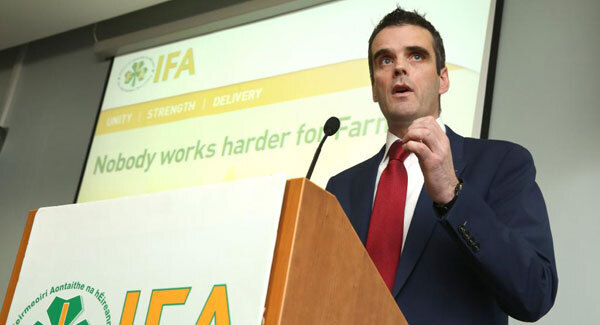
IFA President Joe Healy said the results highlighted the critical importance of CAP direct supports across all farming sectors.
“The low-income figures on the livestock, sheep and grain side, the sectors most dependent on direct payments, show that Minister Creed has to demand and insist on an increase in the CAP Budget, in the negotiations in Brussels,” added the IFA president.
He said the figures fully support the IFA campaign for additional targeted support of €200 for suckler cows, but noted also that extreme income volatility challenges dairy farmers
Calling for CAP payments to be re-jigged to target the low income sectors, Mr Kent said the average dairy farm derives 23% of income from direct payments, but the reliance on direct payments on beef farms is 93% of income.
“Worse still, on cattle rearing and sheep farms, direct payments equate to 113% of income.”
The survey also revealed a strong regional split in farming fortunes,
Average farm income in 2017 was highest in the South-East and South at €47,147 and €42,340, respectively, and lowest in the Border and West regions, at €17,547 and €17,895, respectively.
The strong regional influence of off-farm employment was also clear, with farmers in the South-West likely to be depending more on their agriculture earnings, because only 16% of them had an off-farm job.
In contrast, 30 to 40% of farmers surveyed in the Border, Midlands and West were employed off-farm in 2017.
The survey, based on a sample of 800 farms, represents 84,599 Irish farms.
See next week’s Farming for broader analysis of the Teagasc Farm Survey 2017 results.