Celebrating 175 years of Case IH, JI Case and International Harvester
Massey Ferguson, Zetor and John Deere have all celebrated anniversaries of one kind or another recently.
Case IH has beaten them all, commemorating not just 50 or 100 years, but their 175th anniversary, at their global headquarters in Racine, Wisconsin, USA.
It was there that founder Jerome Increase Case established the Racine Threshing Machine Works, to produce a then revolutionary machine to speed up the separation of grain after harvest.
In 1869, Case went on to manufacture the first steam engine tractor.
Although wheel-mounted, it was drawn by horses and used only to power other machines.
Then in 1876, Case built the first self-propelled traction steam engine.
As steam engines quickly replaced horses for threshing, the JI Case Threshing Machine Company became the world’s largest producer of steam engines, by 1886.
In 1902, five companies merged to form the International Harvester Company in Chicago, the deal being brokered, personally, by JP Morgan, the American banker who dominated corporate finance and industrial consolidation at the time.
The company produced its first combine harvester in 1915.
In 1923, it introduced the Farmall, the world’s first row-crop tractor.
Thus, International Harvester provided greater productivity, reliability and safety, in a revolutionary, unified system of tractors and implements for ploughing, cultivating and harvesting.
International Harvester sold more than five million Farmall tractors.
In 1972, the David Brown tractor operations in the UK were sold to Tenneco Inc of America, who then owned the JI Case company.
In 1977, International Harvester launched the unique single-rotor axial-flow rotary combine, which also revolutionised farming, with its simplicity, grain quality, grain savings, crop adaptability, matched capacity and high resale value.
Case IH was formed in 1985, when JI Case acquired the agricultural division of International Harvester, uniting the legacies of Case and IH in a single brand.
Its first product, the Magnum tractor range from 160 to 240 horse power, was introduced in 1987, and became the first tractor to win the Industrial Design Excellence Award.
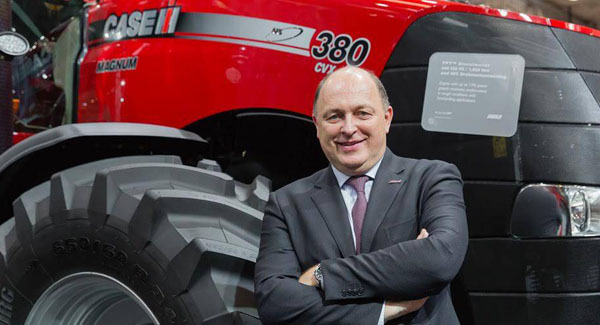
Now producing up to 380 horse power, the Magnum continues to be one of the most recognisable Case IH products, and more than 150,000 have been sold.
The Case IH Quadtrac tractor range, which was launched in 1996, also established a new benchmark.
It now includes one of the most powerful tractors in the world, the Steiger Quadtrac 620 with up to 692 horse power, delivering the greatest pulling power while implementing efficient, ground-conserving tillage and drilling concepts.
Last year, Case IH unveiled the Autonomous Tractor Concept.
Able to operate autonomously with a wide range of field implements, this ground-breaking concept is designed to make agriculture more efficient, economic and environmentally-friendly, at a time when finding skilled labour is becoming increasingly difficult for farmers in many parts of the world.
“The Case IH 175th anniversary is a testament to many years of quality, perseverance and progress,” said Case IH Brand President, Andreas Klauser.
“It’s also an occasion to reflect on our guiding principles of innovative engineering, efficient power and agronomic design, a philosophy that will continue into the future.
“I am certain that if Mr. Case could see the company today, he would instantly recognise that the core values which he championed all those years ago are still at the heart of everything we do.
“I have no doubt he would approve of the fact that we involve customers in every new range, model and product update, through our Customer Driven Product Design, but what he would think of the Autonomous Tractor Concept we can only guess.
“When I look at the enormous transformation which has taken place in agriculture over the last 175 years, it is very exciting to think about what might be achieved during the next 175 years.
“I am sure that will be discussed during our celebrations with customers, dealers and employees.”