New Zealanders come to aid one man Irish farms
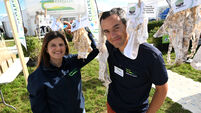
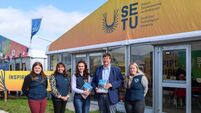
And the National Ploughing Association welcomed the New Zealanders, by signing a memorandum of understanding with the National Fieldays Society, organisers of the biggest agricultural show in New Zealand.
Exchange visits, and other co-operative programmes will emerge from the twinning of Europe’s biggest outdoor rural exhibition — the Ploughing — and the largest agricultural trade show in the southern hemisphere.
Meanwhile, Irish farmers took the opportunity at Tullamore last week to see how farmers on the other side of the world go about their business, by inspecting the range of products from New Zealand companies being launched in Ireland.
On the New Zealand Trade and Enterprise, they learned that New Zealand had the world’s first electric fencing for livestock, first refrigerated meat shipment, and first digital milk meter.
One of their exhibitors at Tullamore, LIC Automation, is one of the world’s largest farm automation and information companies.
Part of Livestock Improvement Corporation, a 100-year-old farmer co-op, they were in Ireland as part of their goal to expand globally towards €160 million in revenues.
They specialise in manufacturing integrated and innovative in-shed farm automation and sensor technology systems.
They say they are launching in Ireland to help dairy farmers here grow their herd size while remaining ’one-man’ operations.
Their Protrack farm automation, used on 1,700 New Zealand farms, is now available in Ireland under the Saber frand.
LIC Automation head of sales and marketing, Lester Deighton, revealed they will collaborate with Irish manufacturers, and they are already working with Carbery Plastics in Clonakilty, Co Cork, which is manufacturing the photo booth for the Saber heat detection system.
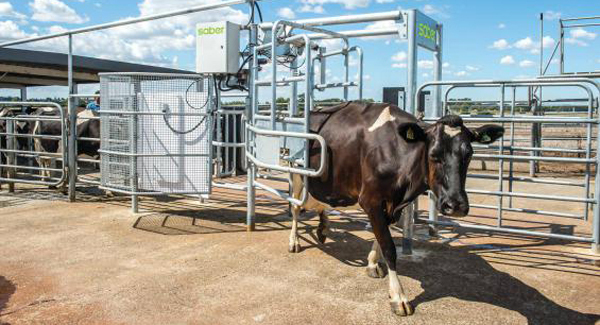
Cows walk through the in-race Saber photo booth set up in the farmyard, which takes a picture of the cow’s heat patch (LIC have their own patches, priced at €1.40 each), and evaluates the heat patch for signs of activation.
Cows deemed to have no activity can be drafted back to the paddock.
It is designed to reduce production losses through missed heats, while reducing the labour associated with manual heat detection.
If a patch is deemed activated or missing, the cow can be automatically drafted to a pen ready for the farmer to inspect her and put the cow aside for artificial insemination.
Cow heats can be automatically recorded on herd management computer systems.
In LIC tests, only one cow out of 56,000 was incorrectly drafted by the photo booth and automatic drafting.
According to Lester Deighton, it adds up to cost savings by enabling farmers to stop using bulls at the tail-end of the breeding season, and that could enable full return on investment in two or three years in a 150-cow herd.
Cows not coming in heat are also detected.
The special Ploughing price for this heat detection system with automatic drafting is €29,500, excluding VAT.
Saber has a range of farm automation modules.
They work best with the €3 EID ear buttons which more Irish farmers are now putting in their calves.
Also on sale here now is Saber drafting, automatically directing cows with EID through two-way or three-way gates, costing €11,000-13,000 (or remote controlled for cows without EID, costing €8,000-9,500).
One of the alerts available is missing cows.
They have automated drafting for all milking systems, working in the background, while the farmer gets on with milking.
Something more affordable for the dairy farmer is the Saber SCC Sensor, an in-line SCC test that provides a live SCC result within two minutes of starting milking the cow.
This mastitis early warning is priced at €1,250 per sensor, it can be connected to a flashing light alert if the SCC is high (€120), or a traffic light system (€200). Both of these suit a herd without cow EID.
Or a recording hub which connects to other Saber modules can be used (€3,500).
By putting a sensor with every second milking unit, on average each cow’s SCC can be measured once a day.