Veterinary advice: Loss of fluid most important thing to correct in the scouring calf
I have just come back from yet another case of a scouring calf.

Veterinary advice: Loss of fluid most important thing to correct in the scouring calf

The farmer was at his wits’ end, with new cases popping up almost every hour.

Scour test kits, catheters, drip and advice.

There are a lot of conflicting recommendations out there, be it from tradition or from the internet or from current research.

I will try to sort out the wood from the trees, and help clients manage their way through the spring without losses.

Scour is a watery faeces caused by a damaged gut or a poorly functioning gut.

This damage is always caused by infectious agents, most commonly viruses and parasites.

A calf on high volumes, and especially on ad-lib volumes, of milk may have softer stools, but this is not a scour that can get a calf sick.

For the vast majority of scours it is not possible to diagnose the infectious cause just by looking at it.

All the major causes of scour are very contagious.

The first thing to do is to remove the scouring calf from all in-contact calves, to a sick bay, to prevent further infection of the rest.

In the case of suckler calves, separate the calf and the dam from other calves and dams.

Disinfection procedures are obligatory.

A scouring calf loses large volumes of fluid through scour, and this is the single most important thing to correct in the scouring calf.

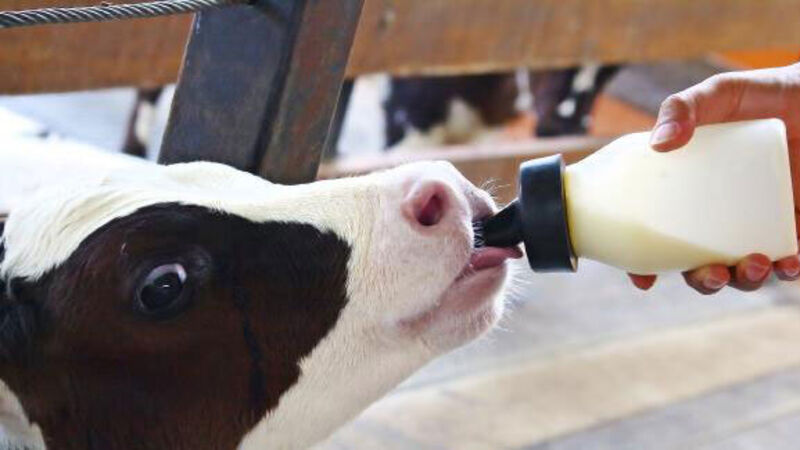
Rehydration powders mixed with two litres of warm water should be fed to all scouring calves, in addition to their milk feeds. Do not stop feeding milk to scouring calves, as there is no adequate nourishment in rehydration powders alone.

Milk will in fact help the gut to heal.

If, for example, a calf is taken off milk and fed rehydration powders only for three days, this calf does not only have to recover from a damaged gut, but must now also overcome three days of starvation, and will be malnourished.

This will reduce the survival rate of recovering scouring calves.

So what should we feed scouring calves, you ask?

Give them their full morning and evening milk feeds, and give at least one extra rehydration powder during the day.

If the calf comfortably takes another feed of electrolyte in the late evening, then give it.

Once a calf, even a calf with a scour, is bright, and drinking well, it does not need medicines other than rehydration.

In fact, antibiotic use should be avoided in healthy animals.

We need to keep antibiotics for only when we actually need them, and thus prevent resistance to antibiotics.

Antibiotics only work on bacteria.

As previously mentioned, the main causes of scour are viruses and parasites, and antibiotics are useless against them.

Antibiotics should therefore only be used when a calf is actually sick (slow to drink, slow to approach milk, ears down, temperature, etc), as this calf may be septic with secondary bacterial infections.

Again, rehydration is more important than any injection.

If the calf stops drinking, contact your vet, as now the calf is at serious risk of dehydration and even death, and may require a drip and additional treatments.

As with everything in my job, prevention is always better than cure.

Hygiene at calving; taking the calf off the cow promptly after calving; colostrum management; adequate nutrition of at least 13-15% body weight per day of milk or high quality milk replacer (22-26% whey derived protein) for the following feeds, are all very important.

In the case of a 50 kg calf, 13-15% means 6.5 to 7.5 litres of milk divided in two feeds.

If there are multiple calf scour cases on the farm, contact your vet, as additional preventions may be necessary for this year or next year, but these shall be discussed in detail in other articles.

More in this section

Farming

Newsletter

Keep up-to-date with all the latest developments in Farming with our weekly newsletter.

Cookie Policy Privacy Policy Brand Safety FAQ Help Contact Us Terms and Conditions

© Examiner Echo Group Limited