Re-purposed tools are a help to small farms
And while the smaller scale of this kind of enterprise is attractive to the urban consumer as an idea, in practice it can be difficult to make ends meet.
While it is possible, especially through horticulture, to make a living on a small acreage, it’s difficult to make a very good living.
With the Organic Farming Scheme, there are specific supports for the purchase of new equipment. But this kit has to be new, to qualify.
There are a couple of ironies here. The grant only part-covers the kit, leaving it at a remarkably similar price to second-hand equipment. And if the farmer fundamentally dislikes the mega-waste of our general disposable, build-in-obsolescence society, why not try to make the best of what’s already made and out there?
How can smaller-scale food producers make their business more efficient and more cost-effective, while retaining the idea of reuse, or, more aptly, re-purposing, as the more ecologically sound way to function?
One such method is by getting involved in what is called Farm Hack. Farm Hack is described as “a worldwide community of farmers that build and modify our own tools. We share our hacks online and at meet-ups, because we become better farmers when we work together.”
In other words, these farmers make what theyneed. And they make the plans available to others, for free, who add to or take away from the design as required.
Farm Hack is a “wikipedia” for the farm tools of smaller-scale production, a copyright-free way to collaborate and generate the best form the hive mind.
Of course farmers have always constructed some of their requirements, using the skills of the carpenter, the welder and engineer, and whatever else is needed. Necessity has bred ingenuity through the ages. Farm Hack brings this practice into the 21st Century.
Farm Hack was founded in the US in 2010 by a group called the Greenhorns, a very tech-savvy and well networked development organisation, hosting meet-ups.
The principles of open source technology are what Farm Hack is founded on: this means that tools and techniques are shared and developed on the farmhack.net online forum.
Indeed, the Farm Hack website itself is built in an open and collaborative way.
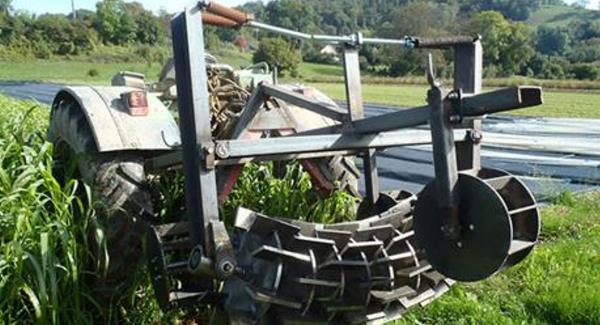
Tools, planting, energy, water, harvest and fencing are among the most popular categories. Here are some examples of the kinds of things on Farm Hack.
Culticycle: A pedalpowered tractor for cultivation and seeding, built from readily available lawn tractor, ATV, and bicycle parts.
Low cost pedalpower root-washer: this should be easily constructed on the farm, suitable for carrots, potatoes and other root vegetables.
Cover crop roller: jused to roll standing annual cover crops, crimping the stem to prevent regrowth and create a heavy mulch.
Triangle quick-attach to three-point hitch: enables faster and safer changing of implements than a standard three-point hitch. The design also enables use of a standard three-point hitch if the tractor side of the quick attach system is not installed.
Livestock weigh scales: make your own accurate electronic weighing scales for less than €450.
Waterer for rotational grazing: easy-to-move, low-cost watering system that reduces issues with fixed watering locations.
For small, mixed farms, these solutions and the way they are developed, in collaboration without copyright, could signal a way to embrace cutting-edge and yet very cobbled together technology.
Very 21st Century!