Denise Hall: Women take their place on GAA pitch
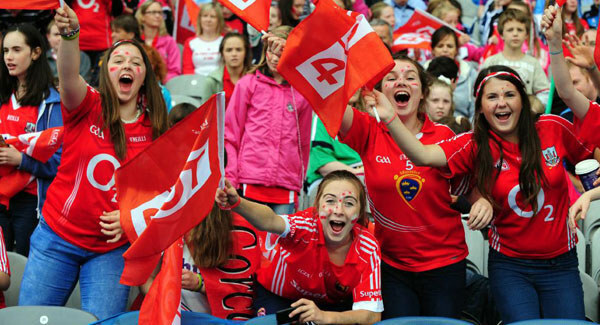
When Michael Cusack and Maurice Davin set up the GAA in 1884 in Thurles, Co Tipperary, they saw no place for women in the new association, except as spectators whose principal function was to cheer on the men.
Since those early days, the role of women in sport has changed dramatically.
Women’s role in sports has had a long and difficult road to travel to gain any semblance of parity, and not just with the GAA.
In the UK, 100 years ago, women’s football was frequently attracting much larger crowds than men’s games were. On St Stephen’s Day in 1920, the famous Dick Kerr’s ladies team drew 53,000 fans for their match against St Helen’s ladies. Thousands more were outside the gates.
Then, just as women’s football looked as if it were about to become a permanent fixture of English sport, the Football Association announced it was going to bar women’s matches from all FA-run grounds.
The FA justified this by saying, “Complaints having been made as to football being played by women, the council feel impelled to express their strong opinion that the game of football is quite unsuitable for females, and ought not to be encouraged.”
Despite opposition, the ban went ahead, and wasn’t lifted for a further 50 years.
By 2004, when we could have been forgiven for thinking that matters had improved, and emancipation of women in all areas was a given, Sepp Blatter suggested that women footballers should “wear tighter shorts and low- cut shirts, to create a more female aesthetic, and attract more male fans”.
The late 19th century saw a revolution in sport, not just in Ireland, but all over the world. Games were transformed into organised sports, with written rules and administrative bodies. These sporting bodies were set up by men for men.
In 1903, a ladies hurling team known as Keatings was set up in Dublin by Maire Ní Chinnéide. 1904 saw the formation of another club, known as Cu Chulainn’s.
The formation of these two clubs led to the first recorded public game of camogie. At the time, it was seen as unacceptable for women to wear short skirts, shorts or even trousers, and so they were confined to restrictive clothing in the form of a blouse, and a long heavy skirt which covered the ankles. One special rule drawn up for camogie was that women were not allowed to use their skirts to stop the sliotar.
During the 1960s, women began playing Gaelic football, and by the early 70s, the demand was sufficient to establish an association for ladies football. In 1974, a group met in Hayes’s Hotel in Thurles and established the Ladies Gaelic Football Association.
The rules of football were modified, and an all-Ireland championship was set up.
As for what the recently formed Women’s Gaelic Players Association needs to address, it is fair to say they have their work cut out for them.
A 2014 survey of 600 players showed 7% get travelling expenses for training, only a third have access to regular hot showers afterwards, and 63% were short on savings due to county commitments, sometimes due to injury.
But Dublin Ladies All-Star Lyndsey Davey believes that changes are on the way:
“Over time the gap is starting to close, and female sports are getting increased media coverage. This has been helped by the success of Katie Taylor and the ladies Irish rugby team. Stephanie Roche being shortlisted for Goal of the Year is a massive boost to Irish female athletes.
“It was brilliant when AIG announced their sponsorship of all Dublin teams, including the ladies, as this has gone a long way in helping to close the gap.
“Today the games have never been so popular, with 515 camogie clubs and 1,100 ladies football clubs around the country and abroad,” she says.
Many pioneers of women’s sport in Ireland were ridiculed. However, these women paved the way for thousands of Irish girls and women to play Gaelic games today.
They are as dedicated and determined as those women who dared to fight for their right to play sports over 100 years ago.
Rosscarbery Women’s Football Club is one such organisation and since its inception in 1999, it has become the second largest club in the county.
Chairman Adrian Roycroft told me about their growth.
A few women were approached to see if they would be interested in setting up a club. We started off with U10s and U14s, and the club quickly grew.
We entered our first adult team in 2004 and became the fourth biggest club in Cork. Like many others, we’ve been hard hit by emigration, but we have kept our numbers up.
That’s because we have a great group of people committed to the sport. The club is very important to the community. We have to raise all our own funding.
We have a fashion show every year and a sponsored walk and other events which the community organises.
You know, ladies football is more expensive. It costs more to register with the County Board, €70 for girls and only €18 for boys.
But if our girls and women are not registered, then of course, they are not insured. And to an extent, the success of men’s clubs has overshadowed that of the girls and women. The women don’t get the same profile.
I’m the father of three daughters and I grew up here playing football. My whole family is involved. My youngest, who is five, loves to come to practices and the other parents are very good. They are very supportive.
We tend to see the same group of people at matches and practices. There’s a big social aspect, very important in a rural area like this. It’s a great opportunity for parishes to get together.
Parents can meet up at matches and the younger members can meet children from different schools. In West Cork, you are miles from anywhere.
And that can be hard for young ones who don’t have transport of their own. On Saturday morning, it’s an outlet to get out, meet your friend at practice, no matter the weather.
This is my first year on the committee so things are busy. But you know, I consider myself to be very lucky. I have a job and a great family. Most of all, I love what I do and I want to make sure that there’s a great club here for all the children of the future.”