Denise Hall: Ancient iron craft alive and thriving in West Cork
Not only was he the local toolmaker and engineer, he was sometimes called upon to act as doctor, dentist, undertaker, veterinary surgeon and horse dealer. Many other professions sprouted up under the umbrella of blacksmithing.
My first encounter with a blacksmith was with a legendary figure in the West Cork area, Kealkil man Eugie O’Sullivan, who has sadly passed away.
I had a heavy horse whose feet needed attention and was looking for someone who still practised the art of hot-shoeing. A friend told me about Eugie,a craftsman of the old school.
I was taken aback when he began loading a small hibachi grill into the back of my car, along with a collection of tools, anvils and aprons. All was revealed when we got back to my place and Eugie fired up the grill.
We weren’t about to enjoy an impromptu barbeque. Eugie had found a unique and creative way to continue hot-shoeing and a couple of hours later, the horse was resplendent in four gleaming new shoes.
Blacksmithing has been around since about 1,500 BC and began in what is now known as Syria. It started during the Iron Age with crude stone tools used to work the metal after it was heated, probably while gathered round the campfire.
As the Iron Age progressed, the smith was held in increasingly high regard and could rise to high positions in the social hierarchy.
But it wasn’t always good news. Sometimes smiths became associated with the black arts since most people had very little idea of what went on in the darkness of the smithy associated as it was with gods such as Vulcan.
So violent was this backlash in the middle ages that anyone caught practising smithying could be put to death.
Nevertheless, blacksmithing was called the king of trades because of the smith’s ability to create his own tools. And in ancient Wales he enjoyed a place of honour in the prince’s court alongside the priest and the poet.
It took many years for blacksmiths to discover the magnetic properties of iron, but after they did, compasses were created and a brave new era in exploration was made possible.
The advances in iron production that were made in the late 1700s marked the start of what became known as the Industrial Revolution.
Without the blacksmith the parts to create the machinery in the factories would never have been created. Strange to imagine that prior to the 1800’s, fortunes were made on nails which were so precious that people sometimes burned down barns and houses to sift them from the ashes.
The blacksmith was a symbol of hard work and the mastery of the elements.
And although the smithy can no longer be found in the middle of every village, many blacksmiths have survived and while shoeing is left to the farriers, their work has often become artistic and highly creative.
For 30 years, Cronin’s Forge in Durrus has produced some of the most distinctive, hand crafted iron work in Ireland, using traditional techniques, counting Graham Norton and Ronan O’Gara amongst their clients.
Carmel Cronin’s son Brian is a fourth generation master smith and she told me about the forge’s evolution.
My husband Kevin learned from his grandfather who was a smith. Kevin had a garage but he had always had a flair for metalwork. It was in his blood and he decided to convert the garage into a forge.
It was his dream and he had it up and running but then he died. My two sons and I had a difficult decision to make.
Should we keep going or give up? We decided we were going to give it a go and realise Kevin’s dream. We started with just a few new designs and things were going ok.
Then my son Ciarán was killed, which was another terrible blow. But we kept going somehow.
It’s a gift and Brian definitely has it. He used to help his father. Now we have a body of existing customers who are collectors and we export our designs to the US and Australia but it’s been a struggle.
Brian’s designs reflect the landscape, history and tradition of West Cork, as well as the Celtic influences his father loved. Our visitors to the forge like to meet Brian and see him at work.
There’s a great fascination with the process. We had a coachload of visitors from Poland recently, including the Polish ambassador and they really enjoyed the experience. Our other smith Martin is from Poland so it was quite a get-together.
Yes, it’s now The Forge and Craft Shop. The pieces are chosen to complement items in the forge’s own collection and they have the same commitment to care and design.
We’re very lucky to be surrounded with so many talented artists in this area, people like Mari Stone, whose exquisite porcelain in shown alongside glasswork from Trish Goodbody.
There is also a range of cushions and soft furnishings that work brilliantly with the ironwork on display. We’re hoping that as more visitors head our way to enjoy our fantastic scenery that they’ll enjoy discovering some of the craft pieces that our landscape inspires.
We have regular meetings to decide. You might have an idea but it might not be practical to make.
And we do quite a few items on special commission, so we like to keep on top of them, how they are developing.
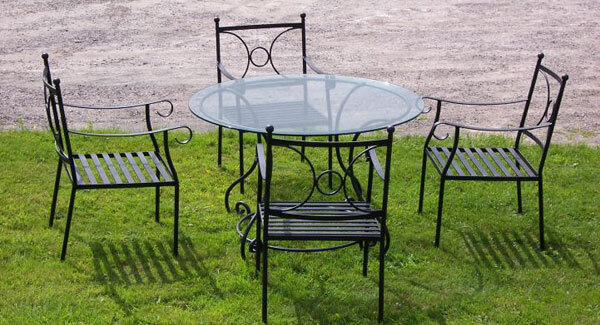
Railings, gates, fire grates with animal heads, garden furniture, we make them all.
We also provide parking, a picnic area and a warm welcome, and smaller items that people can easily take home with them.
We’re very happy with the way things are going and we’re happy to have been chosen by Bord Fáilte this year and to have been picked by the Craft Studio Experiences as one of the best places to visit.”