Average farm income up 6%... but this is not a pretty picture
hat’s the summary of Teagasc’s National Farm Survey of 80,000 farms (it does not very small farms, nor farms with pigs, poultry, horses, horticulture).
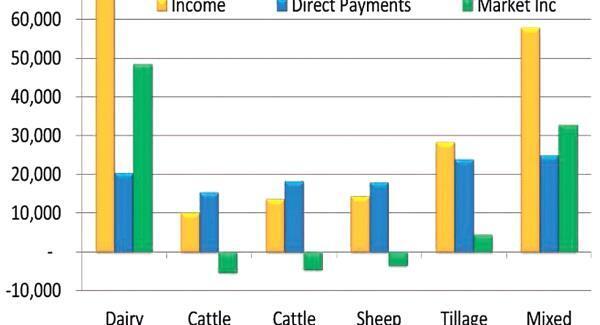
Ireland’s 15,700 dairy farmers had an average family income from dairying of almost €69,000 in 2014, an increase of 9% on 2013, and the highest level ever. Despite quotas, milk supplies were up 3%, while costs, particularly for feeding, were down.
The story is very different on 15,700 farms (again) engaged predominantly in suckler beef production. These farms yielded an average income of only €10,300, up 8% from 2013.
The 26,000 survey farms predominantly involved in cattle fattening had average income of just €13,800, down 12% on 2013, largely attributable to a decline in beef prices.
There are 12,200 sheep farms with average 2014 income of €14,600, a 24% increase from 2013, which was a particularly bad year for them.
There are 6,800 tillage farms, with an average income of €28,500. There are also 2,800 farms with both a large dairy and a cattle enterprise, which achieved an average income level of €57,900.
Income per hectare on a dairy enterprise was €1,252, while on a tillage farm it was €490 but only €263 on a suckler farm, €265 on a sheep farm and €345 on a cattle fattening farm. Income per hectare varies from €770 in the South- East, and €718 in Cork and Kerry to €371 in the border counties and €400 in the western region.
These income figures include the various Common Agricultural Policy subsidies — which exceeded the income achieved on cattle and sheep farms. In other words without the subsidy, these farms would not have generated any income.
The figures do not include income earned by farmers or their family members by working off their own farm. Not surprisingly, given the low incomes achieved on cattle and sheep farms, 29% of these farmers have off-farm employment. This figure is 44% in western counties. (When assessing these figures, you should bear in mind the proportion of famers who are of pensionable age and not available to work in the broader labour force).
The income survey data can be looked at in two ways. It is good news that the average farm income is up, by 6%. But this is not a pretty picture. Agriculture is a “major national resource”, and a sector with supposed comparative advantage. Plans for economic recovery are partly based on its development. Yet, most of the 54,000 farms engaged in cattle and sheep production cannot produce an acceptable income. And most of their unacceptable income is EU subsidies. And this is not new.
Now that the chains are off the profitable dairy sector, it is reasonable to ask why so much of our agricultural efforts are concentrated in sectors which provide consistently so little return. Should more of our valuable land resources not now be converted to dairy?
What are the reasons for such a poor return from cattle and sheep? Is it to do with the structure of the meat processing and marketing industry, which fails to give a fairer return to farmers?
Is it to do with the structure of the farming sector itself, with too many holdings and insufficient scale? Is it to do with the skills of an aging labour force, which has chosen these less arduous enterprises?
The average age of farmers is 57, (dairy farmers 53, cattle finishers and sheep farmers 59). Clearly, a high proportion of cattle and sheep farms are operated by people of pensionable age, who may lack the skills and energy needed to maximise the potential of our climate and soil, while for many others, farming is a part-time occupation, subsidiary to their other job.
Yet, unlike other enterprises — such as pubs or shops — management does not pass to a new generation, because of the Irish family link with the land. A national institution, Aer Lingus now in its third generation, is coming under new ownership.
In recent years courses in agriculture have become quite popular with the young. A major issue is how these enthusiastic and skilled young people are to get access to land. Only 0.4% of the land area comes on the market in any one year. That means any particular piece of land only changes hands every 250 years. It’s no wonder it’s so difficult for young ambitious farmers to get land.