Don’t buy any old bull; check figures
A pedigree stock bull is a substantial investment. For many, it is something they have to buy only once every five or six years.
The bull chosen will have a huge influence on your suckler herd’s performance for many years. The purchase therefore deserves to be given time and effort.
Pearse Kelly, drystock specialist in the Teagasc Animal and Grassland Research and Innovation Programme, gave the following advice in the March-April edition of the Today’s Farm magazine for Teagasc clients.
The days of buying a bull based on his looks and what the seller tells you about his ancestry are long gone.
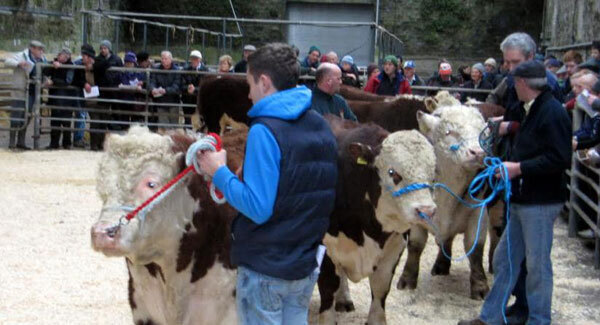
The Irish Cattle Breeding Federation (ICBF) publishes breeding values on every pedigree bull born in the country. Use these figures (and the stars that go with them) to help make up your mind when comparing bulls. Go to bull sales where there are published indices available on the animals. Catalogues are usually available to download from the web before these sales, or you can ask the breed society to post one to you before the sale. If you are buying a bull privately, only deal with breeders who can give you all the relevant figures.
Many farmers now buy bulls they see advertised on websites such as DoneDeal. When you ring to discuss the bull, ask for the full ear tag number and enter this into the ICBF bull search facility on the www.icbf.com website.
This will give you all of the breeding values on that bull along with his ancestry.
It might save you a journey if they do not match your requirements.
Suckler farmers who have no interest in keeping replacement heifers out of a particular bull should focus on what the terminal index values are for the bulls they are looking at. High terminal index bulls (those with four and five stars) are more likely to produce calves with above average daily gains, have better conformation than the breed average, and have higher feed efficiency. These three traits make up 71% of the index. Difficult calving bulls are heavily penalised on this index.
The majority of suckler farmers, however, would like the option of keeping some replacements from a bull they have purchased. The replacement index should then be your index of choice, rather than the terminal index. It identifies bulls that have the potential to produce breeding heifers with both good maternal traits and good beef traits.
A word of warning though – bulls with high star ratings for the replacement index can get this from their maternal traits, from their beefing traits, or from a combination of both.
A bull with five stars for the replacement index can also rank poorly on the maternal traits of milk and fertility.
It is important to take note of the key profit traits in conjunction with the overall figure.
Looking at the overall index values is not enough. You also need to look at the key profit traits, before you make any decision. Some traits may be more important to you than others. For example, the key profit trait for calving difficulty estimates how hard it will be to calve a bull’s own progeny.
Mature suckler cows calving in a fit condition should not have a great amount of difficulty when bred to bulls with estimated calving difficulty figures of up to 8%.
However, maiden heifers should not be bred to bulls with estimated calving difficulty figures above 4%.
For some farmers, these figures may be even too high, and they will aim for bulls with lower figures, to reduce the risk even further.
If you are trying to improve fertility among your replacement heifers, the key profit trait for daughter calving interval should be negative — that is, daughters from this bull are likely to reduce the average calving interval of your herd.
Similarly, if milk is important in your heifers, you should pay close attention to the key profit trait for daughter milk — it should be positive, and the higher the better.
No breeding index in the world is 100% accurate.
They are only a prediction of how a bull will perform, and like all predictions, they can sometimes be wrong.
Farmers over the years have given examples of buying a bull that is five stars for an index on the day of purchase, and a couple of years later, that bull had only one star, due to his performance being much lower than predicted.
All of the indices and key profit traits have reliability figures published beside them.
The higher this figure is, the less likely that a bull’s breeding values will change considerably over time (the range is from 1% to 100%).
The more data that is available on a bull, the more reliable his star rating will be (the higher his reliability figure).
Stock bulls that have been weight recorded and or linear scored will have more reliable star ratings.
If they are bred from bulls and cows with high reliability figures, their own figures will be more reliable. Where the reliability figures are low for a young bull, check the indices of his sore and maternal grand-sire, as these can also give a good indication of a bull’s potential.
The star rating published for a bull helps to narrow your selection when choosing a bull, but his pedigree and physical appearance are also important.
His own physical build should match what the figures are saying about him.
Examine the size of his scrotum and testicles to ensure they are the correct size for his age. Inspect his legs and feet, and avoid sickled/swollen hocks, or other funcionality problems that could affect him.
Assess his body condition to ensure that he is fit and ready for a busy breeding season.
Young bulls will not be able to run with many cows in their first year, and they should if at all possible be broken in slowly.
Ask the seller what diet he has been on, and what he should be fed on for the first month on your farm, to adjust his diet slowly.