The nuts and bolts of how agri environment scheme GLAS works
The new Common Agricultural Policy is heavy going â as farmers have been finding out at 14 Department of Agriculture information meetings around the country.
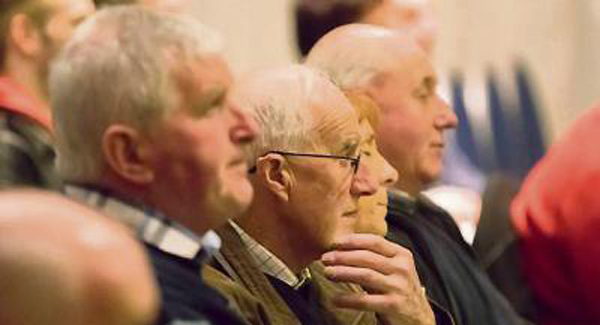
However, what struck me at one of the meetings last week in Castlebar, Co Mayo, was the small attendance.
Either farmers reckon they know the new schemes and donât need more information â or feared they would be even more confused after attending.
The agri environment scheme GLAS was outlined in great detail at Castlebar, and meeting chairman Liam Fahey said at the outset that the department âwants everyone, where possible, to joinâ.
Patricia Kelly from the departmentâs office in Johnstown Castle outlined the tiered system for entry. She advised farmers to ensure their GLAS adviser is on the approved list which is on the departmentâs website.
She said when advisers submit herd or flock numbers into the system, it will tell them if the farmer qualifies for entry under Tier 1. The system will also identify vulnerable water sites, for entry under Tier 2a.
Farmers donât have to apply for GLAS+, the department will automatically give access to this higher paying version for those who meet the criteria. Ms Kelly also stated that actions from Tier 3 can be chosen by those in Tiers 1 and 2, to bring up their payment. Farmers were also reminded that GLAS is not a whole-farm scheme, and afforestation can be taken on part of the farm.
On commonages, Ms Kelly said that one adviser is required for each commonage. She also said the departmentâs âCommonage Containerâ, which is available on the departmentâs website, gives information about commonage lands. This will be useful for farmers wishing to join the scheme, and for advisers who wish to prepare commonage and farm management plans.
The âcontainerâ gives information on the commonage identifier, which is a unique number assigned by the department to identify the legal entity that is the commonage which may cover more than one LPIS parcel.
The amalgamation of these parcels into commonages was carried out by the department in an automated fashion, primarily based on the proximity of parcels to one another within a townland.
This may have incorrectly resulted in parcels being considered to be part of a single commonage â so care should be taken when reviewing the LPIS parcels that make up the commonage, to ensure that it reflects the correct position on the ground.
If there are any errors in this, Patricia Kelly advised commonage owners to contact the Commonage Section of the department, by email to commonages@agriculture.gov.ie or at Lo Call 076 106 4448.
The âcontainerâ also gives details on the size of the commonages; âYâ is shown for those commonages greater than 10 digitised hectares, and âNâ is shown for those less than or equal to 10 digitised hectares.
The GLAS commonage area is also shown, which is the area eligible for payment under the scheme, and is based on the reference area, plus certain areas of agri-environmental value such as bog, habitat, marsh, rough grazing and scrub. If it appears as zero, it means that the department is currently working on establishing the area, and it will soon be updated.
Ms Kelly noted that a farmer with more than 0.25 hectares on a small commonage (less than or equal to 10ha) must have an individual commonage farm plan drawn up by his/her advisor.
A farmer on a commonage greater than 10 hectares must be part of a commonage management plan. This will be drawn up by a GLAS commonage adviser and will cover all farmers on the commonage who wish to join GLAS.
The department has a guidance document on the âcommonage containerâ available on their website, in the GLAS section.
David Buckley of the GLAS division outlined all the actions that farmers can take. He noted a few key dates: a nutrient management plan must be in place by December 31, 2016; and farm training must be completed by December 31, 2017 (a six-hour course). March 31, 2016 is the date for many of the capital actions to be carried out.
Mr Buckley pointed out some key points of some of the GLAS actions. Firstly, âthe reference area of the plan canât decrease over the course of the plan.â
Referring to the farmland birds action, Buckley said, â11,000 to 11,500 farmers have rare birds on their holdingsâ. He said that the grey partridge action would be most relevant to farmers in north county Dublin and Offaly, while the twite actions would be most relevant to Mayo and Donegal.
For the low input permanent pasture action, selected LPIS parcels must not have been cultivated in the last eight years, and must have been declared as forage on the SPS for the previous eight years.
For the planting new hedgerows option, Mr Buckley said that only whitethorn, blackthorn and holly are permitted.
Where the rare breed action is selected, a maximum of 10 livestock units applies.
When fencing riparian margins, access must be available for machinery, and no livestock are allowed on the margins.
Traditional stone walls must be maintained from the start of the contract, and a maximum of 4,000m applies, Mr Buckley advised.
Where coppicing hedgerows is selected, gaps that appear after the coppicing must be filled. Mr Buckley also stated that boundary hedges are not eligible unless the external farm boundary adjoins a public road, a private laneway, or a watercourse or water body. You must have control of both sides of the hedgerow being coppiced, for ongoing maintenance.
Mr Buckley highlighted some of the common mistakes that occurred in previous environmental schemes, which farmers should try to avoid in GLAS.
He advised farmers to choose more than the minimum length/area for the various actions; make sure actions are undertaken in the correct field as identified on the plan; and make sure actions are carried out fully.
Riparian margins, arable grass margins etc, must be carried out along the full length of the LPIS parcel, and you must stay with whatever Tier you entered through, for the extent of the scheme.