Cormac MacConnell: We’re being fleeced by ‘modern’ milk
The Tulla man stuck me to my stool, when he said a modern litre of supermarket milk (with extra vitamins added) contains elements that, instead of coming from a cow, actually come from a sheep!
I cannot guarantee that this assertion is true or false, but I am passing it on, for what it is worth.
The conversation at the bar — we both were drinking liquids stronger than milk — started when both of us, who are from different provinces, were recalling our youthful ability to milk cows by hand.
He was born and bred on a four-cow farm, and was quite impressed that my boyhood farmer neighbour taught me how to hand-milk his lovely dainty Ayrshires, when I was about 11 years old, and his helper had been laid low by a bout of pleurisy.
Long as I live, I will always remember that milking process.
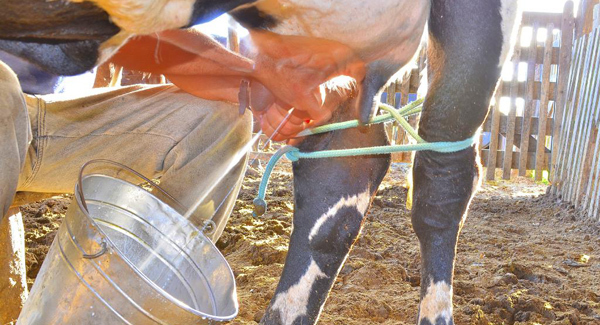
My young forehead was against the cow’s warm flank, as she stood in her byre stall. He had tied her tail to her hind leg before I had begun, so I would not be knocked off my three-legged stool by any of the chunks of dried dung adhering to her tail, and, after a while, she relaxed and released her warm streams of rich milk to my hopeful hands.
I will also always remember the ‘stranjstranj’ sound of those first jets of milk striking the bottom of the metal bucket between my legs.
And the satisfaction of pouring my first buckets of milk into the strainer fixed into the top of the aluminium can, the gauze slowly sieving the morning milk.
Then, on to the next, patient cow, feeling like a professional milker already.
And from there, the Tulla man and myself remembered the days when milk would go sour within what seemed mere hours, unless you took precautions.
Both of us remembered creamery cans full of milk being stood for cooling in ponds and rivers, until they were collected by the milk lorry from the roadside stands.
And both of us remembered the churning in the kitchen, when you took your turn at the wooden-handled dash, which miraculously converted the cream into butter. We walked down memory lane, and it was both nostalgic and pleasant.
What was not at all pleasant, however, was what happened after I said I was concerned, more than slightly, about the extraordinary shelf- life today of the typical supermarket litre of milk.
It does not seem to ‘turn’ or sour any more in the carton, I said, and even allowing for refrigeration, this was remarkable. Even a bit worrisome.
And it was then the Tulla man claimed that a product obtained from the fleeces of mountain sheep is routinely being added to supermarket milk nowadays, and one of the consequences is a longer shelf life!
He said I should have noticed that there are about 100 different species of milk sold in shops, nowadays.
There is organic milk and super-milk, and milk reinforced by inputs of one kind or another.
Once upon a time, he said, we were simply informed that the retail milk in the bottle or carton was pasteurised.
That day, he said, is long gone. Now we are told that a wide range of vitamins have been infused into the milk, before it reaches us. And it was immediately after that the Tulla man nearly knocked me off my stool, by suggesting that some elements of what is in my morning glass of milk come from a sheep rather than from a cow.
And that is the pure truth, as I heard it.
He claimed that one of the most common sources of the Vitamin D that is commonly used to reinforce our retailed milk is... believe it or not... the fleeces of sheep. It was his point that one of the sources for the Vitamin D infusions is lanolin, extracted from the shorn fleeces of sheep.
“That stuff, Cormac,” he said,” is the natural oil in the fleeces that all our mothers had to wash out of the Aran sweaters they knitted us for our birthdays and for Christmas. That is the truth of it, for sure.”
I am still shocked to the core. I have not downed a glass of milk for the last three days.
I have not checked out his allegation, but I am certain that some amongst you lot, being more informed than I, know whether or not there is any substance to his claim.
For my own part, I am even more concerned now that my carton of milk, unlike the lovely, rich raw milk of my childhood, has such an incredibly long shelf life. Is that fundamentally a good or bad thing?
I don’t know the answer to that one.