Farm joy at letter from America
A letter from America was always eagerly awaited in homes across rural Ireland during much of the last century.
That was because it invariably included dollars from family members who had emigrated to find a new life for themselves in the land of opportunity that was the United States.
Those much-appreciated dollar bills helped those at home to cope with the difficulties arising from small wages, a scarcity of jobs and poor prices for cattle and other produce of the land. Rural society with farming at its core has dramatically changed since those depressing economic times, but the reality of a long-awaited letter from America has not entirely disappeared.
It arose again in a most public way during the past few weeks.
This time it was not from Irish emigrants, but it still brought good tidings for the country’s €2.2bn beef export industry.
The letter came from the Food Safety and Inspection Service of the United States Department of Agriculture in Washington, and it was signed by Alfred Almanza, acting administrator.
It had been awaited with the same eager anticipation as the letters from America that postmen delivered to households countrywide long ago.
The letter, addressed to Martin Blake, chief veterinary officer, Department of Agriculture, Food and the Marine in Kildare Street, Dublin, didn’t contain any dollar bills but what it stated was potentially more valuable to the country’s beef sector.
It confirmed that the US market for Irish beef had been re-opened after a long hiatus, a development that led to Minister Simon Coveney predicting it could be worth at least €50m to €100m to the sector this year.
The US banned the import of beef from the European Union due to fears over BSE 15 years ago and only lifted it last March.
Ireland has now become the first EU state to secure access to the huge US market for beef, following an intensive campaign by the minister and his team.
The Food Safety and Inspection Service (FSIS) of the USDA conducted an on-site audit of Ireland’s beef slaughter inspection system last July and furnished a report, leading to Washington’s decision.
It concluded that “Ireland has consistently and effectively implemented a beef slaughter inspection system that satisfies all criteria for equivalence with the FSIS meat inspection system. Accordingly, Ireland is now eligible to resume shipment of beef carcasses to the United States”.
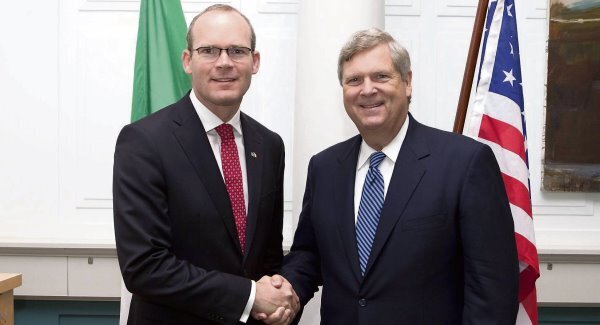
Mr Coveney, who had raised the matter with US Secretary of State for Agriculture Tom Vilsack, welcomed the decision, along with beef producers and processors. He said the US announcement was a huge endorsement of Irish beef and the country’s production and regulatory systems. Mr Coveney said the large Irish-American community will be a key target of promotional efforts.
“My department and Bord Bia have been planning for this announcement for some time now and will announce a number of initiatives in the coming weeks including a dedicated website aimed at American consumers and buyers highlighting the quality of Irish beef,” he said.
Mr Coveney said Irish beef will be marketed in the niche “green beef” sector in the US, because it is grass-fed and free from hormones.
EU Agriculture Commissioner Phil Hogan said the value of the US beef market to Irish agriculture cannot be understated.
“With the euro at a nine-year low against the dollar and with grass fed beef already enjoying a premium in all cuts, the possibilities for growing exports and revenues are enormous.
“The US is an 11 million beef tonne market, so Ireland will be first out in securing market share in the high-value market segments.
“With our cultural links to the US, it is not hard to dream up an alluring marketing campaign to attract the 40 million Irish Americans, and more besides, back to eating Irish beef,” he said.
Bord Bia described the re-opening of the US market as a significant opportunity.
With the US cattle herd contracting, the market seems set to remain tightly supplied for some time. This is leading to a situation where US steer prices are currently 25% higher than European prices compared to the historical position of being 15% to 20% lower.
“These developments present a window of opportunity for Irish beef to build a premium position in the market,” it said.
Irish Farmers Association president Eddie Downey said the move is a positive development and its significance will be judged by farmers securing improved beef prices from the market place in 2015.
Meanwhile, the European Commission has moved quickly to insist that the US decision was not part of a secret trade-off in ongoing Transatlantic Trade and Investment Partnership (TTIP) negotiations between the two powerful blocs.
Hormone-treated US beef has been banned in Europe since the late 1980s, but Commission spokesman Enrico Brivio said there has not been any trade-off.
“This is a recognition of all the measures that have been taken in Europe after the BSE crisis in the 1990s.
“It’s a step towards normal trade conditions, but it’s not part of any trade-off in the context of TTIP,” he said.