It’s the appliance of science as students get down to business
The Christmas break was an opportunity for many of us to put the feet up and generally do as little as possible.
But it was a time for getting down to business for students with a BT Young Scientist project to complete.
The 2015 BT Young Scientist and Technology Exhibition is under way this week in the RDS, Dublin.
The popular annual competition fosters innovation and entrepreneurship. It includes many student exhibits of particular interest to the farming community.
One such project is centred on an essential tool in most of our lives, namely the radio.
Second-year students Máire Donnellan, Róisín Coffey and Claire McNamara, of St John Bosco Community College, Kildysart, Co Clare, examined the importance of local radio in our lives.
Máire Donnellan explained where the idea originated. “I was at my granny’s house one day after school and I just noticed the interest she had in the radio, she happened to be listening to the death notices on Clare FM, and it was then that I realised the important community service that local radio provides.”
The students interviewed Caimin Jones, who has worked in radio for many years, and spoke to the managing director of Clare FM. Following on from these conversations, the three girls put together a questionnaire to gauge the importance of local radio.
The students asked, for example: “On a typical day, about how many hours do you spend listening to a radio station?”
“If you do not listen to your local radio, please state why?”
They surveyed 800 members of the public, and their results can be viewed at this year’s event in the RDS.
Slurry dangers are considered in the 2015 BT Young Scientist and Technology Exhibition project of transition year students Kayleigh Brosnan, Laura White and Imogen Lyons from Coláiste Íde agus Iosef, Abbeyfeale, Co Limerick.
“The aim of our project is to investigate the hazards associated with livestock gases and examine how these gases might be utilised to benefit the farmer,” Imogen Lyons explained.
“Kayleigh, Laura and myself all come from farming backgrounds, and we were all aware of the risks associated with slurry and the dangers it poses to farmers and animals.
“We hoped through our project that we could become more informed about the gases in slurry, and then use our knowledge.”
“We knew from the start that methane, one of the gases in slurry, could be used as a fuel.”
“We began by researching the gases that made up slurry and the dangers associated with each gas,” Kayleigh Brosnan explained.
“We learned the pros and cons of each gas. We were amazed that slurry could be so beneficial, but could also be such a hazard. We knew the potential danger of each gas, and decided we should find out if farmers in our local area also knew about the advantages and disadvantages to do with slurry.
“So we typed up 11 questions, and to go with the questionnaire, we made a fact sheet to ensure each farmer who filled out the questionnaire was informed of all the answers.
“We then tallied the results and made bar charts and pie charts to represent the data we had collected.
“We tested for hydrogen sulphide with lead acetate, which is a detection paper. When present, the hydrogen sulphide will turn this paper black.”
The students’ aim in this project was to remove all gases, bar the methane. And their model achieved that aim.
“When most of the gases excluding methane had been removed, leaving behind only trace amounts of ammonia, hydrogen sulphide and carbon dioxide, we were left with a fuel that could be used for the benefit of the farmer in a number of different ways, such as heating water,” student Laura White said.
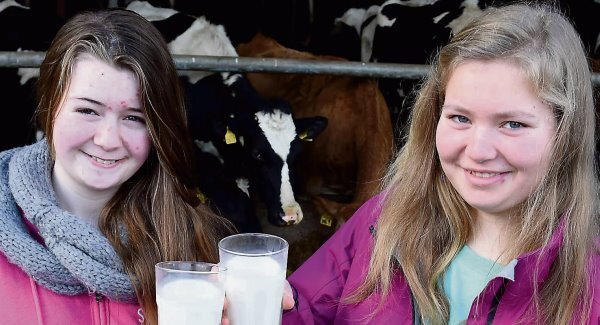
Bandon Grammar School students Lauren Bateman and Grace Kingston’s BT Young Scientist project investigates the beneficial effect that drinking raw milk might have for asthma suffers.
Where did this idea for a project come from? “We had heard a story of a girl who had very bad asthma,” Grace Kingston explains, “and after drinking milk over a period of time, it was said that she had been cured.”
Lauren Bateman said she had been an asthma sufferer as a child... so the students were very keen to investigate their project.
The raw milk for the students project would come from Grace Kingston’s farm in Drimoleague, and a nearby farm owned by Robert Shannon.
And with the help of their enthusiastic science teacher, Paula McGrath, the students got to work. After receiving permission from the parents of seven classmates who suffer from asthma, the raw milk project got underway.
For a set period of time, the seven students were given a glass of raw milk at break time each day. They were asked to fill a page of a diary each evening, writing down how they felt during that day, if they had taken their inhaler, and for what reason.
Grace and Lauren also sought the medical opinions of six West Cork doctors, before embarking on the project. All were very positive and encouraging.
And what of the results?
Well, you’ll just have to go to the RDS before the event closes on Saturday to find out.
Suffice to say, the message I got is that the results are very promising.