Farming special - Day 1: How farmers plan to vote in the next election
While Taoiseach Enda Kenny’s party remains the most popular option among farmers, with 36% saying they intend to vote for Fine Gael in the next election, this is down from 37% last year and down 27 percentage points from the vote the party secured from farmers in 2011.
Conversely, the Irish Examiner/ICMSA farming survey shows support for the main opposition parties is on the rise for the second year in a row.
Fianna Fáil’s support among farmers has grown by five percentage points in the past 12 months to 23%, while Sinn Féin’s vote has doubled to 9%. Labour’s support has dropped one percentage point, and it would now receive a paltry 1% of the farmer vote if a general election was held tomorrow.
Geographically, the spread in voting preference is quite apparent. Almost a quarter of farmers in Athenry, Co Galway, said they intend to vote for Sinn Féin in the next election.
Sources within the farming industry expressed surprise at the level of support for the Gerry Adams-led party and said it indicated a growing disenchantment felt by western farmers and will worry Fianna Fáil strategists on grounds that the small farmer constituency would traditionally have been a ‘solid’ for Fianna Fáil.
It is among dairy farmers that the drain in support for Fine Gael is most visible — falling from 58% in 2013 to 43%.
However, among the other three main farming sectors, support for Fianna Fáil seems to be on the rise. Some 29% of tillage farmers say they will now vote for the party, compared to just 19% last year, while 18% of dairy farmers will vote Fianna Fáil compared to 10% last year. The biggest jump in support for Fianna Fáil is among farmers in other sectors — rising from 13% in 2013 to 32% this year.
Fine Gael received most support from farmers surveyed at the Carbery agricultural show in Skibbereen, Co Cork, at 44%, while Fianna Fáil received most backing in Dungarvan in Waterford, where 32% of farmers said they would give the party their first preference.
Sinn Féin received most support in Athenry, where 23% of farmers would vote for the party — more than 14% higher than the other regions surveyed.
The fact that support for Fine Gael has dipped for the second year in succession comes on the back of a poor result for the party in the local elections in May.
Fine Gael took a hammering at the polls, losing 105 council seats. Both Fianna Fáil and Sinn Féin made significant gains. Micheál Martin’s party gained 49 seats, while Sinn Féin gained 105 seats around the country.
Behaviour & Attitudes director Larry Ryan said despite gains for Fianna Fáil and Sinn Féin, Fine Gael would be largely happy with the results of the survey.
“Ultimately, farmers seem broadly supportive of both Fine Gael and Enda Kenny, with limited evidence of any substantial shift in allegiances,” he said.
Half say coalition best for Ireland
More than half of all farmers believe Ireland is a better country since the current Government took office.
This comes despite a drop in support for Fine Gael and a rise in support for the main opposition parties of Fianna Fáil and Sinn Féin.
The Irish Examiner/ICMSA survey on farming attitudes found 51% of farmers either agree or strongly agree that Ireland is a better country since the current Fine Gael/Labour Government took office in 2011. Just 27% disagreed with this view, with 23% having no opinion either way.
This attitude is most strongly felt among 35- to 44-year-olds, where 65% agreed the country was better off since 2011. However, just 44% of younger farmers under the age of 34 felt the country was in a better place since the current Government took office.
Unsurprisingly, the positive view of the current state of the country under this Government was most strongly felt by Fine Gael voters (3%), followed by Labour (50%), Independents (44%), Sinn Féin (36%), and Fianna Fáil (32%).
Geographically, there was quite a disparity in views among farmers. Whereas at the National Open Day in Leitrim, some 71% of farmers felt that Ireland was a better country since 2011, just 36% of those in Tinahealy in Wicklow felt the same way — the lowest of any region surveyed.
Farmers working outside the main sectors (68%) and dairy farmers (56%) were most most supportive of such a view.
The fact that a majority feel Ireland is a better country since the current Government came into office stands in marked contrast to other findings in the survey which show support for Fine Gael falling to 36% — although it still remains the most popular party for farmers.
Support for Fianna Fáil has risen by 5% in the last 12 months to 23%, while the Sinn Féin vote has doubled to 9%. The combined Fianna Fáil/Sinn Féin vote is up 10%.
Sources within the farming industry have said the view that the country was better off since 2011 was “largely understandable”, given that Fine Gael still retained a substantial farmer vote.
However, they pointed out that the Government should be asking why over a quarter of farmers still feel worse off since 2011, despite the improvement in the economic outlook of the country.
Almost 50% would support Kenny
Almost half of all farmers would choose Enda Kenny to be the next Taoiseach.
The Irish Examiner/ICMSA survey on farming attitudes shows 47% of farmers would choose Enda Kenny as next Taoiseach, followed by Fianna Fáil’s Micheál Martin at 34% and Sinn Féin’s Gerry Adams at 13%.
Support for Mr Kenny is strongest among farmers aged 35 to 44 — some 63% of whom said they would choose the Mayo man to remain as Taoiseach in the next Dáil term.
The only age group which chose someone other than Enda Kenny as next Taoiseach was the 55 to 64 age group, 43% of whom would rather see Mr Martin lead the country rather than Mr Kenny after the next election
Geographically, there was quite a difference of opinion on who should be next Taoiseach. While Mr Kenny was the most popular choice in all regions surveyed, support for him was most effusive at the National Open Day in Leitrim, where 71% said they wanted the Fine Gael leader to remain on as Taoiseach.
Mr Martin received most support in Tinahealy in Wicklow and Carbery in Cork, where 43% said they would choose him as the next Taoiseach.
Mr Adams received most support in Athenry in Galway, where a quarter of all farmers surveyed said they would choose him over Mr Kenny and Mr Martin as next Taoiseach.
The continuing popularity of Mr Kenny among the farming community will give some solace to his party, as the survey found Fianna Fáil and Sinn Féin are making inroads into the farming vote.
Healthcare, loneliness, and alcohol abuse key issues
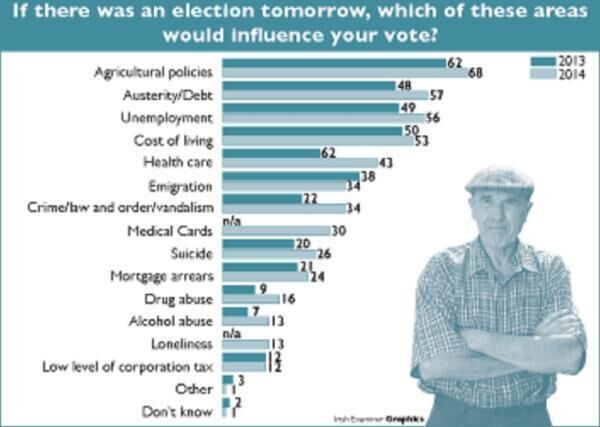
Healthcare, loneliness, suicide, and drug and alcohol abuse are now key issues influencing how farmers will vote in the next general election.
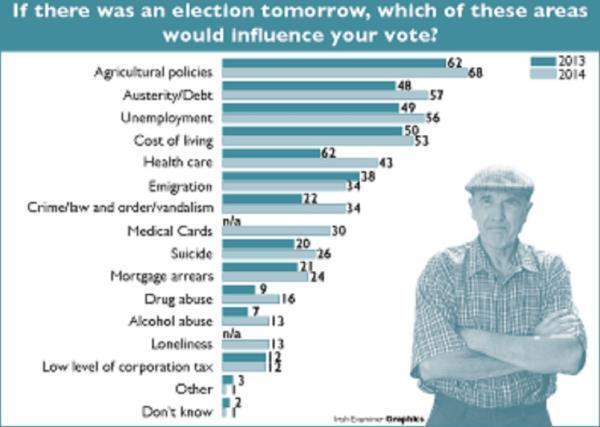
The second Irish Examiner/ ICMSA survey on farming attitudes found that, while the agricultural policies of the various political parties remain the top priority influencing farmers’ votes, issues such as healthcare costs and a range of social issues are increasingly coming to the fore.
A total of 68% of farmers said agricultural policies remained the key factor when it came to deciding how to vote — up 6% on 2013.
These policies were most important to dairy farmers over all other sectors, 72% of whom said it was the key reason influencing their vote. This was followed by tillage farmers at 68%, livestock farmers at 67%, and other farmers at 42%.
However, economic and social issues are now clearly to the forefront of farmers minds when voting. Some 57% of farmers now cite austerity/debt as the key issue influencing their vote, up from 48% last year. Unemployment is the main issue for 56% of farmers, up from 49% last year.
When compared with last year, farmers are now worried less about emigration and more about healthcare costs, which is now cited by 43% of farmers as the main factor influencing their vote — up some 16% on last year.
Social issues also remain to the fore, with 34% citing crime, law and order, and vandalism as key concerns — up from 22%.
Other issues, such as suicide (26%), mortgage arrears (24%), drug abuse (16%), and alcohol abuse (13%), are also increasingly becoming important.
More than one in 10 cite rural isolation and loneliness as the key issue that will influence what party they vote for.
Commenting on the fact that farmers are increasingly voting on social issues rather than specifically those relating to farming, ICMSA president John Comer said remoteness and suicide in particular were issues which increasingly are affecting the farming community.
“The question of loneliness is actually more particular to the farming community,” he said. “The long-established trend towards single- person farming operations and the decline of possibilities for contact and interaction in farming communities actually is contributing to marked increase in the amount of rural dwellers admitting to feelings of loneliness.”
Mr Comer added that it was impossible to get away from the fact that the decline in rural pubs as a result of drink-driving penalties had seen more single farmers staying home alone.
Hospital access
More than 75% of farmers feel they have good access to hospital services. While agricultural policies are the key issue influencing how farmers intend to vote at the next general election, healthcare is the next most important issue. Cost was mentioned by 43% as the main factor which will influence their vote in the next election — up 16% on 2013.
The Irish Examiner/ ICMSA survey found that, despite healthcare being a key concern and concerns over the withdrawal of services from rural areas, 76% of farmers said they have good access to hospital services. A total of 17% disagreed, but just 4% strongly disagreed.
This positive view is held strongly by all age groups, but those aged 35 to 44 are most in agreement with 80%. All other age groups showed support of over 70% for this statement.
Geographically, there was some degree of divergence. In Carbery in Cork, 52% of farmers felt they still had good access to services — the lowest of any region surveyed.
Labour and Sinn Féin voters were most in agreement they still had good access to services at 84%, with Fine Gael voters at 82%, independent voters at 75% and Fianna Fáil voters at 70%.