Above and beyond the call of duty
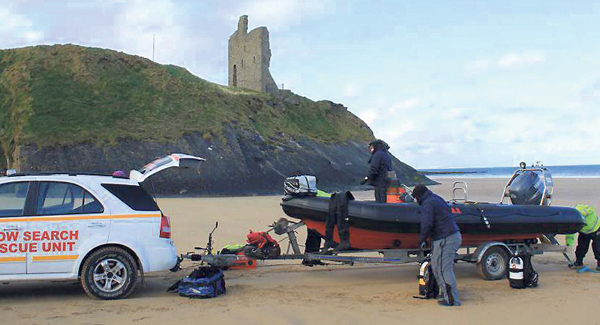
We live in a country that is graced by mountains, lakes, and rivers and surrounded by sea. Sailing, walking, swimming, mountaineering are all ours to enjoy.
Unfortunately, either as a result of bad luck, bad weather or, sometimes, bad judgement, such pursuits can land us in dangerous and sometimes life-threatening situations.
And it’s at such times that survival can depend on the efforts of those stalwart individuals who have dedicated their lives to rescuing those in trouble.
Irish Red Cross volunteers are often called on to help in searches for missing people.
In 1859, Red Cross founder Henri Dunant found himself in the middle of a battle between Napoleon’s forces and those of the Austro-Hungarian Empire. More than 40,000 were killed or wounded.
Horrified by the cries of the war-wounded, many of whom begged to be put out of their agony, Dunant organised help from a nearby village, and began ferrying the wounded to people’s homes and barns.
On his return to Geneva, he wrote an account of the battle and began urging people to set up relief societies.
The following year, the first Geneva Convention for the alleviation of the wounded in the battlefield was adopted, along with the emblem of the Red Cross on a white background.
Specialist search and rescue skills have been developed by the Red Cross, to search for people in mountains and lakes.
Their rescue services are available through the 999/112 systems as a support to specialist agencies, such as the Irish Coastguard and an Garda Síochána.
Prior to 1965, organised mountain rescue was practically non-existent in Ireland. For those in trouble, it was mountaineering groups and local farmers who provided assistance.
By 1986, Mountain Rescue had become a 999/112 service.
Volunteers in search and rescue make themselves available 24/7, no matter how severe the weather, and with no thought for the danger they may be placing themselves in.
Sadly, and despite their best efforts, rescuers do not always find those who are missing, sometimes the only comfort and sometimes, the only comfort that can be offered is the thought that there are dedicated people who continue the search.
Rescuing those in distress is not just the province of humans.
Animals, and in particular dogs, perform a brave and loyal service to humankind. Thanks to their endurance and superior scenting abilities, the dogs that work with the Irish Search and Rescue Dogs Association (IRDA) have helped save many lives, or if that is no longer possible, helped find remains of the deceased.
The IRDA was established in 1986 as a voluntary, non-profit organisation, and is now one of the most recognised K-9 search and rescue teams in Ireland.
The unit provides specially trained dog handler teams from Ireland, Germany, Poland and Holland to assist organisations such as the Gardaí, Coast Guard and the Civil Defence in missing person’s searches and drowning recoveries.
All across the country, there are groups of concerned people who, often after some local tragedy, have come together to form a rescue group.
One such organisation is the Mallow Search and Rescue.
Philip Johnston and John Woulfe told me of the countrywide work their group, Mallow Search and Rescue does.
“It was about six years ago. I am a qualified scuba driver and I’ve been involved in that for many years.
“Sometimes I’d get called out by the Mallow group to assist with a search.
“And I was always amazed by the way that the lads were always there, from five o clock in the morning till late at night.
“They never gave up.
“And they are all volunteers, dedicated and completely committed.
“That impressed me so much that I signed up.”
Did you find it hard to deal with the fact that sometimes, what you were searching for could only be remains?
” I ‘ve come to realise that bringing a sense of closure to the family is sometimes all we can do for them.
“We try to approach any rescue in a professional manner and just do our best.
“I had a friend who is in the same business and some years ago, his 18-year-old daughter was washed off the rocks in a freak and tragic accident.
“We searched for her for days and eventually, we did find her. I know that one of the only things that brought any degree of comfort to my friend was that we didn’t give up until we found her.”
” Every day we start the search hoping that the person will turn up, that we’ll find them. And if we don’t, the next day we are out there, ready to start all over again. The lads of Mallow Search and Rescue are an exceptional bunch of people.”
John Woulfe was involved in starting Mallow Rescue after the tragic drowning of a local young man.
“It was in 1983 and there’s been a heavy demand for the service ever since. We travel all over the country.
“We’ve recently returned from a search in Portarlington and we’ve been so busy that we’ve sometimes worked 69 days straight.”
“No, there’s no time limit on our searches.
“We gauge them on conditions and the nature of the particular situation.
“We have two boats and it costs us about €59,000 a year to keep things going, so there’s a lot of fundraising needs to be done. We get great support locally and the annual Raft Race is always a big money raiser.
“We are fortunate in having a sonar side-scanner, which cost about €25,000, money that was raised by the O’Tuama family of Cork City.
“As it is now, if we run out of money during the year, then we have to put our hands in our own pockets.”