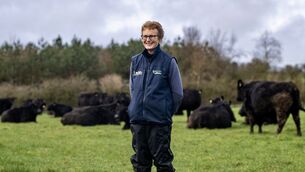
Broken weather leads to silage harvesting difficulties

A lot of very good silage was made in May but towards the end of the month, and in early June, the weather made it very difficult for silage harvesting in most areas.
Broken weather leads to silage harvesting difficulties

The best weather often comes in the last half of May. Unfortunately, the weather broke subsequently, and additive was necessary in many crops that were harvested in broken conditions, in order to ensure reasonably good fermentation in leafy crops.

As crops get more mature and stemmy, the requirement for additive becomes less important, especially if the weather is better. Farmers in heavy ground are finding it difficult to harvest silage, or even to graze.


Farmers who got good crops of silage harvested early, and have 70 to 80% of their winter feed requirements provided, are in a very good position facing into the rest of the season. Their remaining winter feed requirements can be supplied by surplus grass bales and second cut silage.

That is closing up about 40% of the farm for first cut, at the start of April, if possible, is so important — even if it means feeding a little extra concentrate. Only closing for first cut when adequate grazing without supplementation is available can lead to problems in providing adequate winter feed later in the season.

More farmers are buying in crops such as whole crop and maize, or are sowing forage crops such as kale, which is a very high yielder. Even though these are very good feeds, an all-grass silage system is the simplest and easiest for most spring calving herds.

Second Cut Silage Every farmer should carry out a winter feed budget and provide a buffer of around 20% extra feed which can be carried over if not required. Following last year’s winter feed crisis, most farmers have become aware of the need to have adequate winter feed.

Fewer farmers are depending entirely on very late and very early grazing. About 80 units of nitrogen per acre ([plus sulphur) is the general recommendation for second cut silage. However, a number of factors have to be considered before applying N for silage.

Good ryegrass pastures, especially those reseeded in the past four years, will respond to 20 units more than poor quality, old, low ryegrass pastures, and of course, they yield around one third more silage.

Cattle slurry is a very variable product due to different levels of dilution, and different herd diets. An average acceptable figure for undiluted cattle slurry is that an application of 2,500 gallons per acre in the spring would make about 30 units per acre (30% of the total N in slurry) available to the silage crop, and bag-N should hence be reduced by that amount.

However, there is very little N available to second crops from slurry applied in the summer. If no slurry is applied, adequate P and K should be applied.

In fairly good growing conditions, six to seven weeks should be adequate time between N application and harvesting, when the crop should be using up two units per acre per day.

However, during periods of very poor growth, the N will not be active, and a longer period is required between N application and harvesting. Where possible, get grass tested at your co-op or Teagasc before harvesting.

x

More in this section

Farming

Newsletter

Keep up-to-date with all the latest developments in Farming with our weekly newsletter.

Cookie Policy Privacy Policy Brand Safety FAQ Help Contact Us Terms and Conditions

© Examiner Echo Group Limited