Summer work load spells danger

By mid-May in 2014, 12 people had lost their lives on farms. The danger to life is a constant cloud hanging over farming.
Summer work load spells danger

It’s a vital industry, but it’s deadly dangerous.

Agriculture is linked to one in every four jobs outside of Dublin, 10% of Irish exports and of total employment, and 23% of industry turnover.

But far too many are paying with their lives on farms, in deadly accidents which happen while they work on generating the raw material of the agri-food industry.

By mid-May in 2013, two deaths had been reported in the Irish agriculture sector. By the end of 2013, the frightening death toll had reached 16.

By mid-May in 2014, 12 people had lost their lives on farms.

The danger to life is a constant cloud hanging over farming.

Like other jobs, it has the stress and strain of a heavy work load, but the great risk to life adds another layer of worry in farming.

Agriculture Minister Simon Coveney and Enterprise Minister Richard Bruton recently joined the Health and Safety Authority and the IFA in a joint call to all farmers to make safety a top priority.

Mr Coveney identified two weaknesses which make farming dangerous — firstly, time and financial pressures and secondly, many farmers working long hours alone.

They are danger areas which each farmer should look out for.

And when pressures and long hours of working alone meet tractors and machinery, the danger increases to the red alert level.

This combination makes the summer months the most dangerous on Irish farms.

IFA president Eddie Downey has also identified the vulnerability of farmers working alone in potentially dangerous situations. He is asking everybody involved in farming to look out for each other, particularly young and old around livestock and machinery.

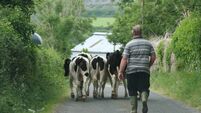
Livestock are of course the other big danger area.

Just how dangerous cattle are is reflected in figures from Britain, where many of those killed are not farmers, but walkers who entered farmland, apparently unaware of the dangers posed by cattle.

Recently a 66-year-old man walking his dog died, and his brother was badly injured when they were attacked by cows in Wiltshire — the third such attack locally in five years. Data from the British Health and Safety Executive shows more than 18 people killed by cattle between 2001 and 2009, and 481 injured, with the two most common factors being cows with calves and walkers with dogs.

Even former home secretary David Blunkett suffered two broken ribs in 2009 when a cow charged at his guide dog while they walked in the Peak District.

Until it becomes profitable enough for every farmer to have plenty of help, including someone standing by to help in case of an accident, farming is likely to remain Ireland’s most dangerous workplace.

In the meantime, maintaining a high level of awareness among farmers of the dangers, and enforcing safety laws, are the best that can be done.

Farmers dread visits from inspectors, because the result is often a cut in their single farm payment.

But they should not dread safety inspections, or even fear fines for safety breaches; they should welcome them.

Nearly 3,000 farms per year have been inspected for safety since 2010, according to the Health and Safety Authority. It is quite likely that these inspections have saved lives by forcing farmers to remove hazards. A similar number of farms are inspected each year to ensure compliance by farmers with the hundreds of rules they must obey in order to draw down about €1.7bn of EU funds per year annually.

However, the only safety requirements in these rules are to do with food safety.

If existing measures continue to fall short of reducing the death toll on farms, the cross-compliance inspection regime could present an opportunity for improving farm safety.

Adding farm safety to the long list of cross-compliance measures which are checked by Department of Agriculture inspectors could save lives.

* In last week’s Farmview, I mistakenly indicated that supermarkets here are happy to import 25% of our drinking milk from the UK, specifically from Northern Ireland.

However, Tesco Ireland have pointed out that 100% of the fresh milk, beef, pork, lamb and eggs which Tesco Ireland sells is from the Republic of Ireland.

SuperValu, exclusive partners in National Dairy Week with the National Dairy Council, says all their branded milk is NDC approved, coming from the Glanbia, ClĂłna, Wexford, Lee Strand, Arrabawn, Donegal/Connaught Gold and North Cork creameries. SuperValu cream is 100% local and NDC approved. The NDC Guarantee assures consumers that milk is farmed and processed in the Republic of Ireland.

More in this section

Farming

Newsletter

Keep up-to-date with all the latest developments in Farming with our weekly newsletter.

Cookie Policy Privacy Policy Brand Safety FAQ Help Contact Us Terms and Conditions

© Examiner Echo Group Limited