Message at heart of floral tribute
Already, snowdrops have made their appearance and the daffodils are well along in some places, a sure promise of spring, their rich colour like distilled sunlight.
Soon there will be wood anemones too — the Lenten rose, and branches heavy with scented whitethorn and bluebells, cloaking the woodland in swathes of an irides-cent blue. The progress of the year is marked by this stately appearance of flowers, blossoms and herbs, which in past times, were often praised for their healing qualities as well as their beauty.
Fragrant rushes and scented meadowsweet were strewn on rough floors, lemon balm was used for cleaning and lavender for nosegays and to ward off malignant humours.
Their beauty has the unique ability to bring cheer when someone is ill or down-hearted, their fragrance used to create exotic perfumes and cer tain foliage used for medicines and foods.
There were references given to flowers and plants in Biblical times. The Hebrew Bible uses plants and flowers as symbols — particularly of love and lovers in the sensual Song of Songs.
“As the apple tree among the trees of the wood, so is my beloved among the sons” Shakespeare also ascribed emblematic meaning to flow-ers, especially in Hamlet.
Over time, a language of flowers developed. Known as floriography, it became a means of silent communication through the use or arrangement of certain flowers.
The origins of this unique form has its pragmatic roots in Turkey of the 17th century, where concubines saw little of the outside world and could not communicate, since they could neither read or write. In 1718, the wife of the British ambassador to Constantinople, Lady Mary Wortley, visited some of the harems and later wrote a letter to a relative in Britain expounding on the “Secret Language of Flow-ers” that she had discovered during her time in Turkey.
Europeans were quick to pick up on the concept and in 1819, Madame Charlotte de la Tour wrote and published what seems to have been the first dictionary of this new flower language, a small book but a popular reference.
While not as repressive as the tightly controlled harems, Victorian England had plenty of restrictions of its own. At its height, the covering of dining table legs by the most zealous was practised. Ankles were out, quality time with someone you might have had your eye on an impossibility without a chaperone if you were an unmarried girl. There were many aspects of the human experience that were deemed unfit for discussion in polite company.
And so Victorians often exchanged small “talking bouquets” sometimes known as tussie-mussies, wrapped in a lace doily and satin to do the job for them. The bouquets were also worn as a fashion accessory and a thriving and competitive business soon grew up to provide them.
No surprise then that Victorian women especially picked up this silent language that allowed them to communicate feelings and meanings that the strict propriety of the times would not allow. In 1884 Jean Marsh and illustrator Kate Greenway published the first comprehensive volume, The Language of Flowers. It was a huge success and is still in print today.
Victorian Pre-Raphelites — a group of 19th century poets — often relied heavily on flowers as a metaphor when they captured classic notions of beauty romantically. John Everett Millais’s painting of Ophelia depicts Shake-speare’s drowned stargazer floating amid the flowers she describes in Hamlet.
But the more popular this silent and often risqué silent language became and the more books and dictionaries were published in the flowermad Victorian era, the more room there was for mixed messages being conveyed as flower definitions were not universally agreed upon.
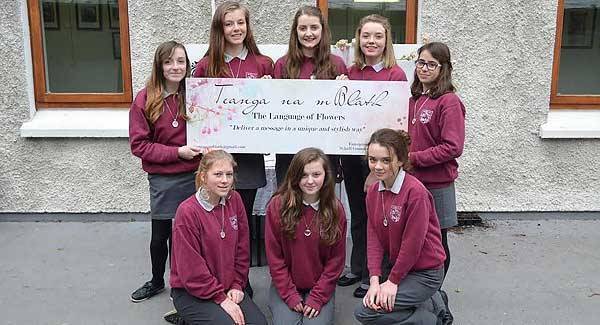
Now a group of enterprising transition year students at Schull Community College have started a small business manufacturing flower necklaces, using the language of flowers to convey a rather special message.
Production manager of Teanga na mBl•th, Flo Mc-Carthy-Doig, told me how it came about.
>> “We were asked to come up with an idea for a small business in our mini-companies class. We were in small working groups of four or five. And we spent ages coming up with ideas, suggestions. But none of them were quite right until someone suggested flowers, from the Victorian Language of Flow-ers We did a lot of research and eventually decided on necklaces built around real flowers that all have a particular meaning and which we explain with each necklace. We buy our flowers from florists, press them in books and order the materials needed for assembling the necklaces from a craft site and then we get busy.”
>> “It was at Christmas, at the college’s production of Oliver and they sold really well. In fact, we sold out. So that gave us a lot of confidence. They are on sale in some shops in the area and at a couple of locations in Cork City. We’ve even managed to make a small profit, which we’ve put back into the business. And we started off with just an idea and the five of us putting in twenty euro of our own money, so we’re very pleased. We also make up necklaces for people who may have special flowers that they want to keep, from a wedding, a christening or a birthday. This is a lovely way of doing it.”
>> “We’d like to be on sale in more locations, particularly during the visitor season this summer. There are so many lovely wildflowers in West Cork that we’d like to experiment with them as well. We want to make bracelets and other items using the language of flowers for people to convey their feelings. It’s a lovely tradition.”
>> “We’re young and we’re not bogged down with responsibilities. We can do it because we love it. This project has taught us so much about business and about life. But there are so many young people who feel there’s nothing out there for them. They can make things happen for themselves though. We’ve learned that. We’d like to see Teanga na mBlath grow and expand. Unemployment is a big problem for young people in this area.”