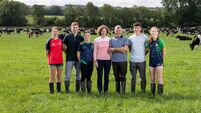
Top-up boost for young farmers

It is worth up to €16,000 over the five years from establishment of a holding in a young farmer’s name.
Agriculture Minister Simon Coveney said: “It is vital that we do everything we can to encourage young people to take up a career in farming if the innovation and new ideas required to generate the smart, green growth envisaged under Food Harvest 2020 are to be realised.”

The scheme will assist young farmers in the initial stages of establishing a farming enterprise in their own name by providing a ‘top-up’ payment on their 70% basic payment portion of their single farm payment.
The top-up is financed by deducting the full allowable 2% from Ireland’s single farm payment in 2015. Percentages to be applied in later years will depend on demand.
Macra president Kieran O’Dowd said drawing down the full 2% is impossible because it would require 12,000 young farmers. He wants unused funds ring fenced for young farmers.
To qualify, a farmer must be aged 40 or less in their first year of application to the Basic Payment Scheme, and have established their holding within the previous five years. Successful applicants must also have completed a recognised course of education in agriculture giving rise to an award at FETAC level-6 or its equivalent.
The young farmer payment will be calculated as 25% of the national average payment per hectare (based on the national ceiling) for up to 50 entitlements activated by the farmer. Young farmers will also be prioritised in allocation of payment entitlements from the national reserve, along with those who ‘commence their agricultural activity’ (new entrants). Entitlements from the reserve can only go to ‘active farmers’.
A portion of on-farm capital investment grants up to 2020 will be ring-fenced for young farmers setting up for the first time as heads of an agricultural holding. It offers a higher (60%) aid for investment in key physical assets.
And some of the support for dairy equipment capital investment will be priority targeted at young farmers setting up for the first time.
Encouraging young farmers into dairying will be an objective to partly offset start-up costs of approved collaborative farming arrangements (such as contract rearing, partnerships, share farming, cow leasing, etc)