A memory at Christmas of grim times on a small farm
He lives outside the town on a small farm that suffered all the vicissitudes over the years of holdings of its kind. That fickle beast the market, manipulated by ruthless retailers, plunged him into a prolonged recession that put years on him, and a droop in his shoulders. Leeches.
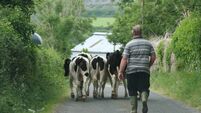
When the bottom fell out of the dairy business, he switched to sucklers. If less remunerative than the milk business, it was less laborious. Dairying pinned him down seven days a week, 52 weeks of each year. And for what? A millstone, it had him working his socks off for buttons and still single in his mid-30s — not having the means to settle down and raise a family. Wives, he told me, don’t come cheaply as they used to in Abbeylaune, his ex-girlfriends spurning the penny-pinching prospects of life on a small farm.
Sometimes, I worried, he’ll sell up like so many others, take a factory job in Abbeylaune, and live in town. I’d miss the farm. Without it, my homecomings wouldn’t be the same. I’d miss my stroll in the meadows, listening to the corncrake and savouring the fragrances and colours of wild flowers that flourish in profusion in the hedgerows. I’d miss watching the frolics of young calves after their release from captivity, just as I missed the hum of the milking machine, and the banter with Joe’s neighbours at the co-op where I often delivered his milk for him.
“I wouldn’t give up farming for love or money, if I were you,” I advised him. Quite frankly, I don’t believe that he would ever adapt to factory work or adjust to town life. The farm is his habitat. He’d miss its flora and fauna, his neighbours and his routines, not to mention the dawn chorus that has been his ancestral alarm clock. Evolution’s philharmonic orchestra, playing for free in good times and in bad.
That weekend with him had been more traumatic than idyllic. Blame the elements — biting north-east winds and freezing snow showers that made all outdoor inhabitants shiver. It was in those last inclement days of March, better known locally as the ‘reeky days.’
The trees were gaunt and leafless, the hedgerows skeletal. Even the grass was critically meagre for hapless animals turned out to graze, their hard-up owners unable to pay for extra fodder that would tide their stock over until the growing season started.
A familiar scenario for small farmers like Joe, at the mercy of late springs and fickle summers. Any wonder they’re forever moaning about the weather.
“One of your cows is down,” I told him, after a muddied ramble through the fields. “Is there anything we can do?”
“Nothing.” He looked away, readjusting his peaked cap and zipping up his anorak, as we stood in the draughty yard swept by swirling winds.
“Would you not call the vet?”
“It’s pointless.” He pulled the cap down further over his forehead, until I could hardly see his eyes. His ancestors would have attributed it to bad luck. Joe was more agnostic about it.
“Pointless? But she’s still alive,” I ed.
“It would be a waste of 50 euro I can ill-afford.” He blew into his cupped hands.
“Are you sure there’s nothing can be done?” I pressed, distressed at having seen the helpless animal keeled over, her left eye bleeding badly, where the big-beaked, scald crows had been pecking her.
“Certain.” There was a disturbing note of finality about his assurance, coupled with a tone of resignation I found off-putting. I shuddered as I pictured the wretched animal dying slowly, her body being lacerated by biting winds and hailstones, while her eyes were being painfully plucked from their sockets by the scavenging scalds. An animal I fondly remembered as a playful calf, frolicking with its mates, now abandoned to its fate.
There must be something I could do. Something that might even bring a measure of relief to the doomed animal, regardless of Joe’s indifference to her suffering.
That afternoon, I tried to prop her up with some rocks, as I watched her continuing to list like a foundering ship, knowing that if she rolled over further, there would be no hope for her. Then I fetched her some hay reserved for the calves and a pail of tepid water, which she drank thirstily, after which she proceeded to munch the fragrant hay.
She was still alive, if not kicking, I rejoiced. If only I could get on her feet and tow her indoors from the elements. Whereupon I was rocked as if by a revelation. “She’s in calf,” I remarked to Joe, as he added turf to the range. “The calf’s dead.” He shrugged with the same stoic resignation I’d noted in response to its mother’s fate.
“How do you know?” I was less pessimistic.
“I’m long enough in the business to know.” He replaced the lid on the fire box and stood the kettle on it.
What could I say? It was not for me — a city-based pen-pusher — to tell him his business. And yet, I refused to give up on the little speckled cow now mercilessly battered by the brutal conditions while I sat in a warm, cosy kitchen.
When I went to inspect her the next day, I was shocked to see the other eye had been on the receiving end of the scalds. It was evolution’s way.
Creatures battening on their helpless fellows even as they lay dying.
The immemorial food chain cruelly kicking in while nature stood indifferently by.
I could see her shivering body regressing into rigor as her heart-beat slowed, sending less and less blood and oxygen to her brain, while an increase of lactic acid brought her muscles to a standstill.
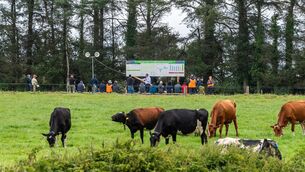
I was relieved, however, to see her drink another fill of tepid water, though she had less appetite for the hay I’d brought her. The previous bundle had evidently been whipped from her by the gales, and mostly consumed by the big brown cow — testament to the survival of the fittest — that had befriended her, before leaving her for the meagre shelter of the whitethorn hedge.
If only the weather would abate, the wretched animal, I felt, might survive. Instead, it seemed to worsen, icy winds whip-lashing her, while hailstones continued to target her with their pitiless cannonade.
Agonisingly, I watched her life ebbing away, as she keeled over further.
And yet, there was evidence of her shifting during the night, that signalled a ray of hope. Had she tried to rise? Or had she been trying to ward off the scalds? While inspecting her eyes, I got a blink from her, suggesting she had enough sight in her best eye to get by, should she manage to rally.
Again, I wondered if the vet might have saved her, had Joe contacted him in time. I had only his opinion. And I still wasn’t sure if money was the rub. Or if he were throwing in the proverbial towel in disillusionment, professing, as he repeatedly claimed, to be a fool to stay farming. Hence the farmers’ protest marches.
SPINELESS Government. Refused to regulate the unscrupulous retailers putting the dairy industry at risk, and farmers like Joe out of business, with their hello money, their cut-price offers and their cheap, imported milk. Gangsters, in Joe’s words, they ‘milked’ the system, in the absence of an effective regulatory authority.
The vet was not without blame, his fee continuing to increase, even as his clients were operating at a loss. I could picture him and his friends at the golf club, washing down fillet steak with Cote de Rhone, while Joe and his kind had to scrimp.
When I further checked the prostrate animal for any evidence of further injuries, I was shocked to find that her udder was bleeding profusely where some flesh had been torn away. Oh no. I realised the fox had paid her a visit. Which accounted for the creased grass from where she had shifted.
“You’re wasting your time,” Joe said, when I returned from my evening vigil. I’d have kept watch by her all night, were it not for the appalling weather and the risk of contracting pneumonia.
The thought of the big-beaked scalds and the ravening foxes tearing her to pieces turned my sleep into a nightmare that propelled me from my bed at the first glimmer of daylight.
Drawing back the blinds in hope of a change in the weather, I was greeted instead by a landscape carpeted in snow, that cast a serious damper on any hopes I had for the stricken animal.
I made a dash to the field with a pail of tepid water for her. It wasn’t necessary. She was dead, further ravaged by the scalds and the foxes.
The second eye had been gouged from its socket, and a huge chunk of her udder devoured. Then I spotted the afterbirth. O my God! Was it possible she had calved during the night? But where was the calf? Had it wandered off into a dyke? Unless it got a feed of milk straightaway, I knew it would perish.
Scanning the whitened field anxiously, I was thrilled to see a frail, barely agile calf trying to suckle the brown cow. I raced back to the house to break the good news to Joe.
“The calf is alive,” I roared at him to get up.
“No way!” he exclaimed, bleary-eyed as he emerged from his bedroom.
“And it’s doing its best to suckle the brown cow.”
“Good! There’s a chance in a hundred she might take to it, having lost her own calf only last week.” He sounded hopeful.
“Fingers crossed.” I could feel my spirits beginning to lift for the first time in days.
“In the meantime, I’d better prepare him a drink from the beastings I keep in reserve for emergencies of this kind.” He pulled on his working gear and headed for the milk-shed with a spring in his step.
“And what do you intend doing with the dead cow?” I called after him.
“I’ll have to ring the knackers to have her removed.”
“And what’ll that cost?”
He gave me one of his disgruntled looks.
“Fifty smackers. You can’t win, can you?” he sighed.
Retailers have a lot to answer for