Destiny of farming at a crossroads
THE landscape of Ireland, shaped over thousands of years, is the focus a new debate over how it is again changing.
Conor Skehan, visiting fellow at Dublin Institute of Technology, started it all at last month's Burren Law School in Ballyvaughan, Co Clare.
He said that fretting and fussing about rural housing is a very superficial symptom of a much greater and far deeper change the collapse of agriculture.
But the Agriculture and Food Minister Joe Walsh took issue with this view in a written reply to a subsequent Dáil question and said it runs contrary to virtually all current analysis of agri-policy.
Yet, in his address to the conference, Mr Skehan said the process has been gathering momentum for nearly 15 years and that the reform of the Common Agricultural Policy (CAP) will bring it to a rapid and dramatic conclusion.
"By 2020 productive agriculture in Ireland will be confined to a narrow band stretching from north Munster to south-west Leinster. Outside of this area all agriculture will be part-time, specialist and secondary.
Mr Skehan, an environmental planning consultant, predicted that across large swathes of the Irish countryside this generation will witness something that hasn't happened for 6,000 years.
For the first time since the late Stone Age the tree canopy will close out the sun and the sky from the ancient fields and meadows. It has begun already.
Mr Skehan, an expert on the Irish landscape, argued that this is just the visible change. Another change is afoot, just as profound, but much more difficult to see. Control of the countryside is changing hands. Not the ownership, just the control.
He said that since first settlement the organisation and appearance of the countryside has been determined by agricultural practices. But the collapse of agriculture as the organising paradigm is leading to a vacuum. And this is rapidly being filled by other systems of organisation.
Where agricultural productivity for substance or profit was dominant in the past, today's landscape is increasingly controlled by ideas and beliefs.
It is becoming a place to receive and reflect the value systems of an increasing urbanised European population.
THESE systems are scientific (ecological, historic, archaeological designations) aesthetic (scenic areas-drives, national parks, special amenity areas) and cultural (landscape associated with history, art and ethnicity).
He said the landscape is beginning to become a patchwork quilt of designations and rural protection schemes which determine where and how the land uses of the future will be arranged.
It will be a new landscape one that is currently emerging very haphazardly as a result of the well-intentioned but uncoordinated imposition of such designations and schemes.
Mr Skehan said no existing planning at county, regional or national level has any coherent positive vision for the countryside after agriculture.
However, Minister Joe Walsh said the view that by 2020 productive agriculture here will be confined to a narrow band stretching from north Munster to south west Leinster runs contrary to virtually all current thinking and analysis of agricultural policy.
An in-depth analysis of the Luxembourg agreement as set out in a recent report by FAPRI-Ireland, an independent group of economists, has stated that the reform of EU agricultural policy and decoupling in particular would be good for Irish agriculture.
The decoupling in the four major agricultural sectors would by 2010 lead to slightly lower production, reduced input costs, higher prices and increased farm incomes.
"At no time has there been any mention of large-scale reductions in production or of a scaling down of activity, with land being left fallow to return to nature or be in effect abandoned," he said.
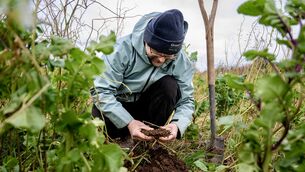
Minister Walsh said that in recent times there was much discussion about the low levels of afforestation in Ireland and the need to increase the scale and scope of tree planting in Ireland, as the area under trees is considered low by European standards. To address this, a comprehensive, soundly-funded forestry programme has been put in place.