Capturing July's celestial events: Testing the Dwarflab Mini smart telescope
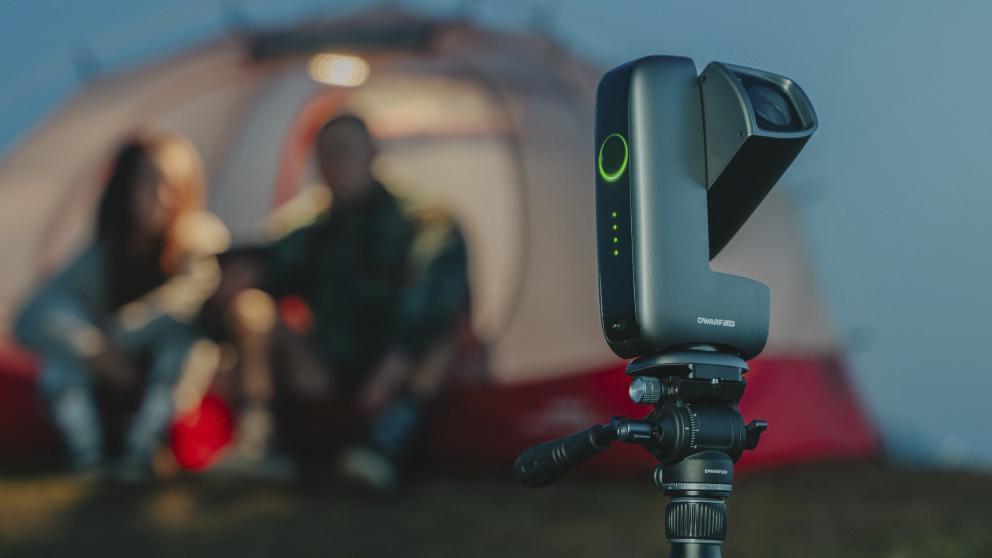
Simplifying the night sky: The lightweight Dwarflab Mini sits ready for use to capture July's celestial displays. Picture: Dwarflab
There is a specific, quiet thrill that comes with waiting for a planetary conjunction. This July, the night sky is offering plenty of reasons to stay up late, from Mars dancing near Uranus to the peak of the Southern Delta Aquariids meteor shower. For anyone with a passion for astrophotography, these fleeting moments are exactly what we live for.
I am currently putting the Dwarflab Mini through its paces for an upcoming review. The second half of the month is set to be incredibly active for stargazers. My goal over the next few weeks is to see whether this compact smart telescope can simplify the often frustrating process of capturing moving targets without my heavy, traditional mounts and camera gear.
The opportunities start on July 10, when a crescent Moon appears alongside the Pleiades star cluster. It’s a striking scene that should be easy to capture, though I want to see how well the Mini's wide-angle lens manages the contrast between the bright Moon and the darker cluster. The activity continues steadily throughout the middle of the month with the Moon passing near Uranus and Mars on July 11, followed by Mars appearing close to Aldebaran on July 13.
The New Moon on July 14 brings much darker skies, which is where I am most interested in testing the Sony IMX662 sensor. With Mercury and Pollux also nearby, it is a prime opportunity for deep-sky imaging. As the month progresses, we have more lunar encounters near Jupiter on July 15, Regulus and Venus on July 17, and the First Quarter Moon near Spica on July 21.
As we reach the end of the month, the Full Moon rises near Pluto on July 29. Finally, the Southern Delta Aquariids and Alpha Capricornids meteor showers peak on July 31. Capturing meteor streaks is notoriously difficult because you need steady tracking and long exposures.
I will be investigating whether the Mini’s equatorial tracking mode can maintain enough stability to catch these fragments as they burn through the atmosphere. It is a small, capable piece of kit, but I want to see where its limits lie before I share my full verdict. Even with the best gear, success really comes down to finding a dark site with a compelling foreground and timing your session for the darkest sky. Beyond that, you just have to pray for clear skies.
€455 amazon.co.uk

CONNECT WITH US TODAY



Be the first to know the latest news and updates