JBL Bar 500: setting the bar for mid-range soundbars
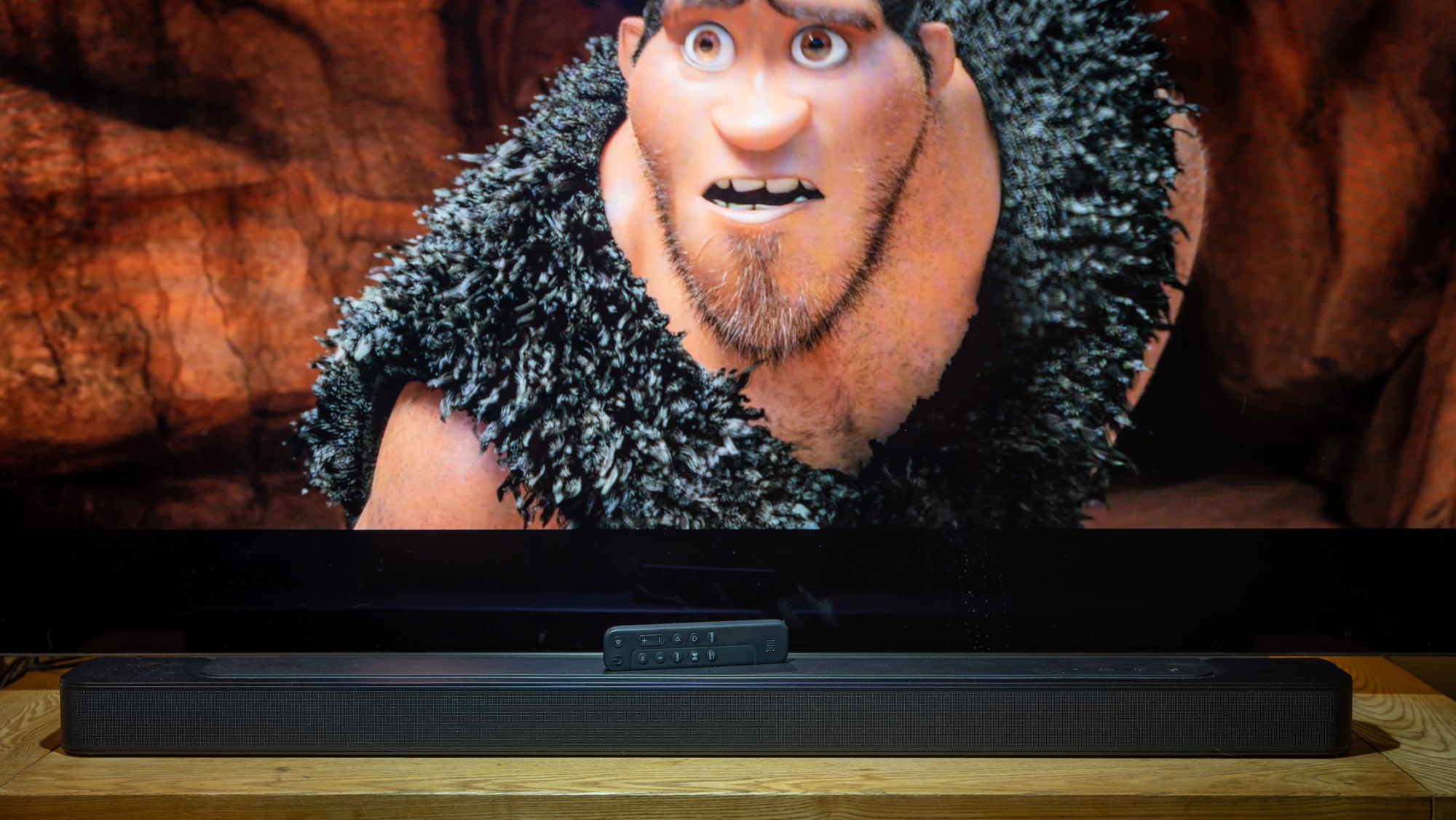
JBL Bar 500 soundbar. Picture: Noel Campion.
Let’s face it, speakers on modern TVs suck and if you want to improve the sound the easy option is to buy a soundbar. The problem is there are a ton of options ranging from cheap to expensive. I’ve been testing the JBL Bar 500 over the last month to see if there’s a middle ground for those who don’t want to spend a fortune but appreciate good sound.

The Bar 500 features a long soundbar with a separate 10-inch wireless subwoofer. The soundbar measures 10.35 cm x 1.02 metres x 5.60 cm centimetres (depth x width x height) and this is important to know because your TV stand height may not be tall enough to fit the Bar 500 in front. With a width of just over one metre and a height of around 5.6 centimetres, the soundbar should fit in front of most 50-inch TVs and above.
I like that the Bar 500 is long as this helps to separate the left and right speakers to improve stereo imaging — smaller soundbars tend to have a smaller soundstage.
The sides are covered with a simple metal cover grille, behind which there’s an LED display for showing information. The top of the Bar 500 is made of plastic, with the middle section being clearly recessed from the rest of the surface. There’s a JBL logo in the middle with two holes for mics on either side. On the right, there are three control buttons and a single LED indicator.
I did all of my testing with it in front of a 65-inch LG C1 TV and it worked fine but was a tad higher than the bottom of the TV frame. Of course, you can wall mount the soundbar too and JBL supplies the necessary brackets and hardware to do so.
The Bar 500 includes a massive subwoofer; finding the best place to put it may be difficult in smaller rooms. It stands 44cm tall and has a width and depth of 30.5cm. Luckily, bass isn’t directional so you can put it anywhere in the room within reason and while you do need to plug it into a power outlet, it automatically connects to the soundbar wirelessly for a neat installation.
There are four large plastic legs with rubber feet on the base of the bass that raise the unit 40mm from the floor to allow the down-firing 10-inch subwoofer room to work. The top is completely flat — perfect for holding a coffee cup — and overall, I like its simple lines and minimalistic shape.
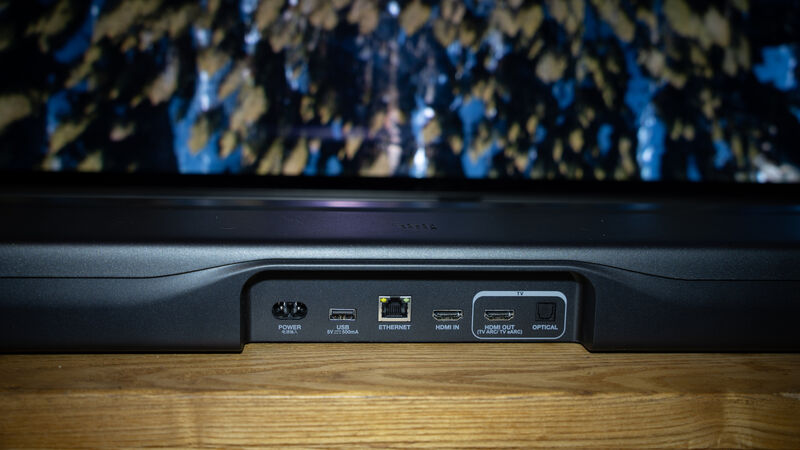
JBL’s Bar 500 connections include HDMI output, as well as a variety of options and settings via the great JBL One app. It not only works wirelessly between devices but also between your smartphone and the soundbar.
In addition to Bluetooth, Apple AirPlay 2 and Google Chromecast, there’s also Spotify Connect, Alexa multi-room media and Google support. In the app, you can add streaming services such as Tidal, TuneIn, Qobuz and Amazon Music, but there’s no option to add Apple Music here. The latter isn’t a big deal since I was still able to stream music via AirPlay 2.
JBL offers two options for connecting to the television: an optical digital input and HDMI with eARC, i.e. the enhanced audio return channel. This enables the transmission of 3D surround sound in the form of Dolby Atmos. A special extra among the connections is the additional HDMI input so that you can connect a games console or a Blu-ray player, for example, and the image is then sent through the soundbar to the television. This HDMI port supports 4K with HDR. The advantage: the Bar 500 does not take up an extra HDMI slot on the TV. There’s also a USB-A port and you can download firmware updates from JBL by saving the file onto a memory stick although this is more easily done via the app. The port supplies 5 volts of power, so you could use it to power a low-powered device like a Firestick.
The Bar 500 comes with full WiFi support including WiFi 6 as well as Bluetooth 5.0.
I mostly used the Bar 500 connected to my TV via the eARC connection, but if your TV doesn’t support eARC, it also works with regular ARC — see below for more info.
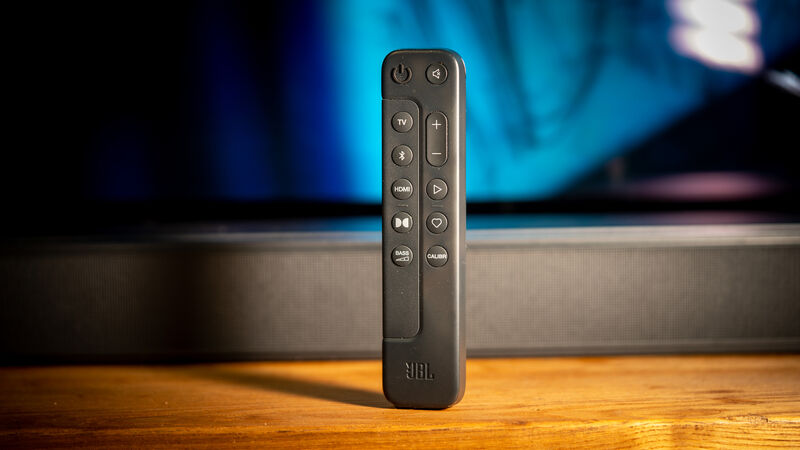
The Bar 500 comes with its own remote control which looks like a small version of the soundbar and offers four dedicated buttons for special functions. One of these is a button for Dolby Atmos, which switches the virtual surround sound on and off. The button with Calibr starts the automatic calibration which emits sounds and then captures the delay using the built-in speakers. The switch with a heart on it is also great. This is called Moment and can be assigned an audio favourite in the JBL app. This can be a favourite song or album, a preferred radio station or a playlist, for example on Spotify. Information about all changes is available via the easy-to-read LED running display.
The bass button is for changing the subwoofer bass strength from 1 - 5.
Enhanced Audio Return Channel (eARC) is an enhancement to the Audio Return Channel (ARC) feature found in many modern TVs. eARC allows for the transmission of high-quality audio, including object-based audio formats such as Dolby Atmos, from a TV to an audio system. Some of the benefits of eARC include:
Improved sound quality: eARC allows for the transmission of high-resolution audio, which can significantly improve the overall sound quality of your home theatre setup.
Simplified setup: With eARC, you don't need to use multiple cables to connect your TV to your audio system. This can make it easier to set up your home theatre system and reduce clutter.
Flexibility: eARC allows for the transmission of a wide range of audio formats, including object-based audio such as Dolby Atmos. This means that you can enjoy high-quality, immersive audio with a compatible audio system.
Compatibility: eARC is compatible with many modern TVs and audio systems, making it easy to upgrade to this feature.
As previously mentioned, the JBL One app has options for the soundbar as well as access to streaming services and radio stations. In addition, settings include sound adjustments via a basic three-band equaliser and you can start the audio calibration from here too.
If you like, you can use the app as a regular remote control, the buttons then appear as small areas on the touch display. If you’re using an older TV that has a delay between video and sound there’s an option to offset the sound using a slider to attain perfect lip sync.
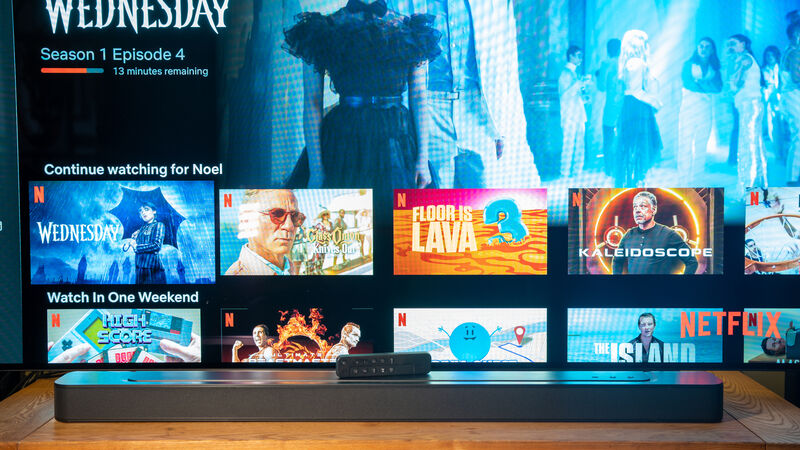
The Bar 500 sounds amazing, even if you don’t turn the subwoofer on. In particular, dialogue is focused front and centre and voices sound natural and crystal clear. Not surprisingly, the Bar 500 is a beast in the bass department. At level 1, the bass is strong and you’ll hear it clearly, even at lower volumes. However, push it to level 5 and objects around the room will start to rattle. I found the volume at 20 was perfect for me when watching action flicks and since I don’t live in a detached house, going all the way to the maximum of 30 was not an option. For general viewing, I left the bass on 3, which is still incredibly powerful.
To be clear, the Bar 500 doesn’t have or support separate rear speakers. It does offer Dolby Atmos and what JBL calls MultiBeam surround sound. The latter simulates the effects of surround sound by bouncing sound in specific directions so that it bounces off of walls and ceilings. The results are incredible and far more immersive than a standard soundbar that can only do stereo. It opens up the soundstage massively without annoying echo and reverb. I liked it so much, I kept it on all the time during my testing, but like any surround system, you first need content that supports it. More movies and TV shows are now supporting Dolby Atmos and it seems to be where the industry is heading. All that being said, MultiBeam isn’t as good as a true surround system with rear speakers, but I think most users will be happy with the virtual surround sound in lieu of a neater setup.
JBL's Bar 500 is a thousand times better than your TV speakers and of course cheap soundbars. It has a plethora of options for connecting most of your devices and provides a thumping bass with a large spacious soundstage. The subwoofer is the same one JBL uses with their more expensive soundbar models including their latest €1,400 flagship Bar 1300 soundbar, which was announced at this year’s CES.
JBL Bar 500 soundbar — €570

CONNECT WITH US TODAY



Be the first to know the latest news and updates