Galaxy Z Fold 4 — the future of Samsung unfolds
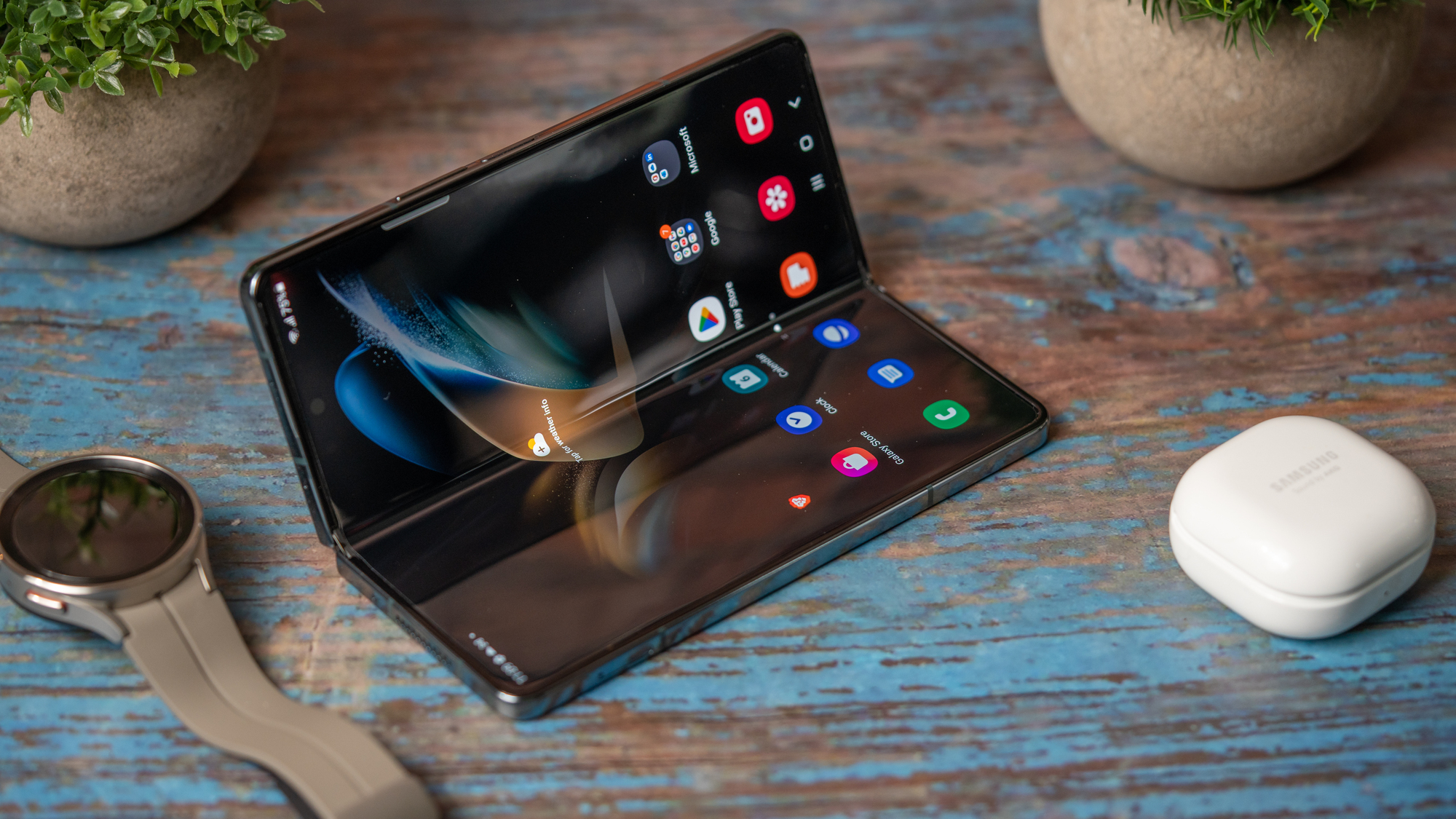
Samsung Galaxy Z Fold 4. Picture: Noel Campion.
It has been less than three years since Samsung released the original Galaxy Fold and while it had a rocky launch, the device is now in its fourth iteration which I’ve been testing for the last few weeks. While the Z Fold 4 is an iterative upgrade but the sum of its refinements further solidifies its standing as a mainstream handset.

The main 7.6-inch display is now a little wider while maintaining the same overall screen size. This allows the 6.2-inch cover display to be a little wider too while shedding some height making the phone more manageable when closed. It now feels more comfortable for regular use.
When unfolded, the Z Fold 4 feels more manageable although it’s still awkward to hold or use in the same way you’d use a regular phone. Unfortunately, the crease in the middle isn’t any less hollow than it was before and I still found it annoying at times when running my finger over it. You do get used to it and it’s only visible at certain viewing angles.
The other changes in specs between the old and new are the Z Fold 4 is now a little lighter and thinner both of which are welcome improvements. However, it’s still a heavy (263g) and bulky phone compared to standard handsets.

While the modifications to the form factor seem only minor, the difference in day-to-day use is more than subtle. I really noticed the difference in overall comfort and pocketability.
It does come with an IPX8 waterproof rating but no dust proofing. The hinge mechanism has been improved and Samsung claims it is good for years of use.

If there’s one hardware feature that Samsung has always excelled in is its displays and the Z Fold 4 is no exception. The front sports a 6.2-inch Dynamic AMOLED display with a resolution of 2,316px x 904px and a 120Hz refresh rate. I still find it a little too narrow when trying to type on the keyboard but it looks stunning and is an improvement in ergonomics from last year. The tall display does have advantages though — widescreen movies look amazing and fill most of the screen and social feeds show more posts.
When you unfold the 7.6-inch inner display you’re treated to a 120Hz refresh rate with a resolution of 2,176 x 1,812px and it too looks striking. Watch a wide-screen movie though and you’ll see massive black bars on top and bottom. You can zoom in to fill the screen but this only massively crops the sides.

In order to assure the inner screen's endurance, Samsung uses a layer of plastic on top of a very thin piece of glass and claims it’s 45% more durable than the Z Fold 3. It comes with a pre-installed screen protector and for good reason since it is far more susceptible to damage than a standard glass screen.
The stereo speakers produce a clear sound that can get plenty loud. They’re excellent for watching moves or playing games on the Fold 4.

The Z Fold 4 uses the latest Snapdragon 8+ Gen 1 chip with the Adreno 730 GPU. It has 12GB of RAM and my review unit came with 256GB of storage with no ability to add additional memory via a microSD card.
The Z Fold 4 is a top-tier performer as evident from my real-world use and all the benchmarks I put it through. I was also impressed at how well it performed in long gaming sessions with consistent FPS in all of the games I played on it.
Samsung continues to improve its OneUI skin on top of Android 12 with each new iteration of the Fold platform. Multitasking is a feasible feature thanks to the larger screen with big improvements in the software that make it easier to use multiple apps at once. This isn’t for everyone but power users who like to multitask will appreciate the extra features and expanded workflows that are now possible.
I love that the Z Fold 4 is compatible with the S-Pen but unfortunately, I didn’t have one that I could test with software like Samsung Note and other apps. Also, this is an optional extra and you need to buy the S Pen Fold edition as other S Pens may damage the screen.

The Z Fold 4 sports a rather large rear camera bump that houses three cameras including a 50MP main, a 10MP telephoto 3x (30x digital) and a 12MP ultra-wide camera. You also get two selfie cameras, one on the cover display and one on the 4MP inner display. The latter is an under-display camera so there’s no punch-hole cutout which is great, but the image quality is terrible and should only be used in good lighting at a pinch.
The cover display selfie camera is far better in terms of image quality and resolution (10MP). Of course, you can also use the rear cameras to take selfies too which look great. Just open the display and use the cover screen to monitor the image and take the shot.

While the cameras on the Z Fold 4 are not the best in class, they're still excellent producing lots of detail with over-saturated colours that many users like. The auto HDR is impressive as are night, portrait and pro modes.
You can shoot video up to 8K at 24 fps but you also get the more practical and space-saving 4K and 1080P options too. Extra features like super steady only work in 1080p at 60 fps but the standard stabilisation is perfect for most scenarios up to 4K.
The Z Fold 4 has the same split battery pack with a 4,400mAh capacity. Generally, I was able to get a full day from a single charge but needed a top-up with heavier use. You still don’t get any charger in the box and the charging is limited to 25w wired and 15w wireless. A lack of any improvement here is a little disappointing when there are phones that can safely charge in less than 20 minutes.
The Samsung Galaxy Z Fold 4 doesn’t feel like a proof-of-concept folding phone anymore that has to be handled with kid gloves. It has matured into a device that more users can use as their everyday phone. However, it isn’t for most people who won’t enjoy all the folding and unfolding or the extra bulk and the fact that this is a large device to hold when unfolded.
That being said, the versatility the Z Fold 4 has to offer is unmatched by any other phone right now.
Samsung Galaxy Z Fold4 from €2,029 Samsung