Ireland needs a stronger electricity grid to drive wind, solar progress
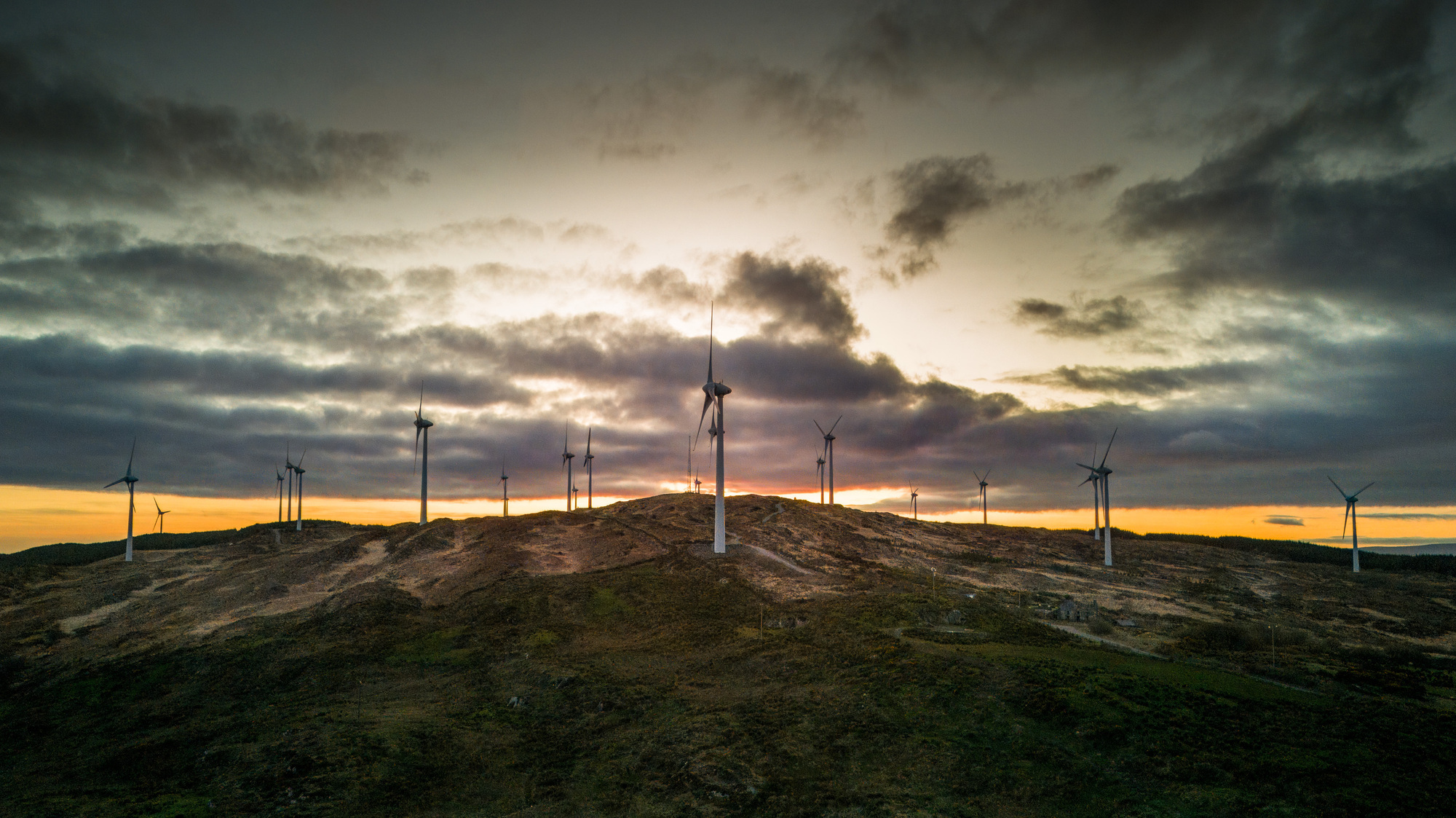
Sunset at the Ballybane wind farm outside Drimoleague, Co Cork. Ireland’s electricity grid was created to service a handful of large power stations; now electricity is increasingly produced by wind and solar projects spread around the island. Picture: David Creedon
Ireland is fortunate to have something most countries would dearly like to possess: an enormous supply of clean energy that we can produce ourselves.
We do not have oil fields or large gas reserves. We import much of the fuel we use to heat our homes, run our businesses and power our economy. But we do have wind, and lots of it.

That matters because every time an Irish wind farm produces electricity, we need to import less fossil fuels from abroad.
It means money that would otherwise leave the country stays in Ireland, supporting Irish jobs and Irish businesses.
It means we are less exposed to sudden swings in international energy markets as wind farms push down wholesale electricity prices. Since 2000 Irish wind farms have delivered a net saving to consumers of nearly €850 million.
Onshore wind farms provide more than a third of Ireland's electricity every year. This is one of Ireland's great economic success stories but we are only starting to realise our potential.
Energy independence can sound a bit abstract. In reality, it simply means that the more energy we produce ourselves, the less we have to buy from somewhere else.
Ireland cannot control the international price of gas. We cannot prevent wars, geopolitical crises or disruption to global energy markets. As we saw with the Russian invasion of Ukraine and the US attacks on Iran, when fossil fuel prices rise, Irish families and businesses pay for it.
But what we can control is how much we depend on those fuels in the first place. Wind energy gives us that choice. The fuel for a wind farm does not arrive in a ship or through an international pipeline. There is no foreign government that can stop the wind from blowing.
That is why every new wind farm strengthens our energy security.
Irish wind farms are already saving billions of euro in fossil fuel imports and pushing down electricity prices. For Irish households struggling with the cost of living and businesses trying to remain competitive, that is enormously important.
The answer to Ireland's energy challenges is not to become better at importing expensive fossil fuels. It is to need less of them.
Those benefits extend beyond the electricity system.
Onshore wind is largely a rural industry. Wind farms bring investment into communities, support jobs and local businesses, and provide an important source of income for local authorities.
Irish wind farms already pay around €75 million annually in commercial rates to rural county councils and this figure will rise. In nine counties, wind farms now account for more than 10 per cent of all commercial rates income.
On top of that, community benefit funds distributed more than €7 million in 2025 to support local clubs, community organisations and other initiatives.
These are real benefits flowing into communities across Ireland. And there is much more to come.
Ireland has a strong pipeline of new wind farms. The investment is there. The projects are there. We have the right people with the skills to deliver.
But our electricity grid is simply not developing quickly enough to keep up.
Ireland's electricity grid is an extraordinary piece of national infrastructure. For decades it has quietly delivered power to homes and businesses across the country.
But the job we are asking it to do is changing. We are moving from an electricity system dominated by a relatively small number of large power stations to one where electricity is increasingly produced by wind and solar projects spread around the island.
At the same time, we are asking electricity to do more as we increasingly use it to power our cars and heat our homes. That requires a grid fit for the 21st century.
Our members have consistently identified weaknesses in the electricity grid as the biggest barrier to Irish energy independence and strengthening our grid is the top priority in our recently published Onshore Wind Action Plan.
More than 3,000 MW of onshore wind farms – over half our existing fleet – has full planning permission but many will struggle to get built as projects are told they may have to wait five years or more to connect.
That should concern all of us.
A wind farm waiting for a grid connection isn’t supplying electricity to your home. It isn’t replacing imported fossil fuels. It isn’t helping to cut your electricity bill. It isn’t paying to repair road or support libraries.
There is another side to the grid challenge.
At times, existing wind farms are able to produce more power than the electricity system can accommodate. When that happens, they are instructed to reduce the amount of electricity they generate.
This is known as "dispatch down". And while some of this is inevitable, levels are now far too high.
EirGrid figures show that 13.4 per cent of available wind generation on the island of Ireland was dispatched down in 2025, rising to 16 per cent in the first nine months of 2026. That compares to 2.9 per cent ten years ago.
We are wasting clean energy and, instead, paying more for imported fossil fuels.
We need to strengthen the grid, but we also have to make better use of the grid we already have.
That means making it easier for batteries to store renewable electricity and for wind farms, solar farms and batteries to share grid connections. It means reducing unnecessary delays in connecting new projects. And it means a clear national plan to steadily reduce the amount of clean energy we lose every year.
There is some reason to be optimistic.
The Government has increased investment in electricity infrastructure and has designated three major grid projects as critical infrastructure. EirGrid and ESB Networks have major investment programmes underway. Everyone involved understands the challenge but delivering a stronger grid will require a national effort.
Next year will mark 20 years since the North-South Interconnector was first proposed. This is one of Ireland’s most critically needed pieces of infrastructure and its absence costs consumers around €100 million every year, but we are still waiting for construction to properly start.
We must build and reinforce our electricity grid much faster. To do this we will need Government, regulators, system operators, industry and communities working together. And we need to explain clearly why this matters.
A stronger electricity grid is not simply about meeting a climate target. It is about lower energy costs. It is about reducing our dependence on imported fossil fuels. It is about keeping more money in Ireland. It is about building desperately needed new homes and attracting new investment.
It is about giving Irish businesses access to the clean, affordable electricity they need to remain competitive and to create jobs.
And, fundamentally, it is about security. In an increasingly uncertain world, the ability to produce more of our own energy is more valuable every year.
Wind farms across the country are producing clean Irish electricity every day, supporting rural communities and reducing our need to import fossil fuels.
Now we need to build on that success. Together, we must build an electricity grid fit for Irish energy independence.
CONNECT WITH US TODAY



Be the first to know the latest news and updates