Alan Healy: Ireland is back relying on Britain for energy
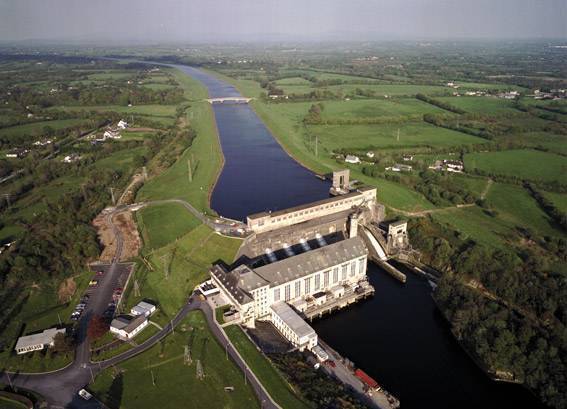
Ardnacrusha was once the largest hydroelectric generating station in the world and remains a landmark of 20th-century engineering.
A century ago, the newly established Free State took a fifth of its Budget to build the Ardnacrusha scheme on the Shannon
On completion in 1929, it was the largest hydroelectric dam in the world. Its success was a statement of what could be achieved when significant resources and effort are put to a task. Ardnacrusha was not the only example; the rural electrification scheme followed and connected every home and business in the country to the grid.
The Second World War saw Ireland cut off from British coal and led to the establishment of Bord na Móna, which became the third pillar of the country's modernisation.
What has happened in recent years and accelerated in recent months has shown how the country needs another Ardnacrusha moment to rapidly address our growing energy needs and wean us off our dangerous reliance on imported gas, oil and electricity.
A report from the Sustainable Energy Authority of Ireland (SEAI) this week lays bare the scale of the problem. The SEAI, an organisation not given to hyperbole, pointed to the economic and security risks when we depend "so completely on fuels owned and controlled by outside forces".
Energy use is at its highest since 2008, and we remain almost 80% reliant on fossil fuels and imported energy. Natural gas remains a massive import.
More than 80% of the natural gas Ireland uses comes from Britain, through subsea pipelines from Scotland. Along with supplying homes and businesses through our gas grid, the imported gas supplied 40% of our electricity last year. And every molecule we import is used straight away. Ireland is the only European country which has no gas storage capabilities.
It was not always this way. For years the Kinsale Head field, discovered off the Cork coast in 1971, supplied the country's gas and fuelled an industrial era around Cork Harbour. It stopped producing in 2020 and has since been dismantled. Corrib, off Mayo, once met more than half of our demand. It is now in steep decline.
The reliance on a single entry point for gas not only creates an economic risk but a major security one. When the Russian spy ship Yantar sailed into the Irish Sea in late 2024, it loitered over those pipelines as well as the internet data cables. A senior security source told this newspaper last year that if the pipelines were cut, Ireland would be "in a whole world of hurt very quickly".
The solution so far has been focused on renewables and much progress has been made. The SEAI say energy-related emissions are at their lowest level in more than 30 years. Wind supplied almost a third of our electricity last year, and solar generation rose by half.
But the gains are being swallowed by data centres, which account for 78% of the growth in demand. The SEAI projects that our energy consumption will rise by 10%. Even in 2040, fossil fuels are expected to supply around half of our energy, and more than half of our primary energy will still be imported.
Offshore wind is viewed as a resource that could change everything, but two decades after the first turbines went up on the east coast, they are still almost all the offshore capacity we have, and that is unlikely to change by 2030.
The south coast should be at the heart of this with a number of planned offshore wind projects. The Port of Cork is building a €100m quay at Ringaskiddy to serve the industry. Yet the port receives no State investment and has a borrowing limit of €16m.
One hundred years ago, the State, with little money, dammed the Shannon in four years. A century later, one of the richest countries in Europe cannot get a turbine into the water off Waterford.
This time we have the money. What is needed is the drive and ambition we saw a century ago. What is needed now is a single delivery body with the power and funding to drive offshore wind off our coasts. In tandem, there is a need for direct State investment in ports, instead of leaving the Port of Cork to borrow. The strategic gas reserve is needed now and not in a decade.
An honest national conversation is also needed about where our energy will come from. There is currently a moratorium on new oil and gas exploration. Just this week, the UK Government took a major step in approving the Jackdaw gas field in the North Sea in the name of energy security. Gas from fields like Jackdaw flows into the same British network and will ultimately feed into the Irish grid.
Even nucleur potential has joined the conversation. The SEAI is studying it as part of its review of a decarbonised electricity system, and a bill is being pursued to lift the 1999 ban. Despite from objections, the response has been interest rather than outrage. If nuclear can be discussed calmly, so can what lies beneath our own waters.

CONNECT WITH US TODAY



Be the first to know the latest news and updates